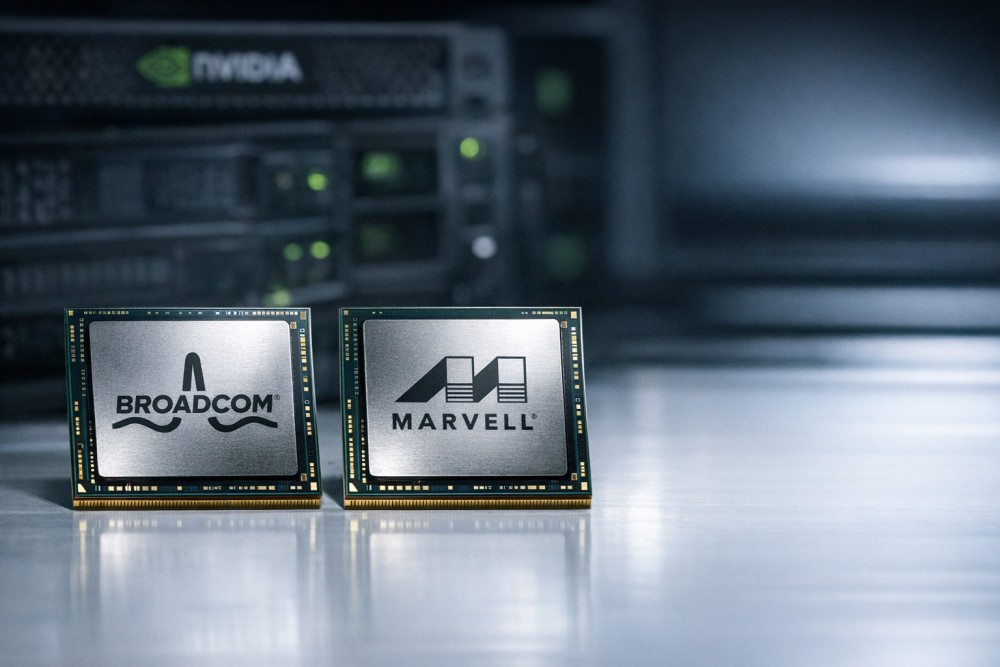
The AVGO vs MRVL debate has become one of the most consequential pair trades in semiconductors, as both chipmakers race to capture the booming custom AI silicon market in 2026.
Hyperscalers from Google to Meta are spending tens of billions on bespoke accelerators, and these two vendors sit at the center of that flywheel.
Custom Silicon Market Position in 2026
Investors weighing Broadcom (AVGO) against Marvell (MRVL) are really asking who owns the post-merchant-GPU era.
Custom ASICs designed for specific hyperscaler workloads now compete head-on with general purpose accelerators from Nvidia (NVDA).
Broadcom is widely cited as holding roughly 70 percent of the custom AI accelerator market, anchored by long-running programs with Google for TPU silicon and Meta for MTIA chips.
According to Yahoo Finance, Broadcom guided that its serviceable AI revenue opportunity from just three hyperscale customers could reach 60 to 90 billion dollars by fiscal 2027.
That guidance reframed how the market values custom silicon programs, and it is the benchmark every Marvell investor now measures against.
Marvell as the credible challenger
Marvell entered the AI custom silicon conversation later, but its design wins with Amazon Trainium and Microsoft Maia gave it a fast-growing second position.
Management has framed AI as the dominant growth engine, with custom compute and optical interconnect now driving the majority of incremental revenue.
The shift from a diversified storage and networking supplier to an AI-centric design partner has happened in barely two years, which is why MRVL multiples expanded so aggressively.
The Marvell Inflection: TPU Win and Nvidia's Investment
Two 2026 events reset the MRVL narrative and forced the AVGO vs MRVL comparison to be re-priced almost overnight.
Google TPU partnership expansion
Marvell secured a portion of next-generation TPU work from Alphabet (GOOGL), ending Broadcom's perceived monopoly on Google's flagship AI silicon program.
The win matters not because Broadcom loses Google overnight, it does not, but because hyperscalers now openly multi-source custom design partners.
Nvidia's strategic stake
The Motley Fool reports Nvidia took a multi-billion dollar position in Marvell tied to co-development of NVLink-compatible interconnect and optical DSPs.
The investment cements Marvell's role in the Nvidia ecosystem at exactly the moment merchant GPU clusters scale into the millions of accelerators.
Revenue, Margin, and Valuation Snapshot
The financial profiles of the two companies remain very different, even as the AI narratives converge.
Scale and profitability
Broadcom is a roughly 50 billion dollar revenue business with mid-60s percent gross margins and operating margins above 45 percent, supported by its VMware software stack and broad networking portfolio.
Marvell is closer to a 6 billion dollar revenue base with gross margins in the low 60s and operating margins still recovering toward the 30 percent range as AI mix expands.
The gap in absolute scale is the single most important framing point when sizing positions in either name.
How the market prices each story
Broadcom trades like a diversified compounder, blending AI growth with stable software cash flows from VMware.
Marvell trades closer to a pure AI growth story, which means higher beta in both directions and a forward multiple that compresses quickly when AI capex sentiment wobbles.
Investors who want lower drawdown risk tend to favor AVGO, while those willing to underwrite a steeper growth curve gravitate to MRVL.
Already trading US stocks on Gotrade? Add AVGO and MRVL to your Watchlist now and check whether your AI exposure is leaning toward the diversified compounder or the higher-beta growth story.
Customer Concentration and Merchant Chip Pressure
Both names share a structural risk that bulls sometimes downplay, customer concentration is extreme.
Hyperscaler dependency
Broadcom's AI revenue leans heavily on three customers, and any program slip at Google, Meta, or a third hyperscaler can move the entire AI growth line.
Marvell faces the same shape with Amazon and Microsoft, plus its newer TPU exposure to Google (GOOG).
Pressure from merchant accelerators
Custom silicon competes directly with merchant GPUs from Nvidia and AMD, and any acceleration in merchant chip price-performance can push hyperscalers to delay the next custom chip cycle.
Foundry capacity at TSMC (TSM) remains a shared chokepoint, since both Broadcom and Marvell depend on advanced nodes and CoWoS packaging that NVDA also competes for.
If Nvidia or AMD lands a generational efficiency leap, the bull case for custom ASIC growth tightens for both AVGO and MRVL at the same time.
Conclusion
The AVGO vs MRVL question in 2026 is less about which company wins custom AI silicon outright and more about which risk profile fits your portfolio.
Broadcom offers scale, software cash flow, and the dominant share of custom accelerator revenue, while Marvell offers higher growth optionality from TPU expansion and the Nvidia partnership, with more single-customer sensitivity.
You can research both names, compare fundamentals, and trade fractional shares of AVGO, MRVL, NVDA, and the broader US AI chip universe directly on Gotrade, with no minimums and a workflow built for active investors.
FAQ
Is Broadcom or Marvell the bigger AI chip winner today?
Broadcom is the larger and more dominant custom AI silicon vendor today, but Marvell has the faster percentage growth profile heading into 2026.
What did Nvidia's investment in Marvell actually fund?
The stake supports co-development on NVLink-compatible interconnect and optical DSPs that plug Marvell into Nvidia's broader AI rack ecosystem.
How exposed are AVGO and MRVL to a single customer?
Both rely on a small handful of hyperscalers for the bulk of AI revenue, which creates real program-slip risk for either stock.
Can I buy AVGO and MRVL fractionally on Gotrade?
Yes, Gotrade lets you buy fractional shares of AVGO, MRVL, and other US AI chip names with no commission and low minimums.