Defense stocks are sitting on the most visible backlog in a decade. The question for 2026 is whether the multiples already reflect it.
The US FY26 baseline defense budget is around $895 billion, with supplemental packages tied to Ukraine resupply and Indo-Pacific deterrence layered on top. That backdrop has pushed Lockheed Martin (LMT) and peers to premium forward multiples that price in a lot of good news.
This piece walks through the budget trajectory, the four prime contractors, the drone sub-sector, and the risks that could compress the trade into 2026.
Defense Budget Trajectory and Supplemental Bills
The FY26 National Defense Authorization Act anchors around $895 billion in baseline spending. Procurement and research, development, test, and evaluation lines are both growing mid-single digits year over year. Supplemental bills add another layer of demand visibility on top of that base.
According to Reuters, Ukraine resupply and Indo-Pacific deterrence packages have moved from one-off events to a near-annual cadence. That changes how investors should think about prime contractor backlog conversion over the next three years.
Munitions replenishment, missile defense, and shipbuilding are the line items growing fastest. Air dominance and space remain the structural priorities. Counter-drone, electronic warfare, and resilient communications round out the spending wedge that is most likely to surprise to the upside in 2026.
The combination supports a multi-year revenue ramp for the largest primes. It also creates room for smaller specialists to win disproportionate share if they execute.
Primes Recap: LMT, NOC, RTX, GD
The four primes trade at roughly 22 to 25 times forward earnings. That is a premium to the S&P 500 and well above their own 10-year averages. The premium is the market paying up for backlog visibility and dividend reliability.
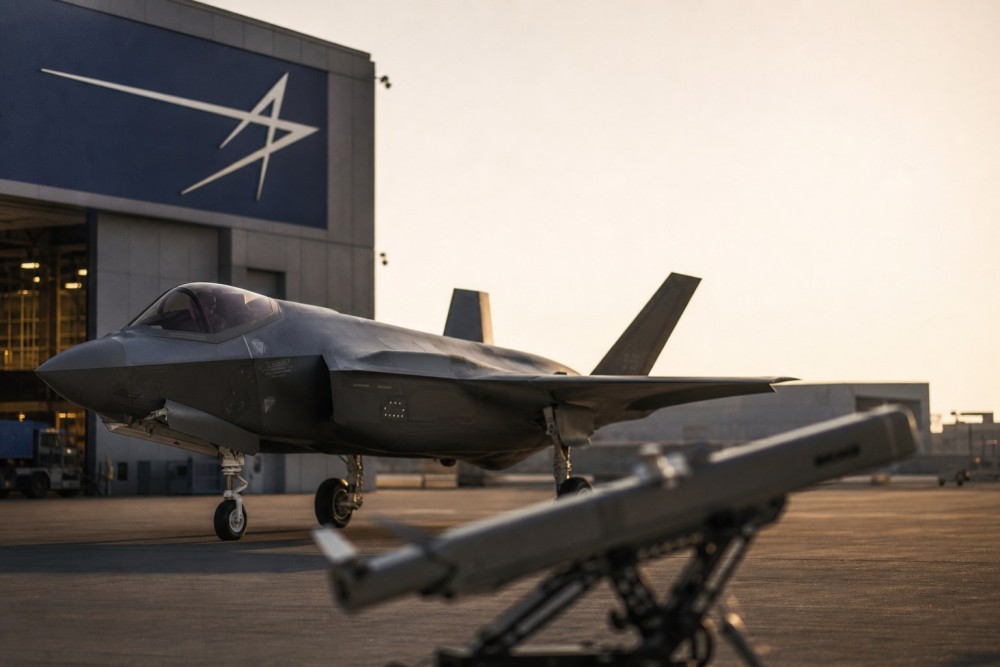
Lockheed Martin (LMT) anchors the F-35 program, integrated missile defense, and a large classified space portfolio. The total backlog sits above $160 billion. That gives multi-year revenue visibility but limits the room for upside surprises beyond steady execution.
Northrop Grumman (NOC) owns the B-21 Raider and Sentinel ICBM programs. Both are strategic, both are long-cycle, and both carry execution risk that has bitten margins in recent quarters. Investors are paying a premium multiple for programs that have not yet hit full-rate production.
RTX and General Dynamics
RTX Corporation (RTX) sits at the intersection of munitions, missile defense, and commercial aerospace through Pratt & Whitney. The Patriot and NASAMS systems are the clearest Ukraine-linked beneficiaries. The GTF engine remediation is the offset that keeps the multiple capped.
General Dynamics (GD) covers shipbuilding, combat systems, and Gulfstream business jets. The submarine line is the structural growth story tied to AUKUS and the broader Indo-Pacific buildout. It is the cleanest pure-play on long-cycle naval demand among the four.
Drone and Counter-Drone: KTOS, AVAV, RKLB
The drone trade is where the higher-beta capital tends to cluster. These names are smaller, more volatile, and more sensitive to single-contract awards than the primes.
Kratos Defense (KTOS) sells jet-powered aerial targets, unmanned tactical aircraft, and hypersonic test platforms. The Valkyrie collaborative combat aircraft program is the most talked-about asset, but the recurring target business funds the runway between marquee awards.
AeroVironment (AVAV) owns the Switchblade loitering munition franchise and a deep portfolio of small unmanned aerial systems. Ukraine demand pulled forward the order book. The company has been investing aggressively in production capacity to defend its lead as competitors enter the loitering-munition category.
Rocket Lab (RKLB) is the most thematic of the three. The Neutron launch vehicle and the Space Systems pivot push it into Space Force and national security launch contracts. According to CNBC, the company is targeting Neutron flight readiness in late 2026. That milestone is the catalyst the equity is leaning on.
Risks: Procurement Delays and Margin Pressure
Three risks deserve real weight in any 2026 defense thesis.
The first is procurement delays. Continuing resolutions and contract award slippage push revenue right and compress quarterly visibility. The primes manage through it. The smaller drone names can swing 20 percent on a single program timing slip, which is a different volatility profile to size around.
The second is margin pressure on fixed-price development contracts. Boeing-style charges on KC-46 and T-7 are the cautionary tale every defense analyst has filed away. LMT, NOC, and RTX all carry some fixed-price exposure that could surprise on the downside if program scope creeps further.
The third is rate sensitivity. Premium multiples on the primes compress fastest if the rate-cut path stalls or reverses. The drone names are even more rate-sensitive given their growth-stock profile and longer-duration cash flows.
Conclusion
The 2026 defense setup is a barbell. Primes offer backlog visibility at premium multiples. Drones offer asymmetric upside with single-contract risk. A reasonable framework is core positions in one or two primes, smaller tactical sizing in the drone names, and a sector ETF like ITA only if you want pure beta without single-name work. Open a Gotrade account to trade US stocks from $1 and size each defense position precisely as backlog visibility unfolds through 2026.
The primes trade at 22 to 25 times forward earnings, a clear premium to history. Backlog supports the multiple, but the margin of safety is thinner than in prior defense cycles.
Which prime has the cleanest growth story?
General Dynamics on submarines and RTX on munitions look like the cleanest near-term stories. LMT and NOC carry more fixed-price program risk into 2026 earnings.
How should I size the drone names?
Treat KTOS, AVAV, and RKLB as higher-beta satellites. Single-contract sensitivity means smaller position sizes than primes, with explicit catalyst dates in mind.
Is the sector ETF a better way to play this?
ITA gives broad exposure to primes and suppliers without single-name risk. Use it if you want defense beta and pick single names if you have a view on specific programs.
Disclaimer
Gotrade is the trading name of Gotrade Securities Inc., which is registered with and supervised by the Labuan Financial Services Authority (LFSA). This content is for educational purposes only and does not constitute financial advice. Always do your own research (DYOR) before investing.