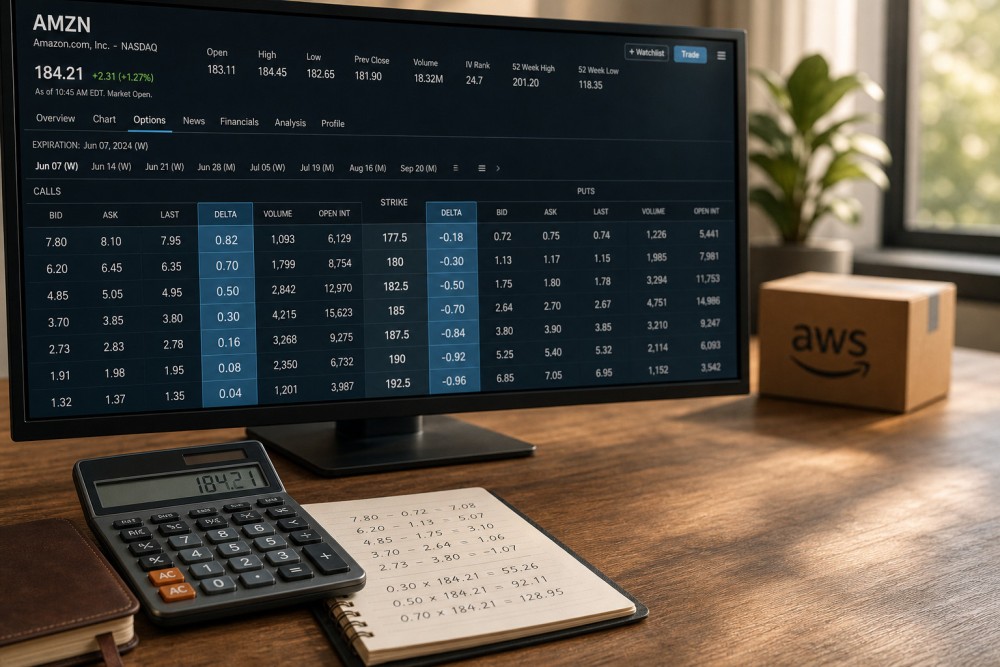
Most retail call buyers pick a contract count by feel. Delta position sizing replaces the feel with a number. It tells you how many contracts equal the stock exposure you actually want.
This guide walks through a $10,000 conviction trade on AMZN. You will see the math at three strikes, the trade-offs at each, and the gamma risk that breaks the initial sizing.
The framework also applies to NVDA, MSFT, and AAPL. The mechanics do not change with the ticker.
Why Delta Is the Right Sizing Anchor
Delta measures how much an option price moves for a $1 move in the stock. A call with delta of 0.50 gains roughly $0.50 if the stock rises $1.
Because each contract controls 100 shares, delta also reads as share-equivalent exposure. A 0.50 delta call behaves like 50 shares of stock at the moment of purchase.
According to Investopedia, delta values for long calls range from 0 to 1, with at-the-money contracts clustering near 0.50. That gives you a clean conversion factor between contracts and shares.
The Position Sizing Formula
The formula is simple. Target share-equivalent exposure equals your dollar conviction divided by the stock price. Contract count equals target shares divided by 100 times delta.
Assume AMZN trades at $200. A $10,000 conviction equals 50 shares of share-equivalent exposure. That is your anchor across every strike choice.
From there, the delta of the chosen strike decides the contract count. Higher delta means fewer contracts. Lower delta means more contracts but less probability the option finishes in the money.
Worked Example: $10K AMZN Conviction at Three Strikes
Start with the at-the-money call near a 0.50 delta. Fifty target shares divided by 100 times 0.50 equals 1.0 contracts. One ATM call gives you 50 share-equivalents at entry.
The out-of-the-money strike sits around a 0.30 delta. Fifty divided by 100 times 0.30 equals roughly 1.67 contracts. Round to 2 contracts and you control 60 share-equivalents at entry, with more leverage but a lower probability of profit.
The in-the-money call carries a delta near 0.70. Fifty divided by 100 times 0.70 equals roughly 0.71 contracts. Round to 1 contract and you control 70 share-equivalents, paying more premium for a position that behaves closer to stock.
Start options trading on Gotrade so the delta sizing math turns into a real AMZN position rather than a spreadsheet exercise. Open Gotrade to act on this idea.
Reading the Trade-Offs at Each Strike
The ATM call balances leverage and direction sensitivity. It moves about half as fast as the stock per dollar, with extrinsic value that decays steadily through expiration.
The OTM call gives you more contracts for the same conviction. That amplifies upside if the stock runs hard. The lower delta also means the position lags early moves and can expire worthless on a sideways tape.
The ITM call is the closest substitute for stock. Higher delta means tighter share tracking, less time premium at risk, and a smaller percentage return on a sharp rally.
Which strike fits which thesis
Pick ATM when you expect a clean move within the contract's life but want some leverage. Pick OTM when you have a specific upside target and accept lower hit rate. Pick ITM when you want stock-like exposure with less capital outlay.
The strike choice is a function of conviction shape, not just direction. Map the thesis to the delta first, then let the formula return the contract count.
Why Gamma Breaks Your Initial Sizing
Delta is a snapshot. Gamma measures how fast that delta changes as the stock moves. A position sized to 50 share-equivalents at entry may behave like 65 or 80 shares after a strong rally.
That drift is why initial sizing is imperfect. Gamma risk is highest on ATM contracts near expiration and lowest on deep ITM or far OTM strikes.
The Cboe Options Institute notes that gamma can cause a position's effective exposure to swell quickly during sharp moves. Rebalance or trim if effective delta drifts far from your original conviction size.
How to Compare Across Tickers
The same framework applies to higher-priced names. A stock at $450 means a $10,000 conviction equals only about 22 share-equivalents, so a single ATM contract already overshoots that anchor.
For lower-priced tickers, the math flips. A $10,000 conviction on a $80 stock equals 125 share-equivalents, which a single ATM call cannot deliver alone.
Run the calculation per ticker. Do not assume contract counts transfer across names with very different share prices.
Conclusion
Delta position sizing turns a fuzzy conviction into a precise contract count. Pick the share-equivalent exposure that matches your dollar conviction, then let the strike's delta tell you how many contracts to buy.
Remember that gamma will move the effective delta as the stock moves. Recheck your exposure after meaningful price changes and trim if the position has drifted past the original size.
Start options trading on Gotrade to size your next AMZN, NVDA, or MSFT long call by delta, not by feel.
FAQ
What is delta position sizing?
It is a method that uses an option's delta to convert dollar conviction into a specific number of contracts.
How does delta translate to share-equivalent exposure?
Each contract controls 100 shares, so delta multiplied by 100 gives the share-equivalent exposure per contract.
When should you pick an OTM strike over ATM?
Choose OTM when you have a specific upside target and accept a lower probability of finishing in the money.
What role does gamma play in sizing?
Gamma changes the delta as the stock moves, so initial sizing drifts and needs to be rechecked after big price changes.