Reviewed by Gotrade Internal Analyst
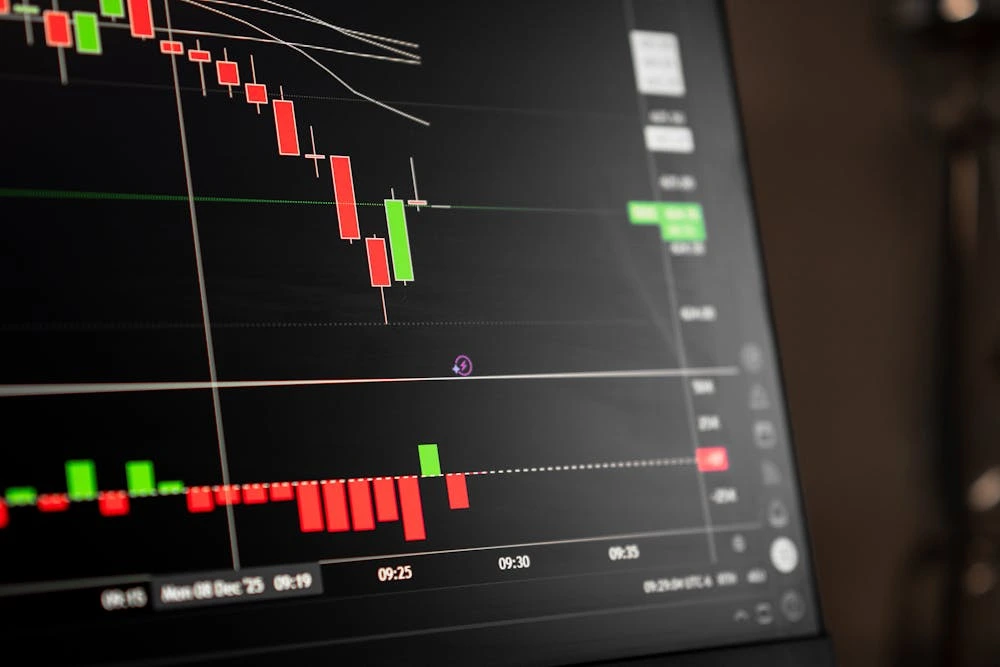
A dragonfly doji is a candlestick pattern that signals strong rejection of lower prices within a trading session. It forms when an asset opens, trades significantly lower, and then closes near or at its opening price. Visually, the candle has a long lower shadow and little to no upper shadow, resembling the shape of a dragonfly.
Understanding the dragonfly doji helps traders and investors recognize moments when selling pressure fails to hold. While the pattern does not guarantee a reversal, it highlights a shift in intraday control that can become meaningful when placed in the right market context.
How the Dragonfly Doji Forms in Price Action
The dragonfly doji forms through a clear sequence of intraday behavior rather than random price movement.
Typical characteristics include:
-
An open and close at or very near the same price
-
A long lower shadow showing aggressive selling during the session
-
Little or no upper shadow, indicating prices recovered fully
During the session, sellers push prices lower with conviction. However, buyers step in aggressively, absorbing supply and driving prices back to the opening level by the close. This failed breakdown is the core message of the dragonfly doji.
What the Dragonfly Doji Signals
Rejection of downside momentum
The long lower wick shows that the market explored lower prices and rejected them. Sellers were active, but they could not maintain control.
This rejection often reflects exhaustion rather than strength from sellers.
Buyer defense at lower levels
The recovery toward the open indicates buyer presence and willingness to defend lower price zones.
This behavior suggests demand may be forming beneath the market.
Shift from pressure to balance
While the dragonfly doji does not show buyers fully in control, it shows that selling dominance has been neutralized.
Balance replaces urgency by the close.
Dragonfly Doji vs Other Doji Variants
Dragonfly doji vs long-legged doji
A long-legged doji reflects conflict on both sides. A dragonfly doji reflects conflict resolved in favor of buyers by the close.
The difference lies in outcome, not indecision.
Dragonfly doji vs gravestone doji
A gravestone doji shows rejection of higher prices. A dragonfly doji shows rejection of lower prices.
They are mirror images with opposite implications.
Importance of wick dominance
The defining feature of a dragonfly doji is the dominant lower shadow. Minor upper wicks do not invalidate the pattern, but strong upper wicks weaken it. Shape matters more than perfection.
Confirmation and Follow-Through
Why confirmation is essential
A dragonfly doji does not confirm a reversal on its own. Confirmation comes from subsequent bullish price action or stabilization.
Higher closes after the pattern improve reliability.
Watching the next session
The candle following a dragonfly doji often determines its usefulness. Continued downside weakens the signal.
Follow-through defines outcome.
Role of volume
Higher volume during the session strengthens the message of rejection. It suggests broad participation in the recovery.
Low volume reduces conviction.
Common Misinterpretations of Dragonfly Doji
Treating it as an automatic buy signal
A frequent mistake is buying immediately after spotting a dragonfly doji. The pattern signals possibility, not certainty.
Patience reduces false entries.
Ignoring broader trend direction
In strong downtrends, dragonfly doji candles may lead only to brief pauses.
Trend strength should guide expectations.
Overlooking market environment
Macro events and sentiment can override technical signals.
Candlestick patterns do not operate in isolation.
Dragonfly Doji and Risk Awareness
Increased volatility around turning points
Dragonfly doji patterns often appear near potential turning points, where volatility can increase.
Risk management becomes especially important.
Position sizing considerations
Because direction is not confirmed, exposure should reflect uncertainty.
Smaller positions improve resilience.
Long-term investor perspective
Long-term investors may view dragonfly doji candles as short-term signals unless aligned with broader structural changes.
Short-term rejection does not guarantee trend change.
When the Dragonfly Doji Is Most Informative
Early signs of stabilization
The pattern is most useful when it appears during early stabilization phases after selling pressure peaks.
It highlights changing behavior before price confirms it.
Combined with support and momentum tools
Using dragonfly doji patterns alongside support levels and momentum indicators improves insight.
Context transforms rejection into information.
Avoiding isolated interpretation
The pattern works best as part of a broader analytical framework.
Integration improves decision-making.
Conclusion
The dragonfly doji highlights strong intraday rejection of lower prices and the emergence of buyer defense after selling pressure. Understanding the dragonfly doji helps traders and investors recognize moments when downside momentum may be weakening, without assuming immediate reversals.
Its value lies in context, confirmation, and patience rather than prediction. If you want to study how dragonfly doji patterns behave across different assets and market conditions, observing rejection patterns and follow-through across markets in the Gotrade app can help deepen your understanding of price action, sentiment shifts, and execution timing.
FAQ
What is a dragonfly doji?
It is a doji candle with a long lower shadow that signals rejection of lower prices.
Is a dragonfly doji bullish?
It can be bullish in the right context, but confirmation is required.
How is dragonfly doji different from gravestone doji?
Dragonfly doji rejects lower prices, while gravestone doji rejects higher prices.
Does volume matter for dragonfly doji analysis?
Yes. Higher volume strengthens the signal.
References
- Investopedia, What Is A Doji Candlestick, 2026.
- Groww, Dragonfly Doji, 2026.