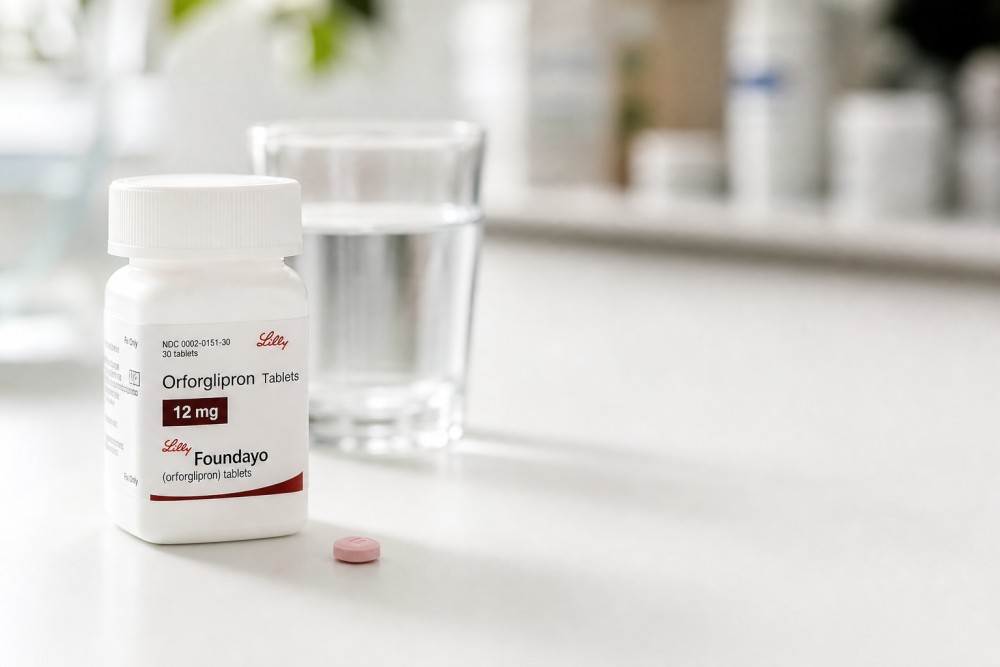
Eli Lilly recently won FDA approval for Foundayo, the first oral GLP-1 pill cleared without food, water, or timing restrictions. The lly add foundayo decision is now in front of every healthcare investor.
The approval covers adults with obesity or overweight plus a weight-related condition. The type 2 diabetes filing comes later this year.
The oral glp-1 reaction in markets has been positive but not euphoric. That gap between fundamental story and price action is where the position decision sits.
Why Oral Format Expands the GLP-1 Addressable Market
Injectable GLP-1 drugs like Zepbound and Wegovy have proven the demand. They have also proven the ceiling on patient adoption.
A meaningful share of eligible patients refuse weekly injections. Needle aversion is a documented dropout reason in obesity care globally.
An oral pill that works comparably removes that barrier. It also opens primary care prescribing in markets where injectable cold-chain logistics are weak.
Lilly is positioning LLY as the only company with both leading injectable and leading oral GLP-1 franchises.
Foundayo Label vs Injectables: Dosing, Efficacy, Side Effects
Foundayo (generic orforglipron) is a once-daily small-molecule GLP-1 receptor agonist. Approved doses are 6 mg, 12 mg, and 36 mg.
Patients take it any time of day, with or without food or water. Novo's Rybelsus requires an empty stomach plus a 30-minute waiting period before eating.
Efficacy data summarized
In ATTAIN-1, the 3,127-patient non-diabetic trial, weight loss at 72 weeks ranged from 7.5% to 11.2% across doses versus 2.1% on placebo.
At the 36 mg dose, 54.6% of patients hit at least 10% weight loss and 18.4% reached at least 20%.
ATTAIN-2 enrolled 1,613 type 2 diabetes patients. Weight loss ranged from 5.1% to 9.6% versus 2.5% placebo, with significant HbA1c improvements.
Side effect profile
Gastrointestinal side effects predominated, mostly mild to moderate. Treatment discontinuations ran 5.3% to 10.3% in ATTAIN-1 and 6.1% to 9.9% in ATTAIN-2 versus 2.7% to 4.1% on placebo.
The delta is consistent with the wider GLP-1 class. Efficacy is slightly below injectable tirzepatide head-to-head, and the convenience tradeoff is what investors will price.
Verdict: Add LLY, Pair Trade LLY/NVO, or Wait for a Pullback
Three actionable positions exist for healthcare investors today. Each suits a different risk tolerance and conviction level.
Option one: add LLY outright
This is the simplest expression. You believe Lilly's combined injectable plus oral franchise compounds revenue for years.
Suitable for long-term healthcare allocations. The risk is buying after a strong run, since the market has already partially priced the approval.
Adding 25% to 50% of a target full position now, with the rest staged into any pullback, balances FOMO against drawdown risk.
Option two: pair trade LLY versus NVO
Long LLY, short NVO isolates the competitive thesis from broad market direction.
The trade pays if Lilly grabs oral GLP-1 share from Rybelsus and Novo's pipeline disappoints expectations.
The risk is sharp. Any positive Novo pipeline data (amycretin, CagriSema, next-gen orals) can squeeze the short leg violently. Size small.
Option three: wait for a pullback
The honest answer for many investors is patience. Approval has been telegraphed for months and the obvious money is already in.
Want to build a position in healthcare leaders like Eli Lilly, Novo Nordisk, and other biotech names without committing thousands per share? Open a Gotrade account and start with fractional positions sized to your conviction.
Waiting for either a 10% to 15% pullback or a type 2 diabetes label scare gives a cleaner entry. The cost is missing further upside if the stock grinds higher.
Manufacturing Advantage and Margin Implications
Small-molecule chemistry is cheaper and faster to scale than injectable peptides, as Pharmacy Times noted on approval.
The GLP-1 market has been supply-constrained for two years. Injectable peptide manufacturing capacity is the bottleneck.
An oral pill manufactured at small-molecule scale changes that equation. Gross margin on small-molecule pills is also typically higher than injectable biologics.
Competitive Response from Novo Nordisk Pipeline
Novo Nordisk is not standing still. The company has a deep next-generation pipeline including amycretin and CagriSema.
Amycretin is an oral and injectable GLP-1 plus amylin agonist with competitive early weight loss data.
CagriSema is a fixed-dose combination of cagrilintide plus semaglutide, with mixed results relative to peak expectations.
The pair trade thesis depends on Lilly's launch execution outpacing Novo's pipeline progress over the next four to six quarters.
For the broader head-to-head context, our LLY vs Novo Nordisk 2026 comparison breaks down the GLP-1 revenue stack across both companies.
Conclusion
The lly add foundayo decision splits into three honest positions. Add now if you have years and conviction. Pair trade LLY/NVO for competitive exposure without market beta. Wait if you suspect the easy money is already priced.
The type 2 diabetes filing later this year is the next catalyst, and Novo's pipeline readouts will pressure the lly nvo pair trade in either direction. For deeper context on Lilly's earnings cadence, see our LLY GLP-1 earnings read-through.
Want to trade US healthcare and biotech stocks fractionally from anywhere? Open a Gotrade account and build your position sized to your conviction.
FAQ
Q: Is Foundayo approved for type 2 diabetes?
Not yet. The current FDA approval covers adults with obesity or overweight plus a weight-related condition. Lilly plans to file the type 2 diabetes application this year based on the Phase 3 ACHIEVE program.
Q: How does Foundayo compare to Novo Nordisk's Rybelsus?
Foundayo can be taken any time of day with or without food. Rybelsus requires an empty stomach and a 30-minute wait before eating, drinking, or other oral medications.
Q: What were the headline efficacy numbers?
In ATTAIN-1, the 36 mg dose delivered up to 11.2% weight loss at 72 weeks. 54.6% of patients hit at least 10% weight loss, and 18.4% reached at least 20%.
Q: What is the main risk to the long LLY thesis?
Competitive pipeline data from Novo on amycretin or CagriSema, a slower-than-expected Foundayo launch, or pricing pressure from US payers and PBMs.