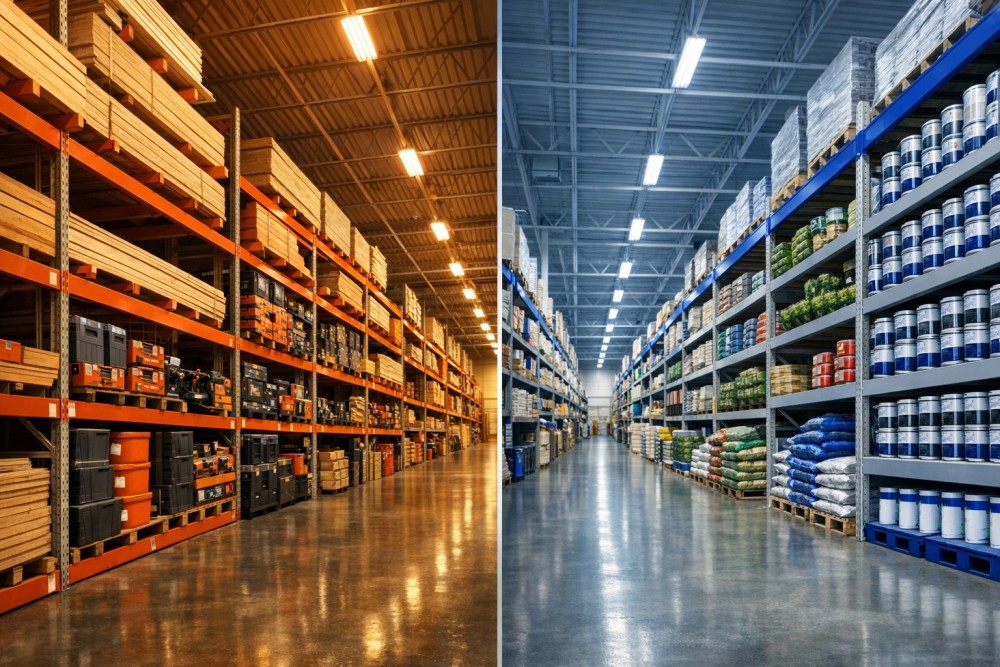
Home Depot and Lowe's are the two giants of US home improvement retail. Both pay rising dividends and buy back stock in a housing market sensitive to rates.
The question for long-term investors is not which is bigger. It is which returns more capital per share over time.
This piece compares Home Depot (HD) and Lowe's (LOW) across model, comps, capital returns, margins, and valuation.
Business Model: Pro Customer Mix at HD vs DIY Focus at LOW
Home Depot (HD)
Home Depot generates roughly half of US sales from professional contractors. Pro customers buy more frequently and in larger basket sizes than DIY shoppers.
This mix gives HD a more durable revenue base. Pros keep buying through soft housing cycles because their projects are already booked.
Lowe's (LOW)
Lowe's has historically leaned DIY, with closer to 75 percent of sales from homeowners. CEO Marvin Ellison has pushed to grow the Pro segment, but the gap with HD remains wide.
The DIY tilt makes LOW more sensitive to consumer confidence and discretionary remodel spending.
Same-Store Sales Track Record: 10-Year Trend Comparison
Same-store sales (comps) measure growth at stores open for at least one year. They strip out the effect of new openings and reveal underlying demand.
Home Depot (HD)
HD has posted positive comps in 9 of the last 10 fiscal years. Average annual comp growth sits near 5 percent through the cycle.
Lowe's (LOW)
Lowe's has been more volatile. Comps have swung from double-digit highs during the pandemic remodel boom to mid-single-digit declines as housing turnover slowed.
Across the decade, HD compounds at a steadier pace. That consistency matters when you reinvest dividends over 10 years.
Buybacks and Dividends: Capital Return Per Share Comparison
This is the heart of the comparison. Both names return cash, but the per-share math differs sharply.
Home Depot (HD)
HD has cut its diluted share count by roughly 30 percent over the past decade. The dividend has grown at a low double-digit annualized rate.
According to The Home Depot Investor Relations, the company has returned over 100 billion dollars to shareholders in the last ten years.
Lowe's (LOW)
Lowe's has been even more aggressive on buybacks as a percentage of shares. The dividend growth rate has matched or exceeded HD over the same period.
The catch is timing. LOW bought back stock at higher multiples in 2021 and 2022, which dilutes the per-share benefit when prices later corrected.
Compare HD and LOW capital return profiles side by side. Open your Gotrade watchlist and track buyback pace and dividend hikes in real time.
Margin Profile: Why HD Runs Higher Operating Margins
Operating margin reflects how efficiently a retailer converts sales into profit before interest and tax. The structural gap here is meaningful.
Home Depot (HD)
HD operating margin runs in the mid-teens, often near 14 to 15 percent. Pro mix, supply chain density, and private label penetration drive the premium.
Lowe's (LOW)
Lowe's has closed the gap under Ellison, lifting operating margin from single digits to roughly 12 to 13 percent. Still, HD retains a 200 to 300 basis point structural lead.
According to Lowe's Investor Relations, the company targets further margin expansion through its Total Home strategy, but full convergence with HD remains a multi-year project.
Valuation: P/E, FCF Yield, and Dividend Growth Rates
Valuation is where the trade-off gets interesting for long-term holders.
Home Depot (HD)
HD typically trades at a forward P/E premium of 2 to 4 turns versus LOW. The market pays up for the steadier comp track record and Pro exposure.
Free cash flow yield sits in the 4 to 5 percent range in normal conditions. Dividend growth has averaged 10 to 12 percent annually over the past five years.
Lowe's (LOW)
LOW trades at a discount on P/E and offers a slightly higher FCF yield. Dividend growth has been faster off a smaller base, often in the high teens.
You are essentially choosing between paying up for quality (HD) or buying optionality on margin convergence (LOW).
Verdict: Which Stock Better Fits a Long-Term Portfolio
For per-share compounding with the lowest variance, HD has the stronger record. Pro mix, margin lead, and buyback consistency favor Home Depot.
For investors willing to underwrite margin convergence, LOW offers a cheaper entry and faster dividend growth. The upside case needs Ellison's Pro push to keep delivering.
Both belong on any US dividend growth shortlist alongside Walmart (WMT). For more on how repurchases compound returns, see our capital return playbook for long-term holders.
Review your retail exposure, then open your Gotrade watchlist to size HD and LOW with your other dividend names.
FAQ
Is Home Depot or Lowe's better for dividend growth?
Both have raised dividends at a double-digit pace, but LOW has grown faster off a smaller base while HD has compounded more consistently.
Why does Home Depot have higher operating margins than Lowe's?
HD benefits from a larger Pro customer mix, denser supply chain, and stronger private label penetration that together drive a 200 to 300 basis point margin lead.
Which stock has a cheaper valuation, HD or LOW?
Lowe's typically trades at a 2 to 4 turn discount on forward P/E and offers a slightly higher free cash flow yield than Home Depot.
How sensitive are HD and LOW to housing turnover?
Both are sensitive, but LOW is more exposed because of its DIY tilt while HD's Pro base provides a steadier revenue cushion through soft cycles.
Can I own both Home Depot and Lowe's in the same portfolio?
Yes, many long-term investors hold both as a paired bet on US home improvement, with HD as the quality anchor and LOW as the margin convergence story.