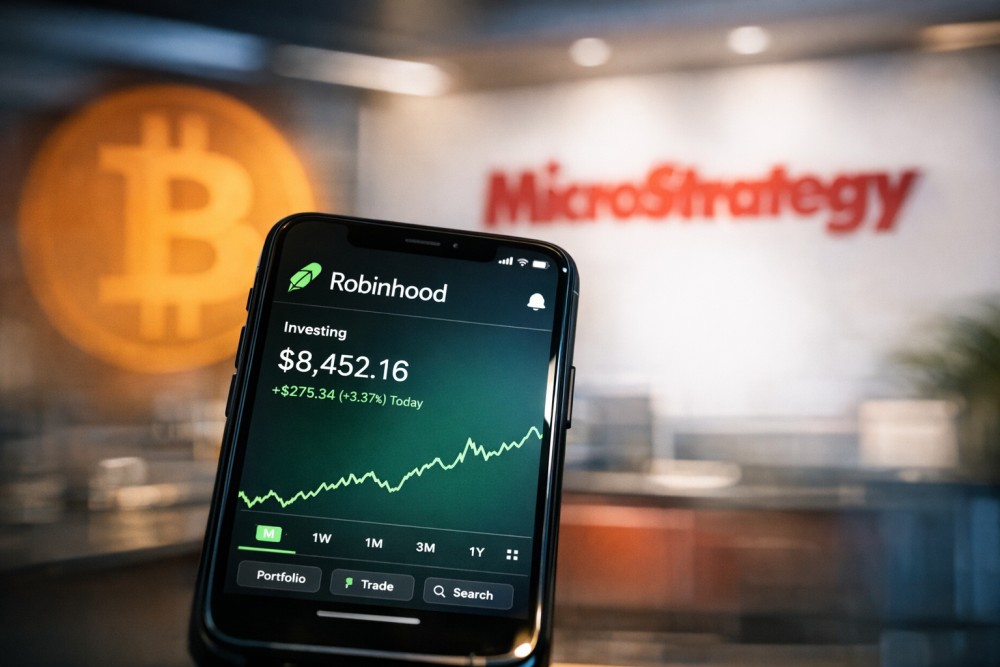
The Robinhood (HOOD) Q1 2026 print and the upcoming MicroStrategy (MSTR) earnings give crypto-adjacent equity holders two different lenses on the same asset class. HOOD MSTR earnings reads more like a barometer than two separate stock events.
If you hold HOOD or MSTR directly, or have crypto exposure through GBTC, IBIT, or BTC itself, both prints carry information that should shape how big your crypto sleeve is.
3 Crypto Exposure Signals From Thursday's HOOD and MSTR Prints
The two companies sit at opposite ends of the crypto-equity spectrum: one earns fees on volume, the other owns Bitcoin directly.
1. HOOD trading volume crypto vs equities mix
Robinhood's Q1 2026 results, released after the close on April 28, showed crypto trading fees down 47% year-over-year while total revenue still grew 15% to $1.07 billion. The takeaway is the mix shift, not the headline number.
According to Yahoo Finance, options trading fees rose 8% and "other revenue" jumped to $147 million from $46 million a year earlier, driven largely by prediction markets and futures. Retail engagement is healthy, but it has rotated away from crypto.
For Robinhood Markets (HOOD) holders, the platform is no longer a pure crypto-beta play. If you bought HOOD as a leveraged retail-crypto bet, the Q1 print just told you that thesis is weaker than it was twelve months ago.
The forward read is whether crypto fees re-accelerate in Q2 or stay depressed. If retail crypto volume stays soft, HOOD's earnings power leans more on options and prediction markets, which trade at very different multiples.
2. MSTR Bitcoin holdings mark-to-market and net asset value
MicroStrategy's Q1 2026 print, scheduled for early May, will be a mark-to-market exercise more than an operating-business update. The software business is small, the Bitcoin treasury is the entire story.
The company holds 815,061 BTC at a cumulative cost of roughly $61.56 billion, an average of about $75,500 per coin. The headline mark-to-market gain will be large, but the more useful number is the premium between MSTR's market cap and the net asset value (NAV) of those holdings.
According to StocksToTrade, Strategy Inc (MSTR) traded up 11.6% in the weeks leading into the print, with TD Cowen raising its price target to $385 and B. Riley to $188. The wide range is itself the signal, since analysts disagree on what the NAV premium should be.
A narrow premium means the market prices MSTR close to its Bitcoin holdings. A wide premium means the market is paying for the acquisition machine itself, the ATM offerings that let MSTR keep buying.
3. Comparison to COIN direct exchange vs treasury strategy
Coinbase (COIN) reports next week and closes the crypto-equity triangle. COIN's revenue is the most direct read on retail and institutional crypto trading volume.
HOOD tells you about retail crypto interest inside a multi-asset broker, COIN tells you about a pure exchange, MSTR tells you how the market values direct Bitcoin ownership through an equity wrapper.
If you hold crypto via iShares Bitcoin Trust (IBIT) or Grayscale Bitcoin Trust (GBTC), those instruments track BTC price directly. Read MSTR's NAV premium discussion as a hint about spot Bitcoin ETF flow behavior.
If HOOD's crypto fees are weak, COIN's volumes are likely weak too, and softer IBIT and GBTC flows tend to follow.
Crypto sleeve check before MSTR prints. Open your Gotrade portfolio and look at total crypto-adjacent exposure across HOOD, MSTR, COIN, GBTC, and IBIT.
Crypto Allocation Decision Before the Print
Sleeve sizing should be a deliberate decision, not a reaction to one earnings line. HOOD in hand and MSTR coming next week give you two clean checkpoints.
A reasonable rule of thumb for diversified portfolios is a crypto sleeve in the 1% to 5% range, sized to your conviction. If your combined crypto-adjacent allocation across direct holdings, MSTR, COIN, HOOD, IBIT, and GBTC sits well above that band, next week is a useful rebalancing window.
HOOD already told you retail crypto engagement softened. If that signal continues at COIN and shows up in MSTR's capital-raise commentary, trimming higher-beta names before adding spot exposure through IBIT or GBTC is the prudent move. Strong COIN volumes and a tight MSTR NAV premium argue for holding or modestly adding. The same earnings-week framework laid out in how to use the earnings calendar to plan trades applies cleanly to this two-print sequence.
Conclusion
HOOD MSTR earnings give you two clean readouts on the same theme from different angles. The trading-platform read and the treasury read together tell you more than either alone, with the COIN print closing the triangle next week.
Read HOOD's mix shift carefully, wait for MSTR's NAV premium discussion, and cross-check both against your crypto sleeve target. Ignoring those signals in favor of headline price action is the most common mistake retail makes around earnings.
Gotrade lets you act on whatever you decide the same day. Buy fractional shares of HOOD, MSTR, COIN, IBIT, or GBTC rebalance your crypto sleeve in minutes from the Gotrade app.
FAQ
When did HOOD report Q1 2026 earnings?
Robinhood reported Q1 2026 results after the close on Tuesday, April 28, 2026.
When does MSTR report Q1 2026 earnings?
MicroStrategy is scheduled to report Q1 2026 results in early May 2026, after market close.
How does MSTR's NAV premium affect my crypto exposure?
A wider NAV premium means you pay more per dollar of Bitcoin owned through MSTR, which can signal using IBIT or GBTC for cleaner spot exposure.