Learning how to read a 10-Q is one of the highest-leverage skills a retail investor can pick up. The filing is where management has to back up the press release with numbers.
Most investors read the headline and skip the document. That is where the edge lives, in the pages everyone else assumes are too dense to bother with.
We will walk through a real recent filing, Apple's FY2026 first quarter report, so the lesson stays concrete instead of theoretical.
Anatomy of a 10-Q: The Five Sections That Matter
According to the SEC's investor education team, a 10-Q contains unaudited financials, MD&A, market risk disclosures, controls, and legal or risk factor updates.
The five blocks worth your attention are the income statement, balance sheet, cash flow statement, MD&A, and risk factors. Everything else is supporting context.
Skip the boilerplate on the first page and the lawyer language at the back. The middle is where new information lives, and it is the only place that changed since the last filing.
Open the filing on EDGAR, search for "Item 2" to jump to MD&A, then scroll back to the financials with management's framing fresh in your mind. This sequence costs you 30 minutes and replaces hours of guessing.
MD&A: How to Spot the Signal Through the Noise
Management's Discussion and Analysis is where executives explain what changed and why. It is also where they choose what to emphasize, so read it as a narrative, not a fact sheet.
Read it with one question. What did revenue growth come from, and is that source repeatable next quarter?
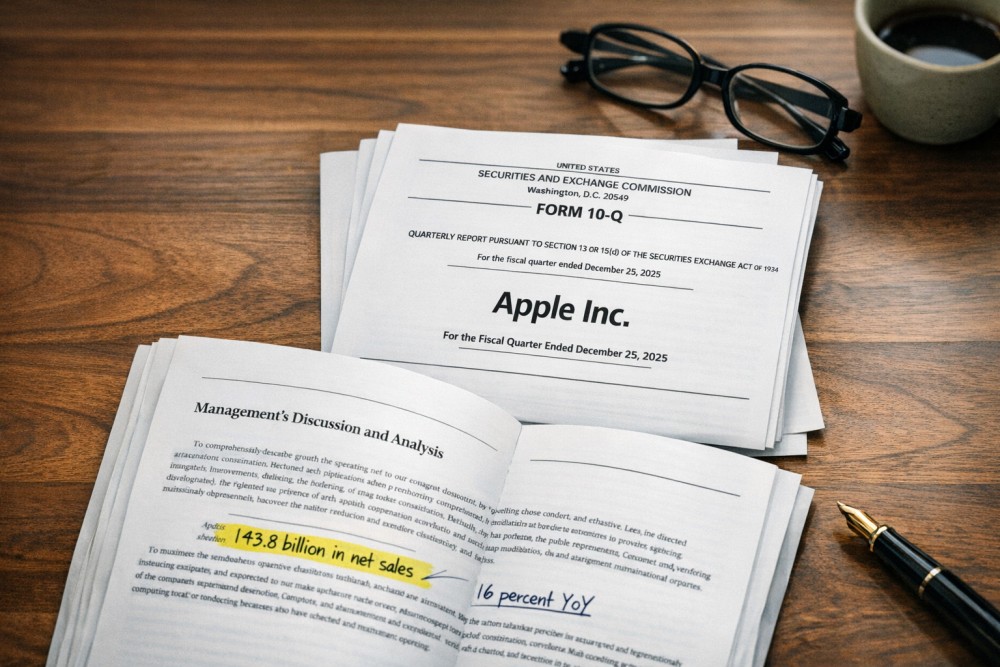
According to Apple's Q1 FY2026 press release, the company posted $143.8 billion in revenue, up 16 percent year over year, with iPhone and Services both setting records.
The MD&A then tells you which geographies and product lines drove that print. If one segment carried the quarter, that is a concentration risk worth flagging.
Pay attention to verb tenses too. "We expect" is forward looking. "We continue to" usually means the trend is intact. Subtle shifts in language often precede a guidance change.
This is the same lens we apply when comparing revenue versus earnings as drivers of stock prices.
Want to apply this to your own watchlist? Start analyzing US stocks on Gotrade with fractional shares from US$1.
Cash Flow Statement: The Honest Mirror
Revenue can be timed. Earnings can be smoothed with accruals and reserves. Operating cash flow is much harder to manipulate.
This is why experienced investors anchor on cash flow first. It tells you whether the business actually collected money this quarter, not just whether it booked it.
Apple generated nearly $54 billion in operating cash flow in the December 2025 quarter, against $143.8 billion in revenue. That ratio of cash flow to revenue is one of the cleanest quality signals in the whole filing.
When you read companies like Apple (AAPL), Microsoft (MSFT), or Alphabet (GOOG), compare operating cash flow to net income. A persistent gap is a yellow flag worth investigating.
Also check the financing section. A company funding dividends with new debt is telling you something the press release will not.
For the deeper view on how the income statement and cash flow statement fit together, our guide to analyzing company earnings reports walks through the linkages step by step.
Risk Factor Updates: What Changed Quarter Over Quarter
Most investors skip the risk factors section. That is a mistake, and it is the easiest one to fix.
The 10-Q risk factors are usually short because they only list updates since the last 10-K. New language here is the highest-signal text in the entire filing.
Read it side by side with the previous quarter. Anything new, expanded, or moved up the list is what management's lawyers think changed in the business.
Common updates include supply chain exposure, regulatory probes, foreign exchange shifts, and customer concentration. Cross-reference these against the MD&A tone for consistency.
If management calls a quarter "strong" but adds a new risk factor about demand softness, believe the risk factor. Lawyers do not write speculative language for fun, and they are the last line of defense against a future shareholder lawsuit.
This same discipline is what separates reactive trading from process. We covered it in our 5 metrics to watch in MSFT and GOOGL Q1 earnings framework.
Conclusion
Reading a 10-Q is a 30-minute habit that compounds. Once you know where MD&A, cash flow, and risk factors live, every quarter gets faster and the patterns start to repeat.
Start with one company you already own or watch. Open the latest 10-Q on EDGAR, read MD&A first, then cash flow, then risk factors. Skip the rest until you have time.
Open a Gotrade account to check earnings on your watchlist, with fractional shares from US$1 on US stocks.
FAQ
How often is a 10-Q filed?
Once per quarter, for the first three fiscal quarters of the year. The fourth quarter is rolled into the annual 10-K.
How is a 10-Q different from an 8-K?
A 10-Q is a scheduled quarterly report, while an 8-K is filed within four business days of a specific material event.
Where do I find a company's 10-Q?
Use the SEC's EDGAR database and filter by filing type 10-Q, or look in the investor relations section of the company's website.
Do I need an accounting background to read a 10-Q?
No, focus on MD&A, the cash flow statement, and risk factor updates first, the rest gets easier with reps.