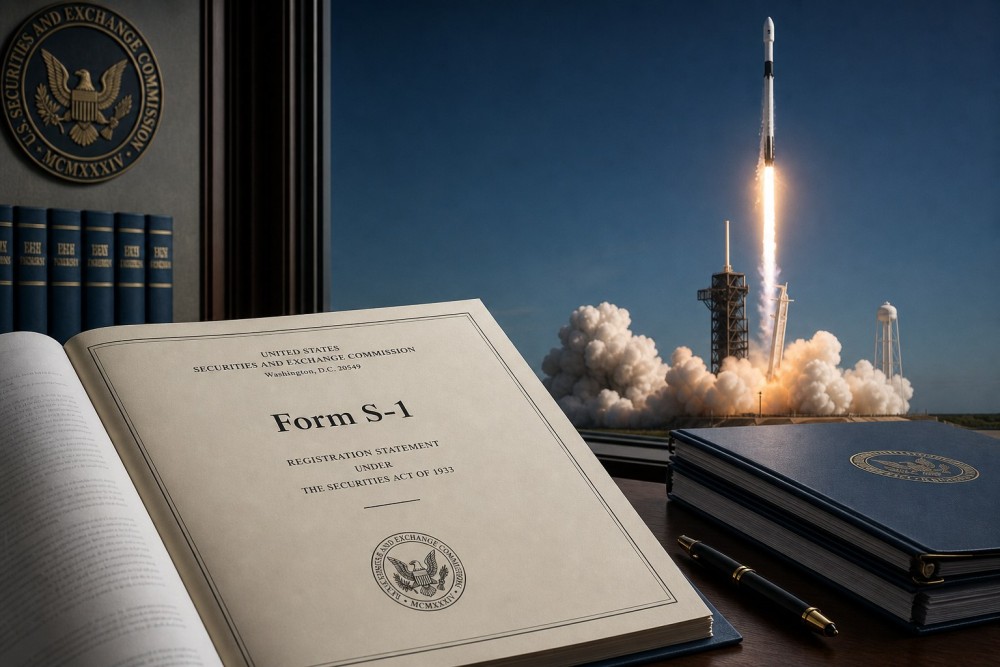
When a private company goes public in the United States, the most important document it produces is the S-1 filing. Learning how to read an S-1 is the difference between buying an IPO on hype and buying it because the numbers, risks, and incentives actually line up.
SpaceX filed its S-1 around May 20, 2026, with a target listing date of June 12 and a rumored valuation range of $1.5T to $2T. That filing is now public on the SEC's EDGAR system, and it is the cleanest live case study retail investors have had in years.
This guide walks through the five sections that matter most, using SpaceX as the worked example.
What Is an S-1 and Which Sections Matter Most
An S-1 is the registration statement that US domestic companies file with the Securities and Exchange Commission before an initial public offering. Foreign issuers file an F-1 instead, already-listed companies use an S-3 for follow-on offerings, and the final pricing version retail sees on launch day is the 424B prospectus supplement. They all share the same DNA, so once you can read an S-1, you can read the others.
The full document can run 300 pages. Five sections deserve close reading.
Prospectus summary
The opening 10 to 15 pages frame how management wants you to see the company. Read it, then read it again with skepticism: every claim here is repeated in more honest language deeper in the filing.
Risk factors
The section most retail investors skip and most institutional investors read first. We will come back to this.
Use of proceeds
A short section that tells you whether IPO money funds growth or simply lets early insiders cash out.
MD&A
Management's Discussion and Analysis is where the business story meets the numbers, and where you can spot deceleration before it shows up in headlines.
Financial statements
Three years of audited financials plus footnotes. The footnotes are where the interesting accounting choices live.
Risk Factors: The Underread Section That Saves Capital
If you only have 30 minutes with an S-1, spend them here. Risk factors are written by lawyers to protect the company in court, which means every meaningful risk the company knows about is disclosed in plain language somewhere in this section.
In SpaceX's filing, the risk factors cover launch failure rates, dependence on government contracts through Starshield, regulatory exposure for Starlink spectrum rights across multiple countries, and concentration risk around founder Elon Musk. A separate sub-section discloses that SpaceX holds approximately 18,712 BTC on its balance sheet, which introduces crypto price volatility into an aerospace company's financials. That is the kind of detail a hype-driven IPO buyer would miss entirely.
Compare this to a recent IPO like CoreWeave. The CRWV S-1 flagged customer concentration risk months before it became the dominant question on earnings calls. Risk factors are not boilerplate. They are a roadmap of what could go wrong, ranked roughly by how seriously management takes each item.
MD&A and Financial Statements: Business Health Check
MD&A is where management explains the financial statements in narrative form. Three things to look for: revenue mix and growth rate by segment, gross margin trajectory, and cash burn versus cash on hand.
SpaceX's S-1 splits revenue into three streams: launch services through Falcon 9 and Falcon Heavy, Starlink consumer and enterprise subscriptions, and Starshield government contracts. Each has a different margin profile and a different competitive moat. Rocket Lab, the closest listed comparable, helps frame what reasonable launch-economics look like. You can cross-reference against RKLB if you want a public-market benchmark.
In the financial statements, scan the cash flow statement before the income statement. A company can post accounting profits while burning cash, or post accounting losses while generating cash from operations. The cash flow statement does not lie about which one is happening. SpaceX's BTC holding will appear as a separate line item in the balance sheet footnotes, and the treatment of unrealized gains and losses matters for how reported earnings move.
Use of Proceeds: How the IPO Money Will Be Spent
This section is short, usually a single page, and tells you whether the IPO is funding the company or funding an exit. Look for the split between primary shares (new money to the company) and secondary shares (existing shareholders selling out).
A healthy ratio in a growth IPO is 70 to 90 percent primary. If insiders are selling more than 30 percent of the offering, ask why. Use of proceeds language like "general corporate purposes" is acceptable but vague. Specific uses like "capacity expansion at the Boca Chica facility" or "Starlink satellite manufacturing" are stronger signals that management has a concrete plan.
SpaceX's dual-class structure is also visible in this section. Class A shares, the ones retail can buy, carry one vote each. Class B shares held by founders and insiders carry ten votes each. This is the same playbook Meta, Google, and Palantir used. It concentrates control with the founder, which is a feature if you trust the founder and a bug if you do not.
Case Study: Key Takeaways From SpaceX's S-1 Filing
Pulling the threads together, SpaceX's S-1 tells a coherent story: three revenue lines, a clear capital plan, a heavily founder-controlled governance structure, and a balance sheet that includes an unusual BTC position. The $1.5T to $2T valuation range is steep, and the S-1 is the document that tells you whether the price reflects substance or sentiment.
The discipline of reading an S-1 before you buy is the same discipline that separates investors from speculators. For a non-filing overview of the same listing, our SpaceX IPO explained for retail investors piece walks through the trading mechanics.
Conclusion
An S-1 is not a sales document, even though parts of it read like one. It is a legal disclosure designed to give a careful reader a complete picture of the company's economics, risks, and governance. The investors who do best in IPOs are usually the ones who read the boring sections.
SpaceX's June 12 listing is one of the most anticipated IPOs of the decade, and the S-1 is now public on EDGAR. Spend an hour with it before the bell rings.
When SpaceX lists on June 12, you can buy fractional SpaceX shares on Gotrade starting from $1, alongside any other US-listed company in our universe.
FAQ
What is the difference between an S-1 and a 424B prospectus?
The S-1 is the initial registration filing, while the 424B is the final pricing supplement released shortly before trading begins.
Do I need to read the entire S-1 before investing?
No, but you should read the risk factors, use of proceeds, and MD&A sections in full before committing capital.
Can retail investors buy SpaceX shares at IPO price?
Most retail investors will buy on the open market after listing on June 12, since IPO allocations are typically reserved for institutional clients.