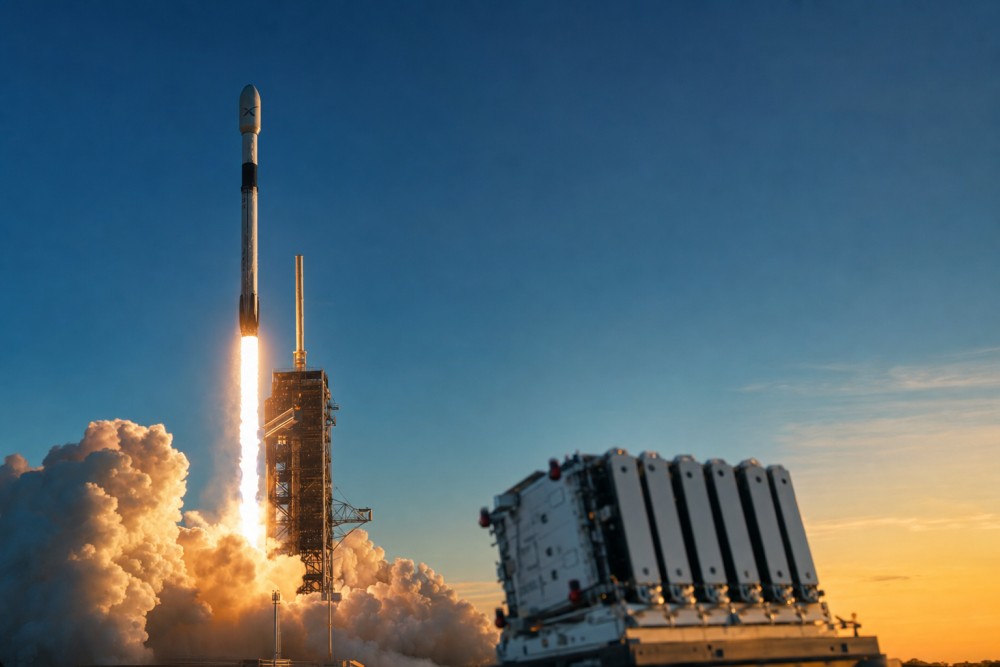
SpaceX is finally going public, and the SpaceX IPO is shaping up to be the largest listing in Nasdaq history. The company filed its S-1 with the SEC targeting ticker SPCX, with the roadshow starting June 4, pricing on June 11, and trading beginning June 12, 2026.
The headline numbers are huge. SpaceX is seeking to raise around $75 billion at a $1.75 trillion valuation.
For retail investors trying to figure out how to buy SPCX stock at listing, the real question is not whether to watch the open. It is whether the SpaceX valuation leaves any margin of safety on day one.
SpaceX Business Overview: Starlink, Falcon, Starship
SpaceX operates three core business lines that share infrastructure but serve very different customers. Falcon launch services remain the cash cow on government and commercial contracts.
Starlink is the consumer growth engine. The satellite broadband product crossed 10 million subscribers as of February 2026 and is still adding 750,000 to 1.5 million new subscribers every month.
Starship is the long-duration bet on heavy-lift reusability. It is the platform SpaceX needs to make lunar and Mars cargo economics work at scale, and it is also the single largest reason the company is still burning cash on a GAAP basis.
The financial center of gravity has clearly shifted to Starlink. Connectivity is projected to generate around $20 billion in 2026, or roughly 70 to 75% of total company revenue.
IPO Filing Highlights: $1.75T Valuation Target
The $75 billion raise at $1.75 trillion would make SpaceX the most valuable company ever to debut on a US exchange. The valuation implies a price to sales ratio of roughly 109 to 116 times trailing 2025 revenue.
On forward 2026 revenue of $27 to $30 billion, the multiple compresses to 58 to 65 times. That is still expensive by any historical IPO benchmark, well above the multiples Snowflake or Airbnb commanded at their own debuts.
For context, the question of how growth companies justify these multiples comes down to revenue versus earnings trajectory. Investors are pricing scale that does not yet exist.
Revenue vs Losses: $18.67B Top Line, $4.9B Net Loss in 2025
SpaceX posted $18.67 billion in 2025 revenue, up sharply from the $13 to $14 billion range in 2024. That is roughly 35 to 40% top-line growth.
The catch is the bottom line. Net loss came in at $4.9 billion in 2025 on heavy reinvestment into Starship development and Starlink satellite manufacturing. Free cash flow remains negative as a result.
The bright spot is segment-level profitability. As reported by Fortune, the connectivity business posted a $1.19 billion profit in the most recent quarter, meaning Starlink is already subsidizing Starship development.
The SpaceX IPO is the first time most retail investors will get a direct shot at pure-play space exposure. If you already trade US stocks through a platform like Gotrade, the listing simply becomes another ticker in your watchlist on day one.
Elon Musk Voting Control: Governance Risk to Watch
Musk retains 85.1% voting control through a super-voting share class. SPCX shareholders are effectively buying economic exposure with negligible governance rights.
This is not unusual for founder-led tech listings. Meta and Alphabet use similar dual-class structures.
What is unusual is the magnitude. An 85% voting lock means board composition, capital allocation, and strategic pivots all flow through one person.
Investors uncomfortable with single-person key-man risk should size SPCX accordingly. The governance structure is a feature of the deal, not a bug to be fixed later.
How Retail Investors Can Participate at Listing
According to CNBC's live coverage, retail allocation at the IPO price will be extremely limited. Most retail investors will buy SPCX in the open market on June 12.
The mechanics here are no different from any other US-listed initial public offering. Once SPCX trades on Nasdaq, any standard US brokerage account can buy it.
The harder question is whether to buy at the open. First-day pops on hyped tech IPOs frequently retrace 20 to 40% within the first 90 days.
A conservative playbook is to wait for the first earnings print as a public company, expected in early November 2026. That gives the market one full quarter of SEC-disclosed financials to digest before committing capital.
For investors who must own SPCX on day one, position-size as a high-volatility growth name. The same logic that applies to other Musk-adjacent positions like Tesla stock applies here. Treat it as a small, conviction-weighted satellite holding, not a core position.
Conclusion
The SpaceX IPO is a once-in-a-decade listing event. The business is real, the growth is real, and the moat in launch and satellite broadband is genuine.
The $1.75 trillion valuation is the constraint. At 58 to 65 times forward revenue, the market is pricing flawless execution on Starlink monetization and eventual Starship commercialization. Any miss on either lever resets the multiple sharply.
For most retail investors, the sensible move is to watch the first earnings cycle before sizing a position. SPCX is not going anywhere after June 12.
Ready to add SPCX to your watchlist on day one? Open a Gotrade account, fund it before the June 12 listing, and trade SpaceX alongside 600+ US stocks with fractional shares from $1.
FAQ
When does SPCX start trading?
SpaceX is expected to price on June 11, 2026, and begin trading on Nasdaq under ticker SPCX on June 12, 2026.
What is the SpaceX valuation at IPO?
SpaceX is targeting a $1.75 trillion valuation with a raise of approximately $75 billion, which would make it the largest US listing ever.
Can I buy SPCX at the IPO price?
Retail allocation is very limited, so most individual investors will buy SPCX in the open market once it begins trading on June 12.
Is SpaceX profitable?
SpaceX posted a $4.9 billion net loss in 2025 on $18.67 billion in revenue, but the Starlink connectivity segment was already profitable at $1.19 billion last quarter.