If you bought NVIDIA in 2023 or earlier, your portfolio has a problem most investors would love to have. The position is likely 5x or more, and what started as a 5 percent allocation is now a quarter of your holdings.
Concentration risk is real even when the thesis is intact, and it gets worse the longer you wait. The hard part is that selling triggers capital gains, and the tax bill on a 4x-appreciated position can feel painful enough to delay action year after year. You have several techniques to bring concentration down without giving the IRS a windfall.
Each one trades complexity for tax efficiency, and the right choice depends on your cost basis, your charitable goals, and how much of the gains you actually need to liquidate today.
Why Concentration Above 25 Percent Is a Risk Even When You Love the Stock
A single-name position above 25 percent of your portfolio means a 30 percent drawdown on that name produces a 7.5 percent drawdown on your entire net worth. Single stocks can drop 30 percent in a quarter on disappointing guidance even when the long-term thesis is still right.
The professional standard for a high-conviction single-stock position is 5 to 15 percent of total equity exposure. Above that, the position size is making a bet larger than the conviction warrants. The full rebalancing framework is in our portfolio rebalancing guide.
Trim Strategy 1: Sell Lots With Lowest Capital Gains First
When you sell shares, your broker can use one of several cost-basis methods. The default is FIFO (first-in, first-out), which usually maximizes your tax bill because the earliest shares have the largest gains.
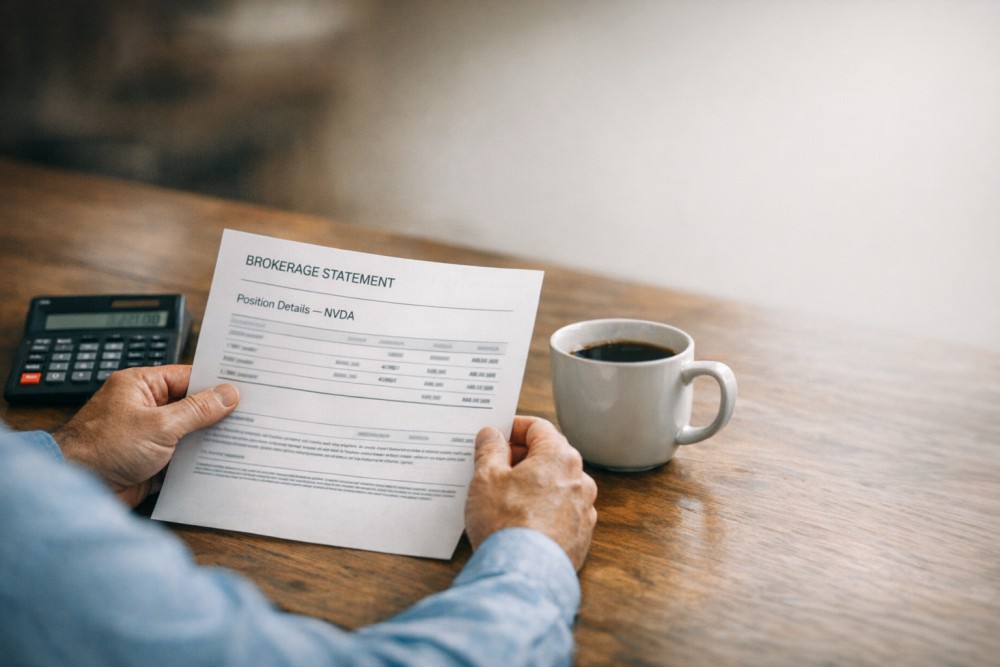
The right move on a long-held NVIDIA (NVDA) position is specific identification: tell the broker exactly which lots to sell. Pick the lots with the highest cost basis first. If you bought tranches in 2023 and 2025, the 2025 lots have far smaller embedded gains.
Selling those first might trim 5 percent of your shares while triggering only 1 to 2 percent of the total embedded capital gain. The technique works inside any standard taxable account and requires no special infrastructure.
Trim Strategy 2: Donate Appreciated Shares Instead of Cash
If you give to charity at all, switching from cash to appreciated-share donations is one of the highest-leverage tax moves available. When you donate appreciated NVDA shares directly to a qualified charity (or to a donor-advised fund), you get a deduction equal to fair market value and you avoid paying capital gains tax on the appreciation.
The combined benefit is roughly 35 to 40 percent of the donated value at higher US tax brackets. If you were planning to give 10,000 dollars to charity anyway, donating 10,000 dollars of NVDA stock is materially cheaper than selling and donating cash. The IRS rules are in Publication 550.
Trim Strategy 3: Reinvest Into Diversified ETFs
Three destinations cover most cases for the proceeds.
Broad market: VOO
Vanguard S&P 500 ETF (VOO) gives you 500 large-cap US names with one trade at 0.03 percent expense. NVDA is still inside VOO at roughly 6 to 8 percent weight, so you do not lose all your AI exposure, but concentration drops dramatically.
AI-tilted: QQQ
Invesco QQQ Trust (QQQ) tracks the Nasdaq-100 and is more tech-heavy than VOO. NVDA's weight is bounded by index methodology. If you want a thematic AI tilt without single-name risk, QQQ is the simplest option.
Direct AI alternates
If you want AI capex exposure outside NVDA, our 5 AI stocks beyond NVIDIA piece walks through second-source GPU, custom silicon, and fab plays.
Worked Example: Reducing NVDA From 35 Percent to 15 Percent
Assume your portfolio is 100,000 dollars total, with 35,000 dollars in NVDA. To get NVDA to 15 percent, you need to sell roughly 20,000 dollars. Using specific identification on the highest-cost-basis lots, the realized gain might be 6,000 to 8,000 dollars instead of the 16,000 dollars you would face on FIFO. At a 20 percent long-term capital gains rate, the tax bill drops from roughly 3,200 to 1,400 dollars. The proceeds go into VOO.
Conclusion
The point of rebalancing an NVDA-heavy portfolio is not to call the top. It is to make sure the portfolio survives a 30 percent drawdown without changing your life. The three techniques above let you bring concentration down without handing all your gains to the IRS.
Pick the highest-cost-basis lots, route any planned charitable giving through appreciated shares, and reinvest the proceeds into VOO, QQQ, or the broader AI stack.
To run the numbers on your own NVDA position, open the Gotrade app, look at your cost-basis lots, and identify the highest-basis tranches first.
FAQ
What if I want to keep my NVDA exposure but reduce single-stock risk?
Trim NVDA back to 10 to 15 percent of the portfolio and rotate the proceeds into QQQ, which still holds NVDA but caps the weight by index methodology.
Are there tax-advantaged accounts where I can rebalance without gains?
Yes. Inside a US IRA or 401(k), buy and sell decisions do not trigger capital gains. Concentration changes inside those accounts have no immediate tax cost.
How often should I rebalance a concentrated single-stock position?
Annually at minimum. If a single name passes 30 percent of your equity portfolio, rebalance immediately rather than waiting for the calendar.
Does specific identification require a special broker?
Most major US brokers support it. Confirm before placing the trade and document the lots in writing for your tax file.