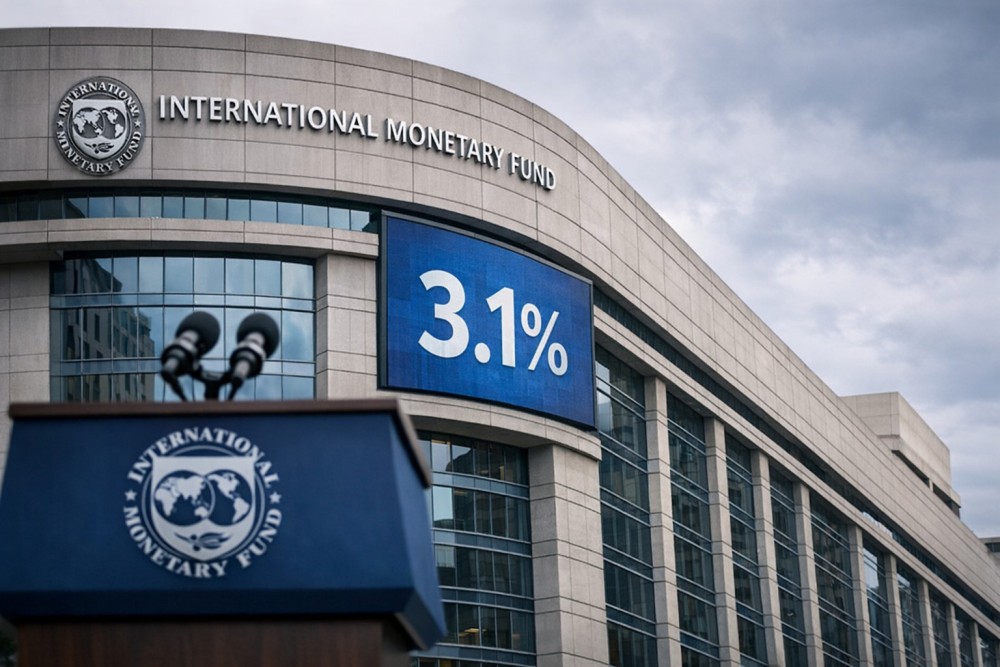
The IMF's April 2026 World Economic Outlook just revised global growth down to 3.1%, and the implications for your IMF outlook portfolio check are immediate. If you haven't reviewed your allocation in the past quarter, now is the time.
The report, titled "Global Economy in the Shadow of War," flags trade policy uncertainty, Middle East tensions, and slowing Chinese momentum as dominant risks. The question isn't whether these headwinds exist. It's whether your portfolio is positioned to handle them.
IMF Cut Emerging Market Growth to 3.9%, Is Your Portfolio Exposed?
The IMF slashed its emerging market growth forecast to 3.9%, down from 4.2% in October 2025. That 0.3 percentage point cut reflects a meaningful shift in the growth trajectory for an entire asset class.
According to the IMF World Economic Outlook, commodity-importing emerging economies face the steepest headwinds. Rising energy costs and tighter financial conditions are squeezing margins across these markets.
What this means for EM-heavy portfolios
If you hold broad emerging market ETFs like VWO or EEM, check your current weighting. A position that made sense when growth was forecast at 4.2% carries a different risk profile at 3.9%.
India remains the bright spot at 6.5% projected growth. China, however, was revised down to 4.5% from 4.8%. Since China typically represents the largest single-country weight in most emerging market funds, this downgrade directly impacts your returns.
Countries and sectors most affected
Commodity importers among emerging markets are the hardest hit by the revised outlook. Countries dependent on energy imports face a double squeeze: weaker growth and higher input costs.
Sectors tied to consumer discretionary spending in these economies are particularly vulnerable. When growth slows, consumer spending is usually the first casualty.
US Stocks vs Emerging Markets: Which Is Performing Better in Your Portfolio?
The US economy stands at 2.1% projected growth for 2026, making it relatively resilient compared to other advanced economies at 1.6%. This divergence matters for your global portfolio allocation review.
US-focused holdings like SPY have continued to benefit from stronger domestic fundamentals. Meanwhile, emerging market stocks portfolio allocations have underperformed as growth forecasts eroded.
The performance gap is widening
The spread between US and emerging market growth projections has widened to its largest since 2022. Your US positions are likely carrying more weight in total returns than your EM holdings.
Check your allocation percentages on Gotrade. If you allocated 30% to emerging markets six months ago, underperformance may have shifted that weight lower, but the risk exposure remains tied to your original allocation.
Geopolitical Risk Now a Primary Factor, Which Sectors Are Vulnerable?
The IMF explicitly flagged Middle East geopolitical risks as a major downside factor for the global economy. This isn't background noise. It's now a primary variable in the growth forecast.
According to Reuters, trade policy uncertainty is weighing on investment decisions globally. Companies are delaying capital expenditure, and the effects ripple through supply chains and equity valuations.
Energy and defense exposure
Energy sector stocks are directly exposed to geopolitical disruption. If your portfolio includes oil and gas producers or energy ETFs, the risk-reward calculus has shifted.
Technology companies with significant international supply chains, including names like Microsoft and Amazon, also face indirect pressure from trade policy uncertainty. Their exposure is less immediate but still worth monitoring.
Review your sector allocation on Gotrade. Check whether your portfolio is overweight on energy, commodities, or EM-dependent sectors. Compare your current allocation against your target, and adjust if you've drifted too far from your plan.
Portfolio Allocation Check: Are You Too Concentrated in One Region?
Concentration risk is the silent portfolio killer. If more than 40% of your portfolio sits in a single region or sector, the IMF's latest projections make that exposure worth revisiting.
Global growth at 3.1% means no single region offers a clear safe haven. US resilience at 2.1% is relative, not absolute. Emerging markets are decelerating.
How to run a quick allocation check
Open your Gotrade portfolio and look at your holdings by region. If any single country or region exceeds 40% of your total, consider whether that concentration is intentional or the result of drift.
Understanding what ETFs are and how they provide instant diversification can help you rebalance without making dozens of individual trades.
Rebalancing doesn't mean panic selling
Rebalancing is a discipline, not a reaction to headlines. The IMF data gives you an informed basis to review positions, not a reason to liquidate them.
If you're unsure where to start, reviewing how to invest in US stocks can help you rebuild a balanced allocation across regions.
Conclusion
The IMF's April 2026 outlook is a clear signal to check your portfolio positioning. Global growth at 3.1%, emerging markets at 3.9%, and elevated geopolitical risk mean that portfolios built on last year's assumptions may no longer match current conditions.
The action isn't to panic. It's to review. Check your emerging market exposure on Gotrade, compare your regional weightings, and make sure your allocation still reflects your risk tolerance and investment timeline.
FAQ
What did the IMF forecast for global growth in April 2026?
The IMF revised global growth down to 3.1% for 2026, from 3.3% previously.
How much did the IMF cut emerging market growth forecasts?
Emerging market growth was cut to 3.9%, down from 4.2% in the October 2025 projection.
Should I sell my emerging market ETFs based on the IMF report?
Not necessarily; use the data to review your allocation and ensure your EM weighting matches your risk tolerance.