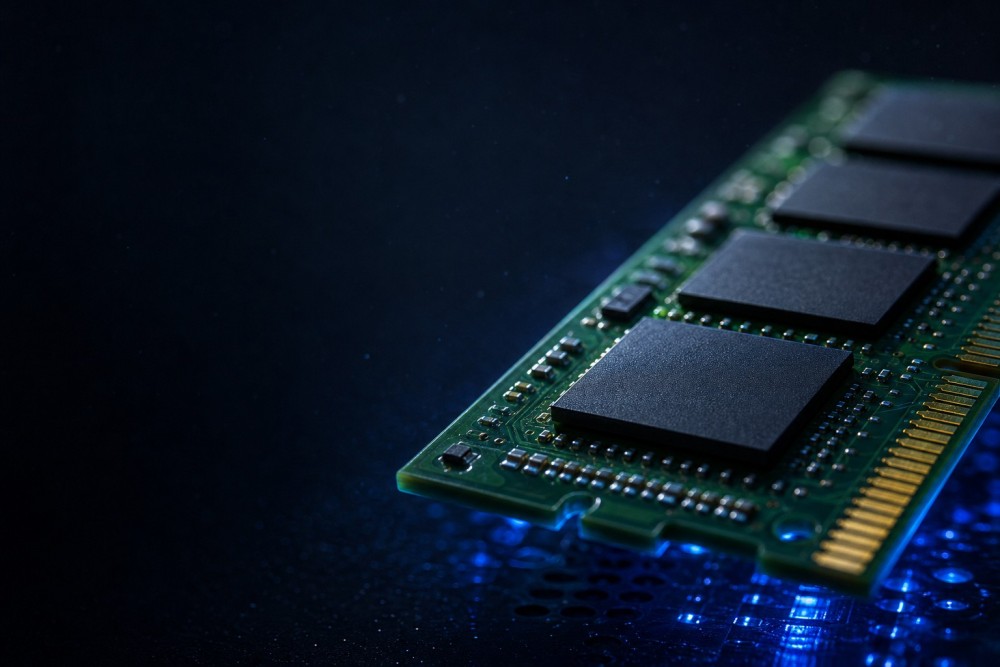
The 2026 memory cycle is the most dramatic upcycle since 2017. Pricing, margins, and hyperscaler bookings have all reset higher in a matter of quarters.
Two listed names give investors clean exposure. Micron Technology is the diversified incumbent across DRAM, HBM, and NAND. Sandisk Corporation, spun off from Western Digital in 2025, is a pure-play NAND name.
This piece compares the two on product mix, customer base, margin and capex paths, and how a pair trade might frame the next 12 months.
Product Mix: DRAM, HBM, and NAND Exposure by Vendor
Micron sells across all three memory categories. DRAM contributes roughly 79% of revenue, with HBM and NAND splitting the remainder.
Sandisk sells one thing. Every dollar of revenue comes from NAND flash and SSDs sold into client, enterprise, and embedded markets.
Where the AI dollar lands
HBM is the bottleneck product for AI training. Each Nvidia Blackwell accelerator consumes multiple HBM stacks, and supply is sold out through calendar 2026.
NAND benefits more indirectly. AI inference clusters need enterprise SSDs to hold model weights and cached results, which is the lane Sandisk dominates.
Diversification versus purity
Micron captures both the HBM upside and the NAND tailwind, but a NAND price reversal would dilute the HBM story. Sandisk has no DRAM hedge. When NAND moves, the whole P&L moves with it.
Customer Concentration and Hyperscaler Wins
Both names are heavily exposed to a small group of hyperscalers. The contract structure, however, looks different.
Sandisk recently locked in five multi-year supply contracts representing roughly $11 billion in financial guarantees. Three of those alone carry around $42 billion in contractual revenue, an unusually long visibility window for a NAND vendor.
Micron has effectively pre-sold its calendar 2026 HBM output. Management has confirmed allocation to a handful of GPU and ASIC customers, with Broadcom custom-silicon designs adding a second leg to the demand pull.
How the books look today
Sandisk’s data center revenue surged 233% sequentially to roughly $1.5 billion last quarter, concentrated in a few AI buyers.
Micron’s HBM book reads similarly. A small set of accelerator vendors absorbs most qualified supply.
Concentration risk read-through
Both companies are essentially priced on three to five customers behaving rationally. A capex pause from any single hyperscaler hits both names quickly.
Sandisk carries more single-product risk. Micron carries more capacity-allocation risk if the HBM mix shifts away from its qualified parts.
Margin Trajectory and Capex Discipline
The margin gap is closing fast, but the starting points are very different. Micron sits on roughly 58% gross margin and 26% operating margin, with about $1.7 billion in annual free cash flow at current run-rates.
Sandisk reported 56% gross margin in its most recent quarter, up from 23% a year earlier. Operating margin swung from negative 7% to positive 7%, while free cash flow remains slightly negative at around minus $120 million.
Capex paths diverge
Micron is reinvesting aggressively. Fiscal 2026 capex is guided at over $25 billion. Construction spend alone may add another $10 billion in fiscal 2027 as new fabs ramp.
Sandisk is the opposite shape. The balance sheet is debt-free with $3.7 billion in cash, and the board has authorized a $6 billion buyback rather than greenfield fab spend.
What it means for returns
According to The Motley Fool, Sandisk’s contracted book and capital-light posture give better downside protection in a cycle reversal.
Micron has the better scarcity asset in HBM, but the heavier capex bill means returns depend on the cycle staying tight through 2027.
Pair Trade Setup: Long MU vs Short SNDK and Reverse
Both stocks have moved fast, so directional bets carry single-cycle risk. A pair trade isolates the relative thesis.
Long MU, short SNDK
This expresses a view that HBM scarcity outlasts NAND scarcity. The trade works if HBM pricing holds through 2027 while NAND rolls over as Sandisk competitors add wafer capacity.
Triggers to watch: HBM allocation expansions for Blackwell successors, capex resumption from Korean NAND peers, and any Sandisk customer renegotiation.
Long SNDK, short MU
This expresses the view that Sandisk’s contract book plus buyback compounds faster than Micron’s capex-funded growth. The trade works if hyperscaler SSD bookings keep accelerating and Micron’s fab construction overruns weigh on free cash flow.
Triggers to watch: additional multi-year Sandisk supply deals, Micron capex guidance revisions, and any HBM share loss to Korean competitors. Investors who prefer single-name exposure can use the deeper Sandisk stock analysis as a starting point before sizing either leg.
Conclusion
Micron and Sandisk are the cleanest listed ways to play the 2026 memory cycle, but they are not interchangeable. Micron offers scarcity in HBM and diversification across categories. Sandisk offers contractual visibility and a capital-light balance sheet.
The right exposure depends on which scarcity lasts longer: HBM allocation or hyperscaler NAND demand. A pair trade lets investors take a relative view without betting the entire memory cycle.
Gotrade gives you fractional access to MU and SNDK on the US market. Build either leg from $1, with no minimums, and rebalance as the cycle evolves.
FAQ
Is Sandisk the same as the old SanDisk consumer brand?
No, SNDK is the post-spin-off pure-play NAND and SSD company that separated from Western Digital in February 2025.
Why does Micron get more of the AI memory margin today?
HBM is the binding constraint for AI training, and Micron is one of only three qualified HBM suppliers globally.
Does Sandisk make HBM?
No, Sandisk is NAND-only and has no DRAM or HBM exposure.
How do I trade MU and SNDK from Indonesia or Southeast Asia?
Both stocks are available as fractional shares on Gotrade, with positions starting from $1.