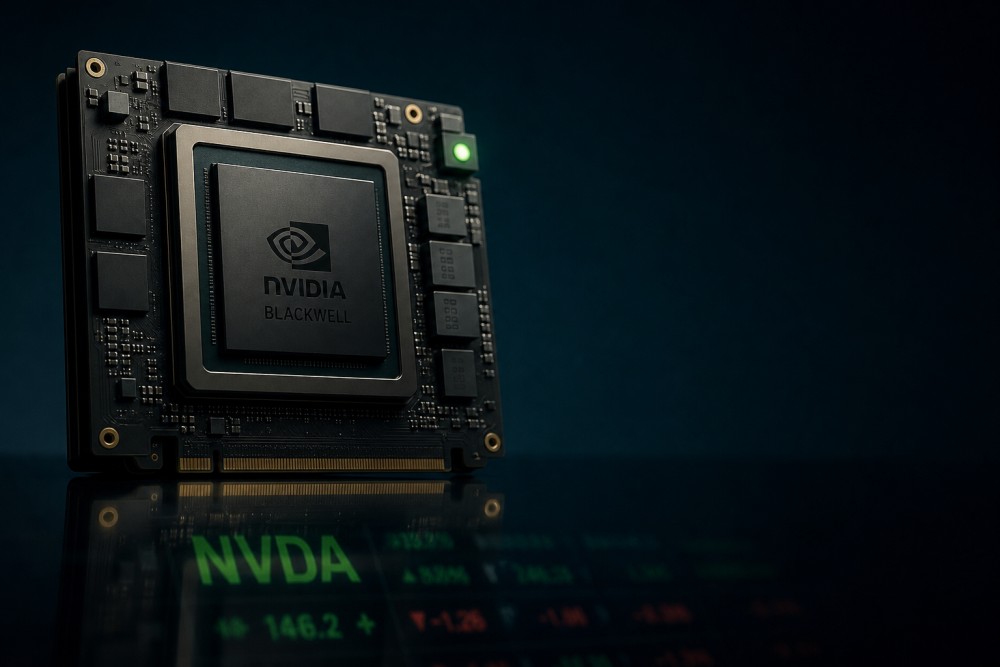
Nvidia (NVDA) just delivered another beat-and-raise print, and the nvda earnings buy hold trim debate is back in every trading chat. The numbers were big, the guide was bigger, and Blackwell shipments are finally moving at scale.
The question is no longer whether the AI cycle is real. It is whether the easy money in Nvidia (NVDA) has already been made.
Here is the full nvidia q1 fy27 reaction and the nvda blackwell trade playbook from here.
Headline Numbers: Revenue, EPS, Gross Margin vs Consensus
Nvidia reported total revenue of $81.6 billion for Q1 FY27, up 85% year over year and 20% sequentially. That is a clean beat against the buy-side whisper near $79 billion.
Non-GAAP EPS landed at $1.87, up 140% year over year, with GAAP EPS at $2.39, up 214%. Gross margin held at 74.9% GAAP and 75.0% non-GAAP, defending the bull view that Blackwell mix is not yet a margin headwind.
Q2 FY27 guidance of $91.0 billion plus or minus 2% implies another double-digit sequential step up. The board also approved a fresh $80 billion buyback, returned $20 billion in Q1, and raised the quarterly dividend from $0.01 to $0.25.
Data Center Growth and Hyperscaler Capex Signals
Data Center revenue printed at $75.2 billion, up 92% year over year and 21% sequentially. That single line item is now larger than the entire revenue base most semiconductor peers will report this year.
The 21% sequential growth matters more than the headline. It confirms hyperscaler capex from Microsoft, Google, Meta, and Amazon is still translating into actual shipments, not just press releases. Edge Computing revenue came in at $6.4 billion, up 29% year over year.
The Q1 print confirms AI infrastructure spending is still in its expansion phase, and semiconductor leaders with locked-in hyperscaler order books remain the cleanest way to express that view in a portfolio.
Verdict: Buy the Beat, Hold the Position, or Trim After the Print
Our base case is hold the core position, trim only the trading sleeve, and reserve fresh buys for a pullback. The setup does not justify chasing the post-earnings gap, but a $91 billion next-quarter guide does not justify exiting either.
When to buy
Add on a 5% to 10% pullback that holds the pre-earnings consolidation zone, or scale a first position in over four to six weeks. Pair the entry with TSMC (TSM) exposure to capture the foundry side of the same trade.
When to hold
Hold if NVDA is already a core position sized between 3% and 6% of the portfolio. The Q2 guide and buyback authorization remove most downside catalysts over the next 90 days.
When to trim
Trim if NVDA has grown above 8% through price appreciation, or if the trading sleeve was sized for a single-quarter catalyst that has now played out. Reallocate into adjacent names like Broadcom (AVGO) or hyperscaler customers like Microsoft (MSFT) to keep AI exposure without single-name concentration risk.
Blackwell Production and Supply Constraints
Blackwell shipments ramped meaningfully during the quarter. CEO Jensen Huang framed the AI-factory buildout as the largest infrastructure expansion in human history and said it is accelerating.
Supply remains the bottleneck, not demand. TSMC CoWoS packaging capacity is still the constraint, and customer allocations are reportedly oversubscribed through the back half of FY27. If yields improve and packaging capacity expands faster than the current roadmap, the Q3 and Q4 FY27 guides have upside not yet in consensus.
Stock Reaction Setup: Options Skew and Post-Earnings Levels
The options market priced in a roughly 7% move into the print, and post-earnings positioning suggests dealers will need to chase strength on any sustained move above the prior all-time high. That mechanical bid can extend the rally for two to three sessions.
For a peer-relative read heading into this print, our prior NVIDIA vs TSMC vs Broadcom comparison walks through the relative-value setup across the three names. Loss of the pre-earnings consolidation zone would shift the read from buy-the-dip to wait-and-see.
Conclusion
Nvidia Q1 FY27 confirms the cycle without resetting it. Revenue beat, gross margin held, the Q2 guide stepped up, and capital returns expanded materially. The bull thesis is intact.
Position sizing, not direction, is the decision that matters now. Hold core, trim only the trading layer, and use weakness as the entry rather than chasing the gap. The AI chip rotation playbook walks through how to balance NVDA against AMD and Intel exposure across a full cycle.
Trade Nvidia and the full AI infrastructure complex on Gotrade with fractional shares from as little as $1. Open an account, fund in minutes, and start building your AI portfolio with the same names institutional desks own.
FAQ
Q1: What were the key numbers in Nvidia's Q1 FY27 report?
Nvidia reported $81.6 billion in revenue (up 85% year over year), $75.2 billion in Data Center revenue, non-GAAP EPS of $1.87, and guided Q2 FY27 to $91.0 billion plus or minus 2%.
Q2: Should I buy NVDA after the Q1 FY27 beat?
Buy on a 5% to 10% pullback that holds the pre-earnings consolidation zone, or scale in over four to six weeks rather than chasing the post-earnings gap.
Q3: When does it make sense to trim NVDA?
Trim if NVDA has grown above 8% of your portfolio through price appreciation, or if the trading sleeve was sized for a single-quarter catalyst that has now played out.
Q4: What is the biggest risk to the Blackwell trade from here?
Supply constraints at TSMC's CoWoS packaging capacity remain the primary bottleneck, and any slip in the Blackwell production ramp could compress the Q3 and Q4 FY27 guide upside.