The SEC has approved Nasdaq's filing to list and trade QBTC, a cash-settled, European-style Bitcoin index option. This is the headline event for anyone holding Bitcoin proxy exposure on US markets.
The news matters because the approval signals deeper institutional infrastructure around Bitcoin volatility. That changes how to think about positioning across spot ETFs, proxy stocks, and listed volatility products.
This piece lays out a three-route framework for repositioning crypto exposure using IBIT, MSTR, COIN, and MARA.
What Nasdaq's QBTC Approval Actually Means
QBTC is a cash-settled, European-style Bitcoin index option. Cash-settled means no Bitcoin changes hands at expiration. European-style means it can only be exercised on the expiration date.
According to Nasdaq, QBTC expands institutional access to Bitcoin volatility hedging on a major US exchange. That is the signal worth tracking, not a retail trading opportunity.
The downstream effect for retail is indirect. Deeper institutional volatility markets typically lead to tighter spreads and more stable pricing across Bitcoin ETFs and proxy equities.
Route One: Spot Bitcoin ETFs for Clean Exposure
The cleanest way to hold Bitcoin price exposure on a US brokerage is through a spot Bitcoin ETF. The three most commonly used are IBIT, FBTC, and GBTC.
IBIT is BlackRock's spot Bitcoin ETF and tends to lead the category on assets under management and daily volume. FBTC is Fidelity's competing product with a similar structure. GBTC is the older Grayscale product that converted from a closed-end trust to an ETF in 2024.
The practical differences come down to expense ratios, intraday liquidity, and tracking error. IBIT and FBTC generally show tighter spreads and lower fees than legacy GBTC. Verify current numbers on each issuer's site before committing capital.
When spot ETFs make sense
Spot ETFs are the default route when you want Bitcoin price exposure without operating-business risk or hash-rate dependency. They are also the simplest to size.
Where they fall short
Spot ETFs do not offer leverage. If you want amplified upside or downside, you need either options on the ETF, a proxy stock, or a leveraged product.
Route Two: Proxy Stocks for Operating Leverage
Proxy stocks give you Bitcoin-correlated exposure with an operating business layered on top. The three core names retail investors track are MSTR, COIN, and MARA.
MSTR holds a large corporate Bitcoin treasury and adds operating leverage from its software business. It tends to amplify Bitcoin moves in both directions because of its balance-sheet exposure.
COIN is Coinbase, the largest US-listed crypto exchange. Its earnings beta runs through trading volume and custody fees, so the stock tracks crypto activity more than Bitcoin price alone.
MARA is a Bitcoin miner. It is sensitive to Bitcoin price, network hash rate, energy costs, and mining difficulty. It is the highest-beta name in the group.
Start options trading on Gotrade to layer a defined-risk option leg onto your MSTR, COIN, or IBIT exposure as the institutional Bitcoin volatility landscape deepens. Open Gotrade to act on this idea.
Route Three: Listed Bitcoin Options Infrastructure
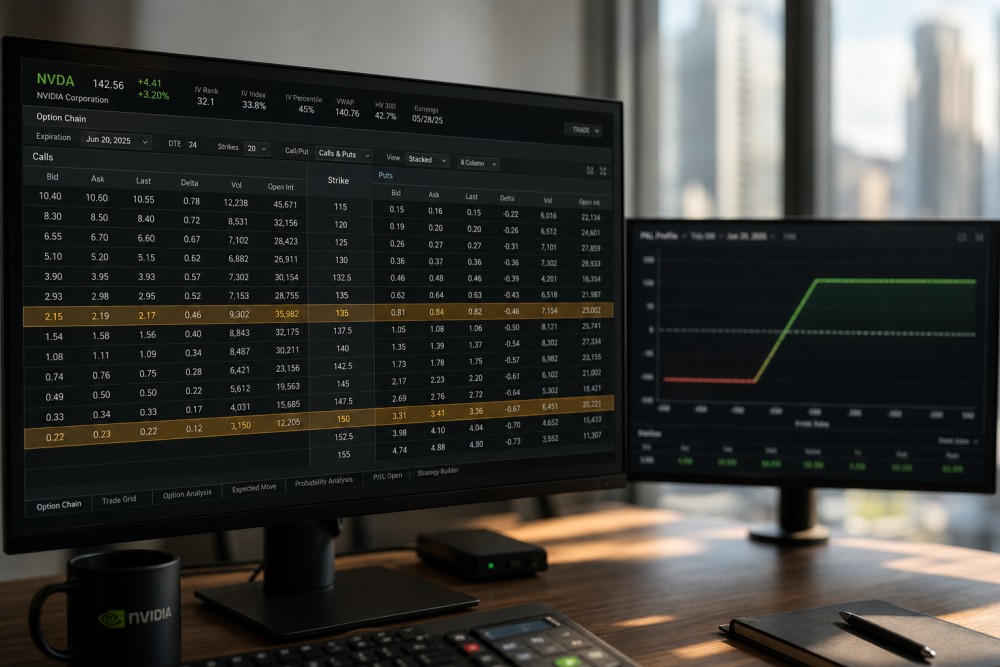
Nasdaq's approval adds a cash-settled index option to a market that already includes options on IBIT and other spot ETFs. The institutional toolkit for Bitcoin volatility is now meaningfully deeper.
According to Investopedia, European-style options can only be exercised on the expiration date, which removes early-exercise risk for sellers. That detail matters for how institutions price and hedge volatility.
For retail, the takeaway is not that QBTC is a new vehicle for you. It is that volatility infrastructure around Bitcoin is maturing, which supports more stable pricing across the proxy stocks and ETFs you can access. Our options trading piece covers the mechanics.
Building a Three-Route Allocation
Treat the three routes as risk tiers. Spot ETFs are the lowest-volatility tier, proxy stocks add operating leverage, and listed options are the institutional tier you read for signal.
A balanced allocation might lean heaviest on spot ETFs, add a smaller proxy-stock slice across MSTR and COIN, and size MARA small. Use the QBTC launch as a reminder to review total exposure, not as a buy signal.
Sizing discipline
Crypto-adjacent equities can move several percent on Bitcoin swings that look modest in dollar terms. Size each position so a single bad week does not force an exit at the wrong price.
Rebalancing cadence
Set a review cadence rather than reacting to every Bitcoin headline. Monthly or quarterly rebalancing back to target weights is usually enough.
Conclusion
QBTC's approval is an institutional milestone, not a retail trade. The real opportunity is in repositioning the Bitcoin exposure you already hold. Spread it across spot ETFs, proxy stocks, and a clearer view of listed options.
Spot ETFs like IBIT, FBTC, and GBTC give you clean price exposure. Proxy stocks like MSTR, COIN, and MARA add operating leverage with different drivers.
Start options trading on Gotrade to add a defined-risk options leg on MSTR, COIN, or IBIT as QBTC reshapes the institutional Bitcoin landscape.
FAQ
What is QBTC?
QBTC is a cash-settled, European-style Bitcoin index option approved for listing on Nasdaq, designed primarily for institutional volatility hedging.
How does a spot Bitcoin ETF differ from a proxy stock?
A spot ETF tracks Bitcoin's price directly, while a proxy stock layers operating-business risk and potential leverage on top of Bitcoin exposure.
When should a retail investor consider proxy stocks over a spot ETF?
When the investor wants amplified upside or downside tied to Bitcoin and accepts the added company-specific operational risk that comes with it.
What is the practical retail takeaway from QBTC's approval?
The takeaway is that institutional Bitcoin volatility infrastructure is maturing, which supports more stable pricing across the ETFs and proxy stocks retail investors actually trade.