A bull call spread on NVDA lets you express a moderately bullish view while capping cost and loss in advance. You buy one call and sell another at a higher strike, same expiration.
This guide walks through strike selection, then runs the profit and loss math on a worked NVDA example at 30 days to expiration.
What a Bull Call Spread Is and Why Traders Use It
A bull call spread is a vertical debit spread. You pay a net premium for the long call. Selling a higher-strike call offsets part of that cost, caps upside, and lowers both breakeven and max loss.
According to Investopedia, the strategy profits when the underlying rises toward the short strike at expiration, and the maximum loss is limited to the net debit paid.
Compared with a naked long call on NVDA, the spread trades unlimited upside for a cheaper entry and a clearer worst case. For traders familiar with options trading, it is often the first structured strategy to learn.
Step One: Picking the Long Call Strike on NVDA
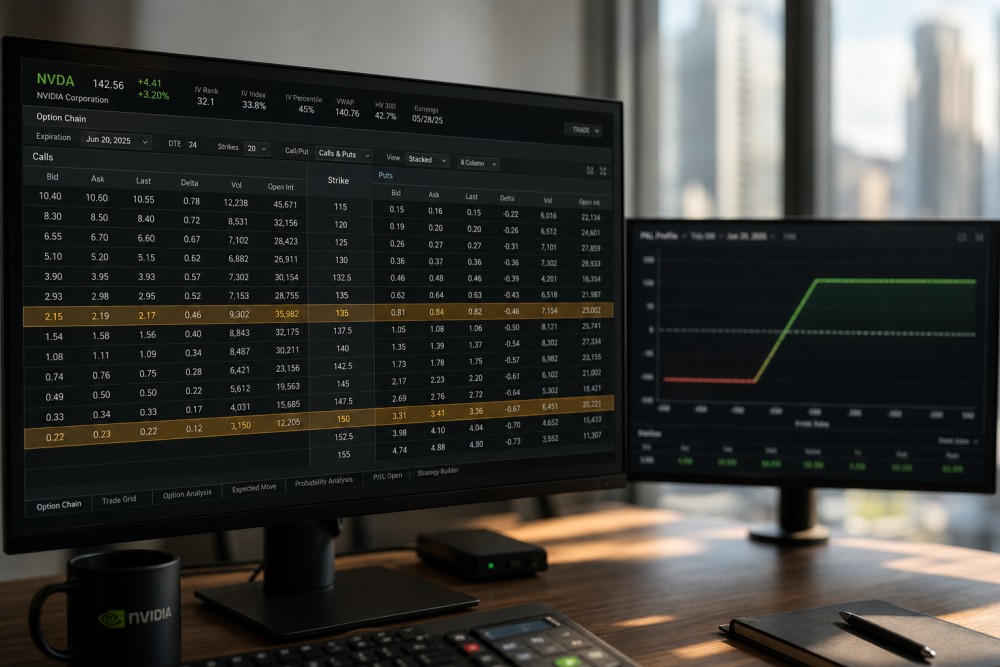
Assume NVDA trades at 135 on 2026-05-25 and you expect a move to 150 over the next month. Your long call should sit close to the current price so it has enough delta to participate in the move.
For this example, buy the 135 call expiring in 30 days at roughly 6.50 per contract. That gives you 50 to 55 delta exposure.
Higher delta means the long leg tracks NVDA more closely, but it also costs more. Picking the long strike price is the conviction step, where you decide how aggressive the bet should be.
Step Two: Picking the Short Call Strike to Cap Cost
Now sell a higher-strike call to fund part of the long premium. If your price target on NVDA is 150, sell the 150 call expiring on the same date. That call might trade near 2.50 per contract.
Your net debit becomes 6.50 minus 2.50, or 4.00 per share. Each option contract represents 100 shares, so the total cost per spread is 400 dollars.
The short strike caps max profit at 150 and lowers the breakeven NVDA must clear. The further out the short strike, the more upside but the higher the net debit.
Start options trading on Gotrade to size a defined-risk bull call spread on NVDA without overcommitting capital. Open Gotrade to act on this idea.
Calculating Max Profit, Max Loss, and Breakeven
The math on a bull call spread is fixed at entry. Max loss equals the net debit, which is 4.00 per share or 400 dollars per spread on the NVDA 135 to 150 example.
Max profit equals the width of the strikes minus the net debit. The spread is 150 minus 135, or 15 wide. Subtract the 4.00 debit, and max profit is 11.00 per share, or 1,100 dollars per contract.
Breakeven is the long strike plus the net debit. On this NVDA setup, breakeven is 135 plus 4.00, or 139.00. NVDA must close above 139 at expiration for the spread to profit.
The Options Industry Council, hosted at Cboe, notes that the risk-reward of a vertical debit spread is fully knowable at entry.
P&L Behavior at 30 Days to Expiration
Map out the payoff at expiration. If NVDA closes at 130, both calls expire worthless and you lose the full 400 dollar debit. If NVDA closes at 139, you recover the debit and break even.
If NVDA closes at 145, the long call is worth 10 and the short call is worth 0. Net intrinsic value is 10 minus the 4.00 debit, or 6.00 per share. That is 600 dollars per contract.
If NVDA closes at 150 or higher, both calls finish in the money. The spread reaches its 11.00 maximum, locking in the 1,100 dollar payoff regardless of how far NVDA runs past 150.
Comparing the Setup to AMZN, MSFT, and AAPL
The same framework applies to other large-cap names. On AMZN, you might build a wider spread to capture a slower grind higher into the next earnings print.
On MSFT, implied volatility is typically lower than NVDA. The debit eats a larger share of strike width, so a tighter spread keeps the risk-reward attractive. The call vs put decision still anchors the directional thesis.
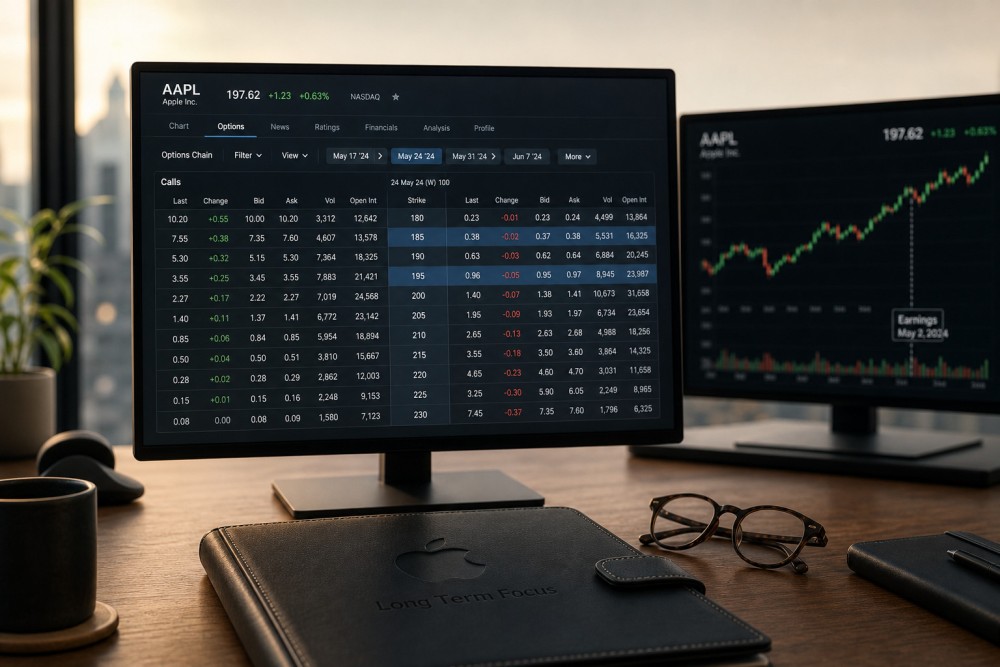
On AAPL, slower realized moves often favor narrower spreads with closer short strikes. Adjust width to match the realistic monthly move you expect, not the headline move you hope for.
Conclusion
A bull call spread on NVDA gives you a clean way to express a moderately bullish view with a known maximum loss. Pick the long strike near the money to anchor conviction, then sell a higher strike at your price target to cap cost.
Run the three numbers before clicking submit. Max loss equals the net debit. Max profit equals the strike width minus the debit. Breakeven equals the long strike plus the debit.
Start options trading on Gotrade to put this defined-risk framework to work on NVDA and other large-cap names.
FAQ
What is a bull call spread?
A vertical debit spread where you buy a lower-strike call and sell a higher-strike call with the same expiration to cap cost and risk.
How does breakeven work on a bull call spread?
Breakeven equals the long call strike plus the net debit paid to open the spread.
When should you choose a bull call spread over a long call?
Choose it when you want a defined-risk bullish position with a clear maximum loss, even if it means giving up unlimited upside.
What is the max profit on a bull call spread?
Max profit equals the difference between the two strikes minus the net debit paid at entry.