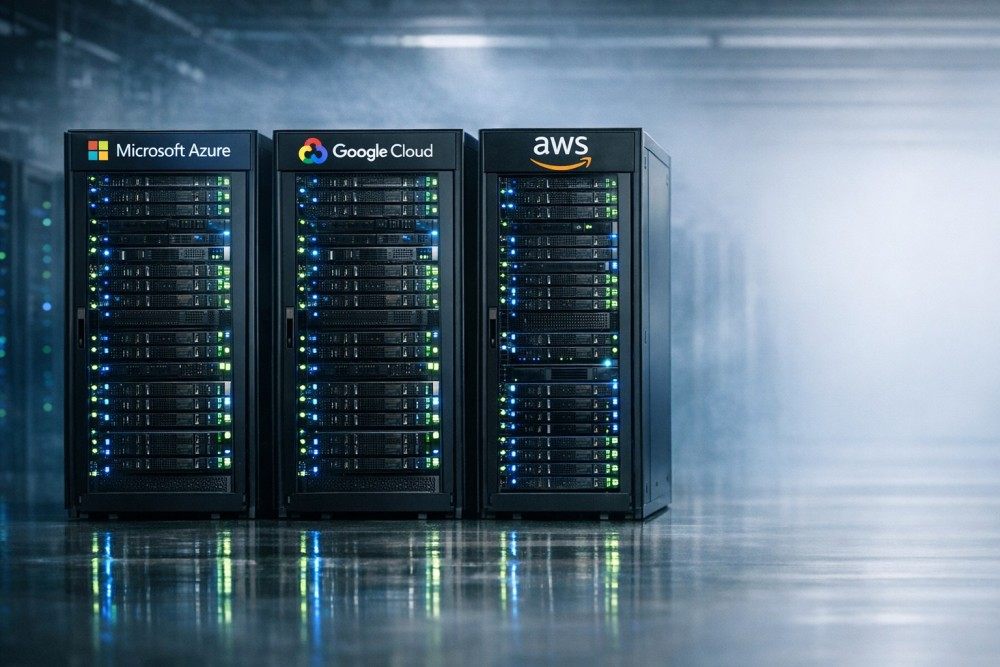
Reading the cloud growth Azure GCP AWS signal correctly is the single highest-value skill for trading hyperscaler earnings this week. All three giants report Wednesday April 29 after the close, and the tape will move on second-derivative cloud commentary, not headline EPS.
This guide walks through the four signals professional analysts triangulate before they touch a price target: constant-currency growth, RPO and backlog, AI workload mix, and gross margin trajectory. Cloud is now an AI infrastructure story, and the old IT-migration framework will mislead you.
Why This Print Matters More Than Usual
Cloud is the swing factor for three of the four largest US companies by market cap. MSFT Azure, GOOGL Google Cloud, and AMZN AWS together generate roughly a quarter of trillion-dollar annual revenue.
According to Bloomberg, hyperscaler capex commitments for 2026 are tracking above 250 billion dollars combined, almost entirely AI-linked. That spend only pays back if cloud revenue acceleration shows up in this print.
Signal One: Constant-Currency Growth
Headline cloud growth rates are noisy because of FX. Always strip currency effects before comparing quarters or peers.
Azure: management gives a constant-currency Azure-only growth number on the call. Anything above 32 percent is a beat versus buy-side consensus. Below 28 percent is trouble.
Google Cloud: GOOGL reports GCP inside the Google Cloud segment, which also includes Workspace. Listen for the GCP-only color in the prepared remarks.
How to read the delta
The acceleration or deceleration matters more than the absolute level. A move from 30 to 33 percent at Azure is far more bullish than 35 percent flat. Sequential change captures whether AI is genuinely additive or simply replacing legacy workloads.
Signal Two: RPO and Backlog
Remaining Performance Obligations are the contracted future revenue not yet recognized. Think of RPO as the cloud equivalent of an order book. A growing RPO means demand is being booked faster than it is being burned.
The Microsoft commercial RPO read
MSFT discloses commercial RPO each quarter and gives a duration breakdown. Watch for RPO growth outpacing revenue growth by a wide margin. That gap is your forward visibility.
The AWS backlog signal
AMZN reports AWS backlog inside the 10-Q. Last print it sat above 150 billion dollars. A double-digit sequential jump would confirm that AI training contracts are still flowing in despite capacity constraints.
Earnings night setup: open your Gotrade Watchlist now and check your AMZN, MSFT, and GOOGL exposure side by side.
If you only own one hyperscaler, you are taking a single-name bet on a sector-wide print. Rebalance before tonight rather than reacting to the tape Wednesday morning.
Signal Three: AI Workload Mix
The most important question on every cloud call is now: how much of growth is AI versus core infrastructure? The market pays a premium multiple for AI-attached cloud revenue.
Azure and Google Cloud disclosure style
Azure: management quantifies the percentage points of growth contributed by AI services. Last print it was around 12 to 13 points of the headline. Expansion of that contribution is bullish for NVDA demand visibility too.
Google Cloud: GOOGL talks about Vertex AI and Gemini API consumption in qualitative terms. Listen for specific customer logos and dollar figures. Vague language is a yellow flag.
How AWS frames it
AWS leans on Bedrock and Trainium adoption commentary. AMZN tends to underplay AI versus peers, so any explicit dollar figure or named customer can move the stock after hours.
Signal Four: Margin Trajectory
AI infrastructure is capital intensive. The bear case is that cloud margins compress as GPU depreciation hits the cost line. The bull case is that pricing power offsets it.
Azure operating margin
MSFT does not break out Azure-only margin, but the Intelligent Cloud segment margin is a clean proxy. Watch for sequential compression below 45 percent as a warning.
AWS operating margin
AWS margin has run between 35 and 38 percent recently. According to CNBC, sell-side models embed roughly 36 percent for this print. A surprise above 38 percent reframes the entire AI capex narrative.
Putting It Together: The Analyst Scorecard
Before the call, write down your expected number for each of the four signals across all three hyperscalers. Twelve cells total. Score each as beat, in line, or miss after the release.
Seven or more beats across the twelve cells is a green-light tape for the broader cloud and AI complex, including ORCL and the semiconductor supply chain. Five or fewer beats and the multiple compression trade gets ugly fast.
Conclusion
Cloud earnings are no longer a referendum on enterprise IT budgets. They are the cleanest read on whether the AI capex cycle is producing revenue, and whether that revenue carries acceptable margins.
The four-signal framework gives you a structured way to separate signal from narrative on Wednesday night. Go in with your numbers written down, score each line as it crosses the tape, and let the scorecard tell you whether to add, trim, or hold.
Open Gotrade, build a basket with MSFT, GOOGL, and AMZN, and use the post-earnings session to act on a thesis you wrote down in advance.
FAQ
What is constant-currency growth?
It is reported revenue growth with foreign exchange movements stripped out, isolating underlying business performance.
Why does RPO matter for cloud stocks?
RPO is contracted future revenue, so rising RPO signals stronger forward visibility than a single quarter of bookings.
Which hyperscaler has the highest AI exposure?
Azure currently leads on disclosed AI revenue contribution, with Google Cloud and AWS catching up through Vertex and Bedrock.
How do I trade three hyperscalers reporting the same night?
Build a basket rather than a single-name bet, since cross-read commentary often moves all three regardless of individual results.