
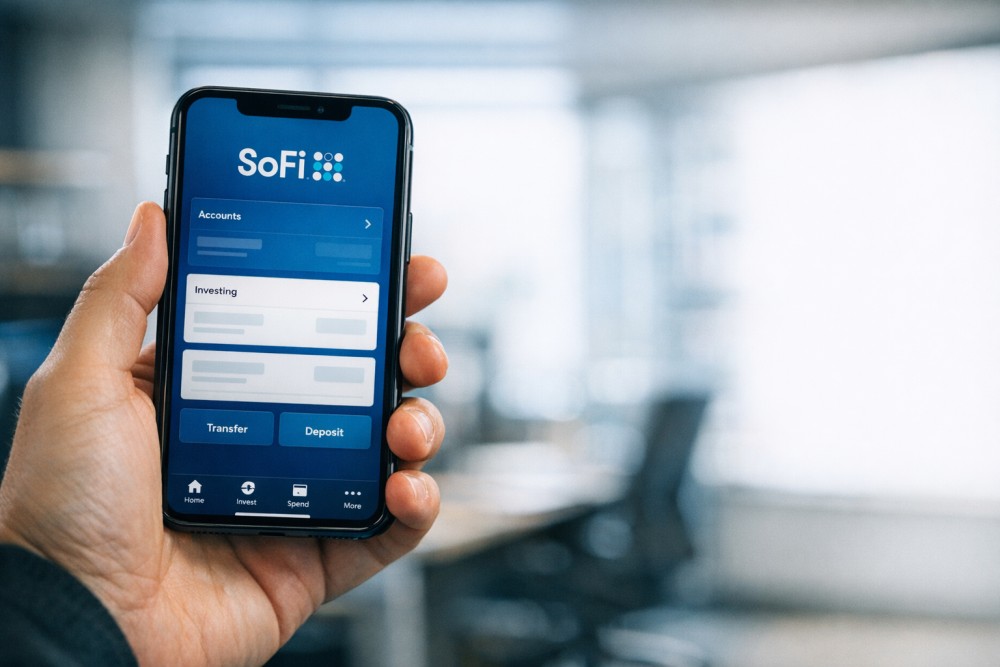
SOFI stock 2026 dropped 12 percent after Q1 results on April 29. Revenue still grew 41 percent year over year to a record US$1.1 billion.
The question across investor forums: buy the dip, or cut losses? This article breaks down the numbers and a decision framework you can use.
SoFi Q1 2026 Results: Revenue Up 41% but Stock Down
Headline Numbers That Beat Consensus
SoFi reported adjusted net revenue of US$1.1 billion in Q1 2026, up 41 percent year over year. That topped the Wall Street consensus of US$1.05 billion.
Net income jumped 134 percent to US$166.7 million. Loan originations hit a record US$12.2 billion across all categories.
A Market Reaction That Reversed Course
Despite the top-line beat, shares of SoFi (SOFI) closed down 15.4 percent at US$15.53. That was SOFI's largest single-day decline of 2026.
Year to date, SOFI is now down roughly 30 percent. The "sell on beat" pattern repeated again, echoing several earlier prints.
Markets often react to forward guidance, not to the quarter that just printed.
Sell-Off Drivers: Guidance and Technology Platform Revenue
Full-Year Guidance Disappointed
Management guided to 30 percent revenue growth and a 30 percent EBITDA margin for full-year 2026. Both landed below the bar analysts had set.
According to Motley Fool, the flat outlook was the main sell-off trigger despite the Q1 beat.
Galileo Lost a Major Client
Technology Platform (Galileo) revenue fell 27 percent to US$75.1 million. The driver: Chime fully exited the platform by end-2025.
For 2026, management is guiding Galileo revenue to about US$325 million. That used to be the segment carrying SoFi's growth narrative. Layer your SOFI position with discipline on Gotrade.
Member Growth 35% YoY, Is the Story Still Intact?
Record Members and Product Adds
SoFi added 1.1 million new members in Q1, total members now 14.7 million. That 35 percent YoY growth set a record for net member adds in a single quarter.
Total products reached 22.2 million, up 39 percent from 15.9 million. About 43 percent of new products came from existing members, a healthy cross-sell signal.
Lending Is Still the Engine
Management is targeting at least 30 percent growth in lending for 2026. Financial services is guided to grow at least 40 percent.
The member growth and product diversification thesis is still alive. Only one segment is weakening: technology platform.
Valuation: SOFI vs PYPL, AFRM, COIN
At US$15.53, SOFI sits in the middle of the US fintech peer group. A simple frame helps put the valuation in context.
Versus PayPal (PYPL), SoFi has a more aggressive growth profile but lacks PayPal's profit scale. PYPL trades like a mature fintech still hunting its next leg of growth.
Versus Affirm (AFRM), SoFi is already GAAP profitable while Affirm still works through BNPL margin pressure. Different models too: Affirm is point-of-sale, SoFi diversifies across lending and banking.
For more volatile exposure, Coinbase (COIN) tracks the crypto cycle, not loan growth. These three names are not apples-to-apples, but the model differences matter before you add to SOFI.
Per StockStory, current SOFI valuation is driven more by Galileo guidance sentiment than by member metrics. That makes the sell-off look larger than fundamentals suggest.
Buy the Dip vs Cut Loss Framework for Retail Investors
Three Questions Before Adding to Your Position
First, is your original thesis still intact. If you bought SOFI for member growth, the 35 percent YoY print strengthens that thesis.
Second, what percentage of your portfolio is SOFI now. If it is above 10 percent, do not add even at a better price.
Third, how long can you hold. Fintech stocks stay volatile until guidance sentiment turns, usually two to four quarters.
Layering Beats a Lump-Sum Buy
For retail investors, scaling in across tranches is more disciplined than buying everything at the "discount" price. The concept overlaps with dollar cost averaging.
Split your target size into three or four layers. If your target is US$100, deploy US$25 now and wait for price-action confirmation next quarter before deploying the rest.
Conclusion
SOFI stock 2026 sold off not because the business broke. Revenue grew 41 percent, members grew 35 percent, and net income more than doubled. The issue was a conservative full-year guide and Galileo weakness after Chime exited.
For holders, a 12 percent post-earnings drawdown is a discipline test, not an automatic cut-loss signal. If your thesis still holds, layered entries beat panic-selling below US$16.
You can start a SOFI position from US$1 per trade on Gotrade.
For a primer first, see how to invest in US stocks.
FAQ
Why did SOFI stock drop 12 percent if earnings beat?
Because full-year 2026 guidance for revenue growth and EBITDA margin landed below analyst expectations, and the Galileo segment fell 27 percent year over year.
Is SoFi member growth still healthy in Q1 2026?
Yes, SoFi added 1.1 million new members for a total of 14.7 million, up 35 percent YoY, with a record 1.8 million product additions.
Should I buy the dip on SOFI or cut loss now?
It depends on your original thesis, your position size, and your time horizon. If the thesis holds and the position is small, layered entries are more disciplined than extreme moves.
How can I start a SOFI position with a small budget?
On Gotrade you can buy fractional shares of SOFI starting from US$1, so you do not need to fund a full share to get started.