

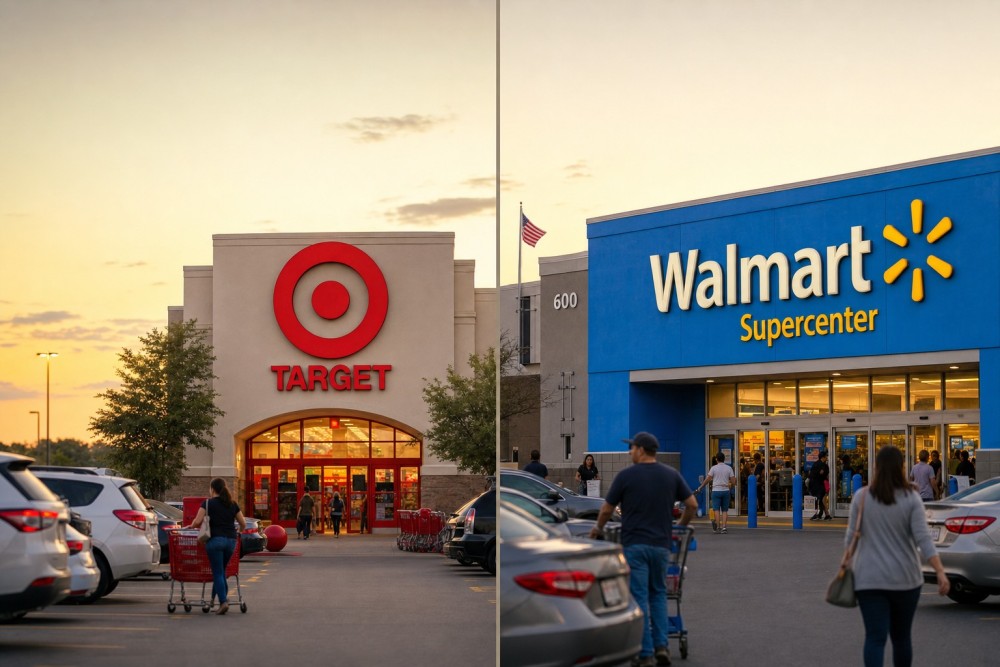
Target and Walmart both report on Thursday May 21, 2026. The same calendar, two very different consumer reads.
The setup is clean. WMT is the staples-tilted essentials machine. TGT is the discretionary-heavy department store wearing a big-box uniform.
That mix difference shapes how each name will trade into the print. It also shapes the cleanest way to express a view.
Why TGT Carries More Discretionary Exposure
Walmart's basket leans toward groceries, household essentials, and pharmacy. Target's basket leans toward apparel, home decor, beauty, and seasonal goods.
That single sentence is most of the divergence. Essentials are steadier through cycles. Discretionary categories swing harder when wallets tighten.
Category mix and basket sensitivity
Walmart's grocery-led mix gives it a defensive floor when consumers downtrade. Higher-income shoppers also keep migrating to Walmart for value.
Target's apparel and home categories carry higher gross margins but lower elasticity. When budgets compress, those baskets shrink first.
What the Thursday prints will signal
WMT reports Q1 FY27 before the open, guiding constant-currency sales of 3.5% to 4.5% and EPS of $0.63 to $0.65.
TGT prints the same day. Street is looking for roughly $1.41 EPS on $24.5 billion in revenue, with full-year guidance of just 2% sales growth and a 4.8% operating margin.
Margin and Inventory Health Compared
The margin gap between the two names has widened across 2024 and 2025. That trend is the engine behind the relative-value trade.
Walmart's flywheel is doing the heavy lifting. Advertising via Walmart Connect and data services tied to VIZIO grew roughly 37% in 2025, adding high-margin revenue that subsidizes low-margin retail.
Where Walmart's edge sits
WMT entered 2026 with leaner inventory and stronger sell-through. Operating leverage from membership, advertising, and marketplace is now structural, not cyclical.
That mix shift is why WMT trades at a premium multiple to the rest of staples retail. The valuation is rich, but the earnings power is real.
Where Target needs to defend
TGT's adjusted profitability compressed sharply through 2025. Analyst work over the past year flagged that Target may need to raise prices roughly twice as much as Walmart to offset tariff input costs.
That asymmetry matters because price hikes on discretionary goods kill unit demand faster than hikes on staples. Margin defense and traffic defense are in direct tension at Target in a way they are not at Walmart.
How to Express the Spread Cleanly With Equities or Options
The cleanest equity expression is long WMT against short TGT in roughly dollar-neutral size. This isolates the discretionary-versus-staples spread and strips out broad market beta.
Position the pair before the Thursday print only if you want to take earnings risk. Otherwise, wait for the print and size in on confirmation of the divergence theme.
Sizing and beta-neutral framing
WMT and TGT carry similar betas, so a 1-to-1 dollar pair is roughly market-neutral. A sleeve at 1% to 2% of portfolio per leg captures the spread without dominating P&L.
The thesis is patient, not a one-print trade. Size accordingly.
Options expressions for the print
The cleanest options play is a same-expiry call spread on WMT against a put spread on TGT. That defines risk on both legs around the earnings reaction.
For single-name expression, a WMT call spread beats outright calls. TGT put spreads work better than naked puts because implied volatility into the print is usually rich.
Risks: Promotional Cadence and Tariff Pass-Through
The pair trade is not riskless. Two specific risks can compress the spread or flip it temporarily.
First, Target can engineer a strong promotional quarter that beats lowered expectations. Discretionary retail comps off a weak base can deliver outsized upside surprises.
Promotional risk on Target
TGT has levers around private brand activation, store remodels, and price investment that can drive a beat-and-raise quarter. If management telegraphs better H2 traffic, the short leg gets squeezed.
That risk is why the pair trade is sized as a sleeve, not a concentration bet. The thesis is structural, but quarterly noise is real.
Tariff pass-through cuts both ways
If tariffs ease faster than expected, Target's higher discretionary mix benefits more on the way down. Walmart's essentials mix is less sensitive to that tailwind.
The opposite tail also matters. If tariffs escalate further, Walmart's scale and supplier leverage handle it better than Target's, widening the spread. Compare the dollar-store cohort like DLTR for a third reference point on how thin-margin retail absorbs input shocks.
Conclusion
Thursday's prints will not resolve the 2026 discretionary-versus-staples divide in one session. They mark the next data point in a trend that has been compounding for six quarters.
The pair trade is the cleanest expression. Long the winner, short the laggard, sized as a sleeve and held through the noise.
If you want exposure to either side, you can trade WMT and TGT as fractional shares on Gotrade. Build the spread in the size that fits your portfolio, not the size the headlines push you toward.
FAQ
When do Walmart and Target report Q1 results?
Both companies report on Thursday May 21, 2026. Walmart prints before the open with an earnings call that morning.
Why is the pair trade framed as discretionary versus staples?
Target's basket leans on apparel, home, and seasonal goods. Walmart's basket leans on groceries, essentials, and pharmacy. That mix difference drives most of the relative performance.
Does the trade still work if both names beat estimates?
Yes, the spread can widen even on a double beat if Walmart's margin commentary is stronger than Target's. The thesis is relative, not absolute.
What is the biggest risk to being short Target into the print?
A promotional reset paired with better H2 guidance can squeeze the short. Use defined-risk options or sleeve sizing to manage that scenario.