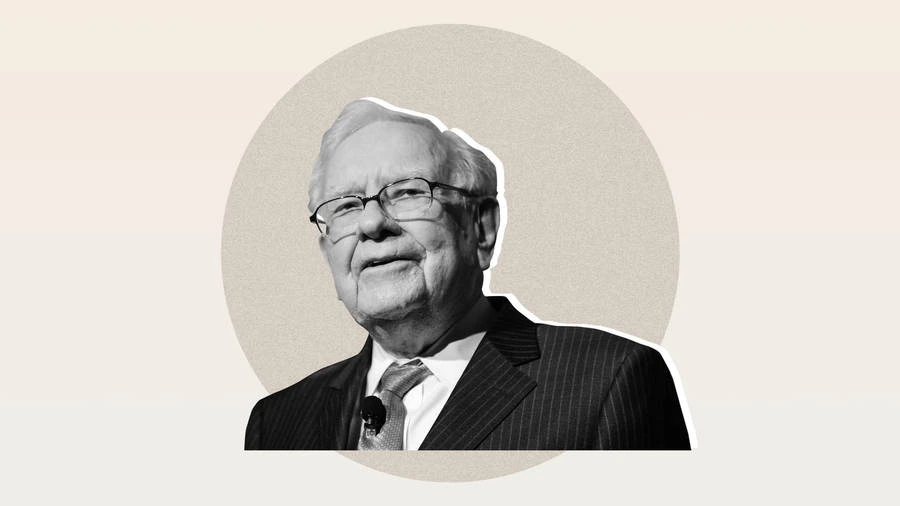
Warren Buffett has compounded Berkshire Hathaway's book value at roughly 20% annually for over five decades. That track record was not built on market timing or complex derivatives. It was built on principles rooted in business analysis, patience, and discipline that any investor can adapt regardless of portfolio size.
Buffett's Investment Philosophy
Buffett's approach begins with a foundational idea: stocks are not lottery tickets. They represent ownership stakes in real businesses. Every investment decision starts by evaluating the underlying company rather than predicting where the stock price will move next.
This philosophy was shaped by Benjamin Graham, who introduced the concept of intrinsic value: every business has a calculable worth based on its assets, earnings, and future cash flows. If the market price falls below intrinsic value, the stock offers a margin of safety.
Buffett evolved Graham's framework by incorporating qualitative factors. Where Graham focused on statistical cheapness, Buffett learned to pay fair prices for exceptional businesses rather than bargain prices for mediocre ones. This shift, influenced by partner Charlie Munger, moved him from pure deep-value toward quality-focused value investing.
Circle of Competence
One of Buffett's most practical principles is investing only within your circle of competence: areas where you genuinely understand how a business works, how it earns money, and what could disrupt it.
Defining your boundaries
Buffett has consistently avoided industries he does not understand. He famously stayed away from technology stocks for decades, not because they were bad investments, but because he could not predict which companies would dominate in ten years. Knowing what you do not know is more valuable than pretending to know everything.
Expanding gradually
The circle is not fixed. Buffett eventually invested in Apple after years of studying consumer behavior and brand loyalty. The key is expanding through genuine learning rather than chasing trends outside your knowledge base.
Why it matters for retail investors
Retail investors face the same temptation to chase unfamiliar sectors during hype cycles. Buffett's principle suggests building deep understanding in a few areas first, then making concentrated bets where your analysis gives you an edge.
Moat and Competitive Advantage
Buffett popularized the economic moat concept: a durable competitive advantage protecting profits from competitors over long periods.
Types of moats Buffett favors
Brand power allows companies like Coca-Cola to charge premiums based on consumer trust. Switching costs keep customers locked into platforms. Network effects make services more valuable as adoption grows. Cost advantages from scale let companies undercut competitors while maintaining margins.
Moat durability matters most
A moat eroding within five years offers limited protection. Buffett asks whether a company will still dominate its industry in 20 years. If uncertain, the moat may not be wide enough.
Moat versus trend
Many companies experience temporary advantages from market trends or first-mover positioning. Buffett distinguishes these from structural moats embedded in the business model. Riding a trend without lasting structural advantage is not a Buffett-style investment.
If you want to research competitive advantages across US stocks and build positions in companies with strong moats, the Gotrade app provides access to fractional shares and company fundamentals.
Buying Wonderful Companies
Buffett's most quoted principle: "It's far better to buy a wonderful company at a fair price than a fair company at a wonderful price."
What makes a company wonderful
Buffett looks for consistent earnings, high returns on equity, low debt, and management that allocates capital wisely. The debt-to-equity ratio and return on invested capital are among metrics he examines when assessing financial health.
Fair price, not cheap price
Unlike strict deep-value investors who only buy statistically cheap stocks, Buffett pays a reasonable multiple for quality. A wonderful business compounding at high rates is worth more than a struggling business below book value. The compounding effect of quality over decades outweighs short-term gains from buying cheaply.
Management quality
Buffett places significant weight on management integrity and capability. He looks for leaders who think like owners, allocate capital rationally, and communicate honestly with shareholders. He avoids companies where management compensation is misaligned with long-term shareholder interests.
Patience and Long-Term Thinking
Buffett has described his ideal holding period as "forever." While he does sell when circumstances change, the default is holding quality businesses through market cycles rather than trading around short-term volatility.
Compounding requires time
A business growing intrinsic value at 15% annually doubles in roughly five years and increases tenfold in about seventeen years. Selling early to capture short-term gains interrupts this compounding trajectory.
Market volatility as opportunity
Buffett views market downturns as buying opportunities rather than reasons to panic. His advice to "be fearful when others are greedy, and greedy when others are fearful" reflects a contrarian temperament rooted in conviction about intrinsic value.
Inactivity as a strategy
When no attractive opportunities exist, Buffett holds cash rather than forcing capital into mediocre investments. Discipline to wait is as important as discipline to act.
Conclusion
Buffett's investing principles form a coherent system: understand what you own, invest in businesses with durable advantages, pay fair prices for quality, and let compounding work over long timeframes. None of these ideas require advanced financial modeling. They require patience, intellectual honesty, and willingness to ignore market noise.
For investors building portfolios in US stocks and ETFs, these principles provide a timeless framework prioritizing business quality over market speculation.
If you want to start applying these principles with fractional shares in US stocks, the Gotrade app lets you invest from as little as $1.
FAQ
What is Warren Buffett's investing strategy?
Buffett uses a value investing approach focused on buying high-quality businesses with durable competitive advantages at fair prices and holding them for the long term.
What does circle of competence mean?
It means investing only in industries and businesses you genuinely understand, which helps you make better decisions and avoid costly mistakes in unfamiliar sectors.
Why does Buffett hold stocks for so long?
Long holding periods allow compounding to work. Selling quality businesses early interrupts the exponential growth of intrinsic value over decades.
References
- Investopedia, Warren Buffett’s Investment Strategy, 2026.
- Berkshire Hathaway, Annual Shareholder Letters, 2026.