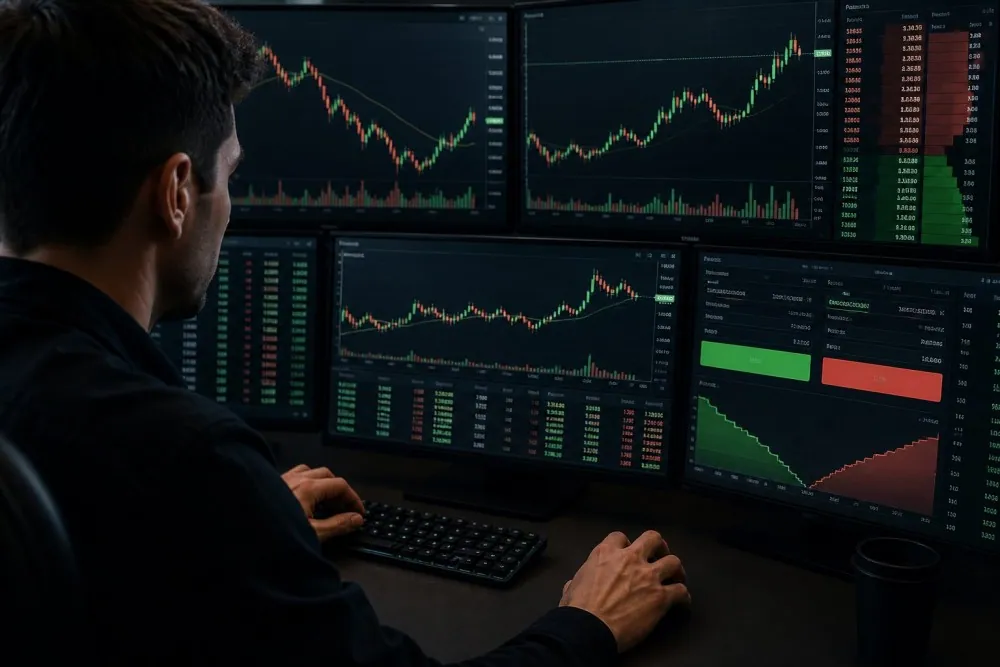
Scalping targets tiny price moves many times a day, held for seconds or minutes.
Transaction costs are the main obstacle, since every round trip pays a spread and fees.
FINRA scrapped the $25,000 pattern day trader rule effective June 4, 2026, and brokers have until October 20, 2027 to switch over (Regulatory Notice 26-10).
Scalping and long-term investing are different activities with very different odds.
Scalping is a strategy frequently chosen by advanced traders looking to capitalize on short-term price movements. Usually the profit target per trade is relatively small, it relies on the high frequency of trading so scalping has the potential to generate profit when executed with discipline and careful calculation.
However, scalping is not without risk. Before trying it, it is important to understand how it works, the analytical techniques involved, and the various challenges you might face.
This guide will cover those, then add other important things such as the new rules set by the US government and what the research actually shows about how scalpers and day traders perform.
Scalping is a short-term trading style built on frequent, tiny gains. A scalper tries to capture a fraction of a percent per trade, then repeats that many times in a session.
Scalping can be a full-time job. It demands fast execution, strict discipline and a working knowledge of order types, liquidity and short-term price action, which is why the risk is high. Usually scalper set stop-loss and take-profit levels before the session starts, so decisions under pressure are not made on emotion.
The logic is that small moves happen constantly, while large moves are rarer and harder to predict. The trade-off is that each gain is small. That makes costs and losses matter enormously, since a single oversized loss can wipe out the profit from many winning trades.
In markets, a scalper is a trader who holds positions for very short periods. Some work in minutes, others in seconds, opening and closing positions to capture small price differences. The word is also used outside markets, for someone who resells concert or sports tickets at a markup. This article covers only the trading meaning.
What a scalper's session looks like
A scalper focuses on the most liquid stocks during the busiest hours, usually around the open and the close. Spreads are narrowest then, and the order book refills quickly. Trade counts are high by design. Opening and closing several positions in the same stock within one session is normal.
That pace demands constant screen time. Prices are watched continuously, and decisions are made in rapid succession throughout the session..
Scalping as securities fraud
In US securities law, "scalping" has a second meaning that has nothing to do with fast-paced trading. It describes an adviser or promoter who buys a stock, recommends it, then sells into the price rise without disclosing that plan.
The US Supreme Court treated this undisclosed practice as a fraud on clients in SEC v. Capital Gains Research Bureau (1963). According to the SEC, eight social media influencers ran this pattern on Twitter and Discord, earning about $100 million in alleged fraudulent profits.
How Does Scalping Work?
A scalper enters when a short-term signal appears, sets a tight exit, and closes the position quickly whether it wins or loses. Three mechanics define the style; First, the target per trade is small, often a fraction of a percent. Second, the stop is tight, so a loss is cut before it grows. Third, the volume of trades is high, because each individual result is tiny.
That structure makes trading costs the central problem. The illustration below shows why.
Assumption (illustrative)
Value
Target gain per trade
0.10% of position
Round-trip cost: spread, fees, slippage
0.05% of position
Kept from a winning trade
0.05%
Trades per day
20
Cost drag per day
1.00% of traded value
Figures above are round numbers for illustration, not a forecast or a recommended setup. Here is an interactive simulation that you can use to get an idea of how scalping works:
Scalping cost and break-even calculator
A scalping example with Apple (AAPL)
Picture a scalper watching Apple (AAPL) in the first 30 minutes after the US open, when volume is heavy and spreads are tight. On a volume spike, they buy 100 shares at a hypothetical $230.00, targeting $230.25 with a stop at $229.90.
If the trade hits its target, the gross gain is $25, but spreads, fees and slippage take a share of it. If it stops out, the loss is $10 plus the same costs, and the scalper may repeat this cycle 20 times in one session.
What Is the Difference Between Scalping, Day Trading and Swing Trading?
All three are active trading styles. They differ in how long a position is held and how many trades it takes.
Feature
Scalping
Day trading
Swing trading
Holding period
Seconds to minutes
Minutes to hours, closed same day
Days to weeks
Trades per day
Often dozens
A few
Less than one
Target per trade
A fraction of a percent
Around 1% or more
Several percent
Overnight risk
None
None
Yes
Main enemy
Transaction costs
Transaction costs and timing
Adverse news between sessions
Scalping is day trading taken to its shortest extreme. Every day trading rule and risk applies, only compressed.
Long-term investing sits outside this table entirely. It holds positions for years and treats short-term moves as noise.
What Strategies Do Scalpers Use?
Four approaches cover most of what is described as scalping. None of them is a guaranteed method, and each depends heavily on execution speed and cost.
1. Spread capture
The oldest form buys at the bid and sells at the offer, earning the spread. It depends on being first in the queue at a given price. In today's markets this space is dominated by automated market makers. Retail traders are rarely competitive here.
2. Momentum scalping
The trader enters in the direction of a sharp short-term move and exits within minutes. Volume spikes and news releases are common triggers. The risk is that momentum reverses just as quickly, which is why exits are set in advance.
3. Range or mean reversion
When a price oscillates in a tight band, the trader buys near the bottom and sells near the top of that band. The approach stops working the moment the range breaks, and breaks tend to be fast.
4. News and event scalping
Economic releases and earnings create bursts of volatility. Some scalpers trade the first minutes of that reaction. Spreads usually widen at exactly these moments, so costs are highest when the moves are largest.
Do You Need $25,000 to Scalp US Stocks?
No, not since June 2026. The old day trader rule required $25,000 in equity once an account made four day trades in five business days. That requirement no longer exists.
FINRA replaced it with intraday margin standards. In Regulatory Notice 26-10, it adopted amendments to Rule 4210. These remove the day trade count, the pattern day trader designation and the $25,000 minimum equity requirement.
The amendments took effect on June 4, 2026, with firms allowed until October 20, 2027 to complete implementation. Not every broker changed on day one.
Item
Before June 2026
Now
Day trade counting
4 in 5 business days triggered the label
No trade counting
Minimum equity
$25,000 for flagged accounts
Standard margin account minimums apply
Basis for limits
Day trading buying power
Intraday margin against actual exposure
The old framework, in place since 2001, is described in the SEC's guidance on margin rules for day trading. Most scalping articles online still describe that version.
One point deserves emphasis. A rule being removed lowers a barrier to entry; it says nothing about whether the activity is likely to be profitable.
Does Scalping Actually Work?
For a small minority, yes. For most participants, the evidence says no, and it is remarkably consistent across markets.
A study of the Brazilian equity futures market tracked everyone who started day trading between 2013 and 2015. Among those who persisted for at least 300 days, 97% lost money. Only 0.4% of that persistent group earned more than a bank teller's salary, which the authors put at US$54 per day. The single best performer averaged US$310 per day, with a standard deviation of US$2,560.
The researchers also found no evidence of learning, traders did not become more profitable as they gained experience. Research on the Taiwanese market points the same way as Barber, Lee, Liu and Odean found that under 1% of day traders earned reliably positive returns after costs.
None of this proves scalping cannot work for anyone. It does mean the base rate is poor, and a plan that assumes you will be the exception needs a clear reason why.
What Are the Costs and Risks of Scalping?
Scalping concentrates every trading risk into a short window and multiplies it by trade frequency count which leads to more cost and risk.
Transaction costs
Spreads, commissions and slippage are paid on every round trip, whether the trade wins or loses. At dozens of trades a day, these small charges compound into the largest single obstacle to staying profitable.
Competition and speed
Short-term price gaps are the main target of automated trading systems that run on faster data feeds and lower latency. A retail trader on a normal internet connection is the slowest participant in that race, often entering after the gap has already closed.
Leverage
Scalpers often use margin to make small price moves big enough to be worth the trade. Leverage magnifies losses as much as gains, and a margin call can force a position to close at the worst possible moment.
Time and pressure
The style demands unbroken attention throughout market hours, leaving little room for other work or rest. Rapid decisions under constant pressure also tend to encourage overtrading, which pushes costs higher and makes losing streaks harder to stop.
Is Scalping Suitable for Beginners?
For most beginners, no. It combines the highest cost structure, the fastest decisions and the strongest professional competition in the market. If you still want to understand it, treat the first phase as study rather than income. Learn order types, measure your actual round-trip costs, and keep any position size small enough that a bad session changes nothing important.
A different question is worth asking first: what is the money for? Short-term trading and long-term investing are different activities with different odds. Investors who hold for years rely on business results rather than minute-by-minute moves. Understanding a company's revenue and earnings, or owning a broad market ETF, works on a completely different timescale.
Conclusion
If you are weighing scalping, work out your own round-trip cost first, then the win rate that cost implies. That single calculation tells you more than any indicator setup, and it explains why research from Brazil to Taiwan keeps finding the same result: most persistent day traders lose money, and the ones who don't rarely beat what a steady job pays.
Then decide honestly which timescale suits your money and your attention.
This content is for educational purposes only and is not investment advice or a recommendation to adopt any trading strategy. Trading carries risk, including the possible loss of principal, and short-term trading carries elevated risk.
Gotrade is the trading name of Gotrade Securities Inc., which is registered with and supervised by the Labuan Financial Services Authority (LFSA). This content is for educational purposes only and does not constitute financial advice. Always do your own research (DYOR) before investing.
Muhammad Zhafran Tsany is a digital market with over years of experience, covering personal finance content since 2024, including stock market basics and beginner investing strategy for Rankia Indonesia. He holds a Bachelor of Business in Digital Business from Universitas Pendidikan Indonesia.