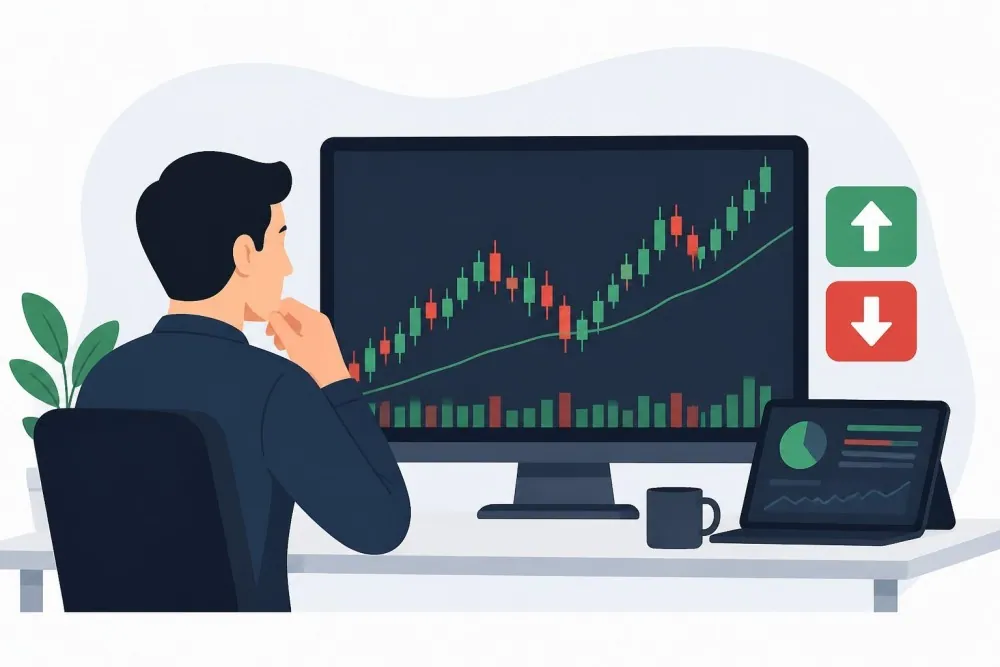
Trading means buying and selling assets such as stocks, with the aim of profiting from short-term price changes
Trading differs from investing, which focuses on long-term value
Trading means buying and selling financial assets, such as stocks, with the aim of profiting from price changes over a relatively short period. This differs from investing, which aims for long term growth in value. Investing may also aim to earn income along the way, like dividends from stocks or interest from bonds.
Definition of Trading in Financial Market
In finance and investment, trading means buying and selling securities such as stocks, bonds, index funds, commodities, and other assets with the intention of making profit from price changes. The word "trade", however, also means any exchange of goods in economics.
When trading financial assets, what happens is that a buyer and a seller agree on a price through a broker, on a specific exchange.
These are general differences between trading and investing. Remember that these are general consensus, not a hard rule. Every trade and investment carries its own risks.
Generally smaller, since fewer trades mean fewer fees
Can be large: fees, spreads and taxes on short-term gains accumulate
Typical risk profile
Conservative
Higher risk of fast losses, especially with leverage or short selling
There is no rule to determine whether trading or investing is the right option for you. Both carry the risk of losing money, and neither is right for everyone. It all depends on your time availability, commitment level, knowledge, and financial risk tolerance.
How a trade works
This is a simplified explanation on how trading works, assuming you already have a broker and an account.
A market order is a command you use to buy or sell right away at the best price available. Generally, you will be able to fill the order immediately, but you may not get the price that you want if it's moving fast. An example would be like: "Buy $100 of the stock right now".
A limit order is a command to buy or sell only at a specific price or better. A buy limit means you are only buying at the limit price or lower, and a sell limit means you only sell at the limit price or higher. You get control over the price, but the order may never fill. "Buy only if the price drops to $190 or lower". The downside is that if it never gets to the price you set, the trade will never happen.
A stop order (or often called a stop-loss) is an order you set to automatically execute when your stock drops to a certain point (stop price). This is designed to limit your losses when a price falls.
For example, you own a stock worth $200, and you set a sell stop order at $180. This means, whenever your stock drops to $180, it automatically opens a market order to sell. Note that in a fast-moving market, the price you receive can differ significantly from the stop price.
Example
This is an example, showing a US stock trade scenario. All figures below are hypothetical illustrations for educational purpose only, not a historical record, prediction, or recommendation.
Setup: Let's say you put $100 into a hypothetical US stock, "Stock X". Stock X has a current market price of $200.00, with a bid of $199.95 and an ask of $200.05.
When you buy, you pay the "ask" price, and when you sell you receive the "bid" price. The gap between them is the spread. Here the spread is $0.10, about 0.05% of the $200.00 midpoint.
Entry: You place a market buy order of $100 fills near the ask, $200.05, giving you about 0.4999 shares.
Profit target: You place a limit sell at $220.00.
Loss limit: You place a sell stop at $180.00.
Exit: Whichever price is reached first ends the trade, otherwise you hold the share.
Gain scenario
Loss scenario
Exit point
Price rises to $220.00, sold at $220.00
Price falls to $180.00, market sell triggered, fills at $179.90
Proceeds (0.4999 shares)
$109.98
$89.93
Result
+$9.98 (+9.98%)
-$10.07 (-10.07%)
Spread & slippage cost
-$0.02
-$0.07
Net
+$9.98
-$10.07
Net with $1 commission ($2 round trip)
+$7.98 (+7.98%)
-$12.07 (-12.07%)
The stop at $180 limited your loss in this example, but notice that it did not cap it at exactly $10, as the sale filled below the stop price, and fees widened the loss further. In real life, a stop loss can fill at even lower, if the price falls fast.
Trading Simulator
You can try simulating your own trade using this trade outcome simulator:
Trade outcome simulator
Market hours
Different markets operate at different market hours.
The NYSE core trading session runs from 9:30 a.m. to 4:00 p.m. Eastern Time (ET), while orders can be submitted from 6:30 a.m. ET and will queue until the opening auction. Some NYSE venues also run early and late trading sessions outside the core hours. Check with your broker on whether you can trade outside the core sessions. The NYSE markets also close on US market holidays, and daylight saving time also affects the schedule.
Markets in other places will have their own schedules, so make sure you know them in detail when considering to enter.
What you can trade
Stocks and ETFs
A stock is a small slice of ownership in a single company. Stock prices move with the companies’ results, news and investor expectations, and some stocks also pay dividends (cash) to its holders. Stocks trade on exchanges like the NYSE during market hours, as mentioned in previous example.
An ETF (exchange-traded fund) is a bundle of many assets, such as hundreds of stocks, bonds or commodities, that trades like a single stock. Many ETFs simply track an index, so one purchase spreads your money across many holdings. Note that ETFs charge a small annual fee (the expense ratio), and their market price can drift slightly from the value of individual assets inside them. ETFs use the same order types and market hours, just like stocks.
Forex
Forex (stands for foreign exchange) is the exchange of one currency for another, for example: EUR/USD. Forex trades run around the clock on weekdays, through a global network of banks and brokers.
Commodities
Commodities are raw goods like oil, gold and wheat, with prices driven by supply, demand, weather and geopolitics. Most individual traders are not holding the physical goods, but trading via futures, commodity-based ETFs, and others.
Crypto
Crypto assets such as Bitcoin and Ether are digital tokens that trade 24/7 on crypto platforms. The rules are different from stock and ETF exchanges, so check with your broker for this one.
Derivatives
Derivatives are contracts whose value depends on another asset. Most common examples are options and futures. Derivative trading is more complex than buying shares, and some can lose more than the amount you put in.
What is options trading?
Besides trading the stock itself, there is also a market to buy and sell the trading contracts. These contracts are called "options", which is one of the derivatives.
An option is a contract that gives the buyer the right, but not the obligation, to buy or sell a security at a fixed price within a specific period of time. When you trade options, you are buying and selling these contracts. Traders use options when they believe that a price will move in certain direction, or to hedge an existing position.
In options, the fixed price is called the strike price, and the price of the contract itself is the premium. There are two types:
Call: the right to buy at the strike price, buyer benefits if the stock rises.
Put: the right to sell at the strike price, buyer benefits if the stock falls.
Example of options trading
All figures below are hypothetical illustrations for educational purposes only, not a historical record, prediction or recommendation.
Say, stock A trades at $50. You buy one call option with a strike price of $55 that expires in one month. The premium is $1 per share, and one standard US equity option contract covers 100 shares, so you pay $100 for the contract. That $100 is the most you can lose as the buyer.
Your break-even at expiry is the strike plus the premium: $55 + $1 = $56. Here is what happens at expiry in three cases:
Stock A finishes at $60: your right to buy at $55 is worth $5 per share. Minus the $1 premium, that is +$4 per share, or +$400 on the contract.
Stock A finishes at $55.50: the option is worth $0.50 per share, less than the $1 you paid. You get back $50 of your $100 and a loss of $50.
Stock A finishes at $50 (or anywhere at or below $55): the option expires worthless and you lose the full premium, -$100.
Common trading styles, compared
Trading styles differ mainly in how long a position is held, how much attention it takes and how often you trade. The table below compares the four most common ones. None of them is a guarantee to profit, and each carries its own risks.
Going long means buying a stock in the hope that its price rises. It is the usual way people buy shares.
Going short means borrowing stocks through your broker, with the aim of selling it now at high price. Your goal is making profit by buying it back and returning it later at a lower price. A short seller profits if the price falls and loses if it rises.
Margin: borrowing from your broker
A margin account lets you borrow money from your broker, using the securities in your account as collateral, to buy more than your cash alone would allow. Short selling also takes place in a margin account and is subject to margin rules.
Borrowing magnifies both gains and losses. In this hypothetical example, you deposit $1,000, borrow $1,000 and buy $2,000 of stock. Interest and fees are left out.
Stock moves
Position worth
Your result on your $1,000
+10%
$2,200
+$200 (+20%)
-10%
$1,800
-$200 (-20%)
-60%
$800
-$1,200 (-120%): your whole deposit is gone, and you still owe $200
Notice how the last row shows that your losses on a margin account can be larger than the money you put in. In practice, a broker would usually act before that point, either by issuing a margin call that asks you to add money or by selling your positions, possibly without asking you first. Check with your broker to make sure you understand this mechanism.
The 2026 US rule change
In 2026, FINRA, the regulator that oversees US brokerage firms, replaced its old day trading margin rules. The new rules took effect on 4 June 2026, but brokers may phase them in until 20 October 2027, so your broker may still apply the old rules for now. Those rules included the "pattern day trader" label, based on counting how many day trades an account made, and a $25,000 minimum equity requirement. These are US broker-dealer rules, and other countries have their own. Each broker also sets its own policy, so check with your broker.
In the academic journal by Barber, Lee, Liu and Odean (2014, Journal of Financial Markets), it is shown that fewer than 1% of traders showed a consistent, dependable ability to earn above-benchmark returns after fees. This study covered day traders on the Taiwan Stock Exchange from 1992 to 2006.
In short, you should learn the basics, keep in mind the cost of every trade, and avoid being overconfident in beating the market.
How to start learning to trade responsibly
Know your risk tolerance
Every trade or investment carries risks of losses. Be honest about how much loss you could handle, both financially and emotionally. Keep your emergency savings and the money for rent, bills and other essentials out of trading.
Practice and start small
Brokers usually provide a free tool to simulate trading with fake money. Use it as a first step to understand how trading works. Once you think trading is right for you, then move to a very small, real money position. Fractional shares let you do this with a small amount, by buying a fraction of a share instead of a whole one. Check your broker's rules on this one.
Size each position and plan the exit before entering
Decide how much you are willing to lose on a trade before you place it. A common rule of thumb is to put a small fixed percentage limit of your trading money, such as 1%. For example: with a $1,000 trading account and a 1% limit, you accept losing about $10 on a trade.
Keep a trading journal
Keep a trading journal to see patterns in your own behavior, and improve your decision making skill. Logging results after fees also keeps you honest, which prevents you from becoming overconfident.
Here is an example of trading journal:
Date
Asset
Direction
Reason
Result
2026-10-14
Stock ABC
Buy (long), 2 shares at $50
Bounce off support; stop $45, target $60
-$12.00 after $2 in fees (stop hit, filled at $45)
Conclusion
Trading is buying and selling assets, aiming to make profit from price changes, over a relatively short period. This differs from investing, which aims for long term growth. There are different trading styles, from scalping, day trading, to position trading, each with its own main risks. One long-running study of day traders in Taiwan found that fewer than 1% could earn profits consistently, after fees. Beginners should learn the basics, practice with demo account, and start small.
Gotrade is the trading name of Gotrade Securities Inc., which is registered with and supervised by the Labuan Financial Services Authority (LFSA). This content is for educational purposes only and does not constitute financial advice. Always do your own research (DYOR) before investing.
Sindhu Partomo is a copywriter and content writer with 8+ years of experience in agencies, B2B, and SaaS. He has been writing about business and finance since 2023, and holds a bachelor degree from University of Indonesia.
Hendrie Saputra holds a Master of Business Administration (MBA) with a concentration in Business Risk & Finance, along with professional experience in finance, marketing, and project management. He is experienced in analyzing market data and developing research-driven business strategies.