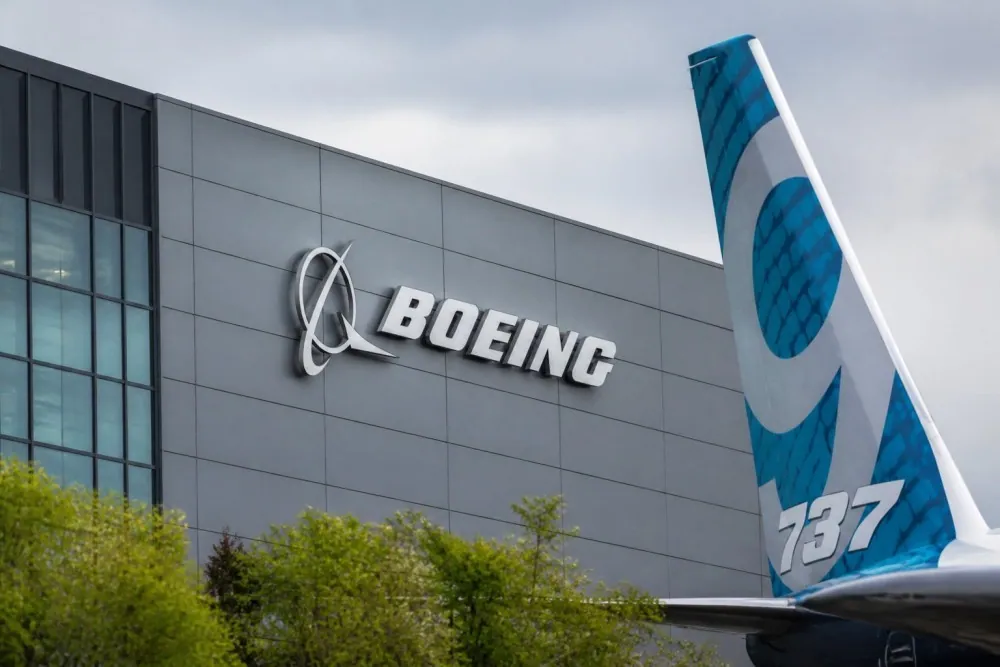
Boeing (BA) is the largest US commercial jet maker, and as of the October 20, 2026 close it traded at 1.60 times sales, according to StockAnalysis, below RTX (2.71) and GE Aerospace (5.89), while its core earnings are still negative.
A central question in any Boeing stock analysis is whether rising deliveries turn into steady, positive free cash flow.
Boeing (BA) Company Snapshot: Jets, Defense and Aftermarket Services
Boeing designs and builds commercial airplanes, military aircraft and space systems, and runs an aftermarket services business. It reports three segments: Commercial Airplanes (BCA), Defense, Space & Security (BDS) and Global Services (BGS).
According to Boeing's second-quarter 2026 results filed with the SEC, BCA generated $11.75 billion of the quarter's $24.56 billion revenue, BDS contributed $7.48 billion and BGS $5.34 billion.
Shares of Boeing (NYSE: BA) closed at $190.47 on October 20, 2026, for a market capitalization of about $150.54 billion, per StockAnalysis. The same data shows the stock down 10.55% over the past 52 weeks, with a five-year beta of 1.26, meaning it has historically moved more than the broad market.
BA is a large-cap industrial tied to two demand engines: airline fleet orders and US defense budgets. Because its reported earnings are close to zero, the stock tends to be judged on operating milestones such as production rates, aircraft certifications and cash generation rather than on a conventional earnings multiple.
Demand is not the constraint. Per the same SEC filing, Boeing's total backlog reached a record $715.3 billion ($715,261 million) at June 30, 2026, up from $682.2 billion at the end of 2025, and the Commercial Airplanes backlog of $596.7 billion includes more than 6,200 airplanes.
Boeing Financials Trend: Revenue Up 34% in 2025, Core Loss Narrowing in 2026
The table below combines full-year figures from Boeing's fourth-quarter 2025 results release with half-year and quarterly figures from the second-quarter 2026 SEC filing. Figures in US dollars; negative values in parentheses.
| Period | Revenue | GAAP net income (loss) | Core EPS (non-GAAP) | Free cash flow (non-GAAP) | Commercial deliveries |
|---|
| FY 2024 | $66.52B | ($11.83B) | ($20.38) | ($14.31B) | 348 |
| FY 2025 | $89.46B | $2.24B | $1.19 | ($1.88B) | 600 |
| H1 2025 | $42.25B | ($0.64B) | ($1.73) | ($2.49B) | 280 |
| H1 2026 | $46.78B | ($0.44B) | ($0.97) | ($0.82B) | 314 |
| Q2 2026 | $24.56B | ($0.43B) | ($0.76) | $0.63B | 171 |
The direction is clearly better. According to the fourth-quarter release, revenue rose 34% to $89.46 billion in 2025 as commercial deliveries climbed to 600 from 348.
The 2025 profit needs context, though: the same release shows a $9.6 billion gain on the sale of the Digital Aviation Solutions business, which added $11.83 to fourth-quarter earnings per share. That gain is larger than the full-year net income of $2.24 billion, so without it 2025 would have been a loss year.
In 2026, per the SEC filing, first-half revenue grew 11% to $46.78 billion and the core loss per share narrowed to $0.97 from $1.73.
The second quarter was the first in this table with positive free cash flow, at $631 million versus a $200 million outflow a year earlier, although first-half free cash flow was still an outflow of $823 million.
As reported by Investing.com from the earnings call, second-quarter revenue beat the $23.95 billion analyst estimate, while the core loss of $0.76 per share was wider than the expected $0.29 loss.
| Segment (Q2 2026) | Revenue | Change vs Q2 2025 | Operating margin Q2 2026 | Operating margin Q2 2025 |
|---|
| Commercial Airplanes (BCA) | $11.75B | +8% | (2.7)% | (5.1)% |
| Defense, Space & Security (BDS) | $7.48B | +13% | (0.2)% | 1.7% |
| Global Services (BGS) | $5.34B | +1% | 18.1% | 19.9% |
The segment split, taken from the same SEC filing, shows where the problem sits. BCA, the largest segment, is still operating at a loss even as its margin improves.
BDS slipped below break-even in the quarter; per Airways Magazine, it absorbed $280 million of losses on the VC-25B presidential aircraft program. BGS remains the profit anchor at an 18.1% margin.
The most recent operating data point is deliveries. Per Boeing's third-quarter deliveries release, the company delivered 161 commercial airplanes in the third quarter of 2026 (124 737s, 22 787s, 10 767s and five 777s), bringing the nine-month total to 475.
Boeing notes that delivery information is not final until quarterly results are issued, and Boeing has scheduled its third-quarter results for October 27, 2026, with a conference call at 10:30 a.m. ET.
BA Valuation vs GE Aerospace and RTX: Sales Multiples, Earnings Multiples and Cash Flow
To frame Boeing's valuation against the aerospace sector, the table compares it with two large US aerospace companies, GE Aerospace and RTX. All figures are as of the October 20, 2026 close, per StockAnalysis data for Boeing, GE Aerospace and RTX.
| Metric | Boeing (BA) | GE Aerospace (GE) | RTX (RTX) |
|---|
| Share price (Oct 20, 2026 close) | $190.47 | $299.87 | $193.34 |
| Market cap | $150.54B | $309.87B | $260.58B |
| Revenue (TTM) | $94.00B | $52.58B | $95.99B |
| Trailing P/E | 71.03 | 34.20 | 31.43 |
| Forward P/E | 215.85 | 33.82 | 25.10 |
| Price/Sales | 1.60 | 5.89 | 2.71 |
| Price/Book | 24.69 | 17.68 | 3.78 |
| EV/Sales | 1.91 | 6.09 | 3.02 |
| EV/EBITDA | n/a (negative TTM EBITDA) | 27.50 | 17.38 |
| Free cash flow (TTM) | ($0.21B) | $8.02B | $9.50B |
The two readings point in opposite directions. On earnings, the multiples are not yet meaningful: the trailing P/E of 71.03 is built on twelve-month net income of $2.09 billion that still contains the one-off Digital Aviation Solutions gain, StockAnalysis shows trailing EBITDA of negative $2.90 billion, and a forward P/E of 215.85 implies analysts expect earnings close to break-even over the next year.
On revenue multiples, Boeing sits below both peers. It generates almost the same trailing revenue as RTX ($94.00 billion versus $95.99 billion) yet carries a market value about $110 billion lower, and its EV/Sales of 1.91 compares with 3.02 for RTX and 6.09 for GE Aerospace.
The table also shows a cash flow gap: over the trailing twelve months, RTX generated $9.50 billion of free cash flow and GE Aerospace $8.02 billion, while Boeing's was negative $0.21 billion, per StockAnalysis.
Per the Investing.com earnings call coverage, management reaffirmed 2026 free cash flow guidance of $1 billion to $3 billion and called its long-term target of $10 billion in annual free cash flow "very attainable."
Even the top of the 2026 range equals roughly 2% of Boeing's current market value. This article does not estimate a fair value.
The balance sheet is improving but remains heavy. According to the SEC filing, Boeing held $20.0 billion of cash and marketable securities and $45.9 billion of consolidated debt at June 30, 2026, compared with $29.4 billion and $54.1 billion at the end of 2025, as reported in the fourth-quarter release.
The high price-to-book ratio of 24.69 reflects a small book equity base relative to that debt. Whether earnings or sales multiples matter more depends on whether Commercial Airplanes margins turn positive.
Boeing Bull Thesis: Record $715 Billion Backlog and a Completed 737 MAX Family
The case that Boeing's fundamentals can keep improving rests on several evidence-backed points:
- Demand is in the order book. The record $715.3 billion backlog, including more than 6,200 commercial airplanes, gives Boeing years of production to deliver, per its SEC filing.
- Deliveries are at multi-year highs. Per Investing.com, the 171 commercial deliveries in the second quarter of 2026 were the highest quarterly total since 2018, and nine-month deliveries reached 475, according to Boeing.
- Production rates are rising with regulator support. As reported by AeroTime, the FAA lifted the 38-per-month 737 cap in October 2025, and in May 2026 CEO Kelly Ortberg said Boeing had "passed a capstone review for rate 47," while FAA Administrator Bryan Bedford said the agency was "absolutely comfortable with 42 to 47." On the July earnings call, as reported by Investing.com, management said the next rate break to 52 per month was planned for later this year.
- The 737 MAX family is now complete. According to Boeing via PR Newswire, the FAA certified the 737-10 on October 20, 2026, after certifying the 737-7 earlier in the year. The 737-10 has 1,555 orders from more than 30 customers, over 30% of the 737 MAX order book, and Boeing says deliveries can begin "in the coming months."
- Cash flow has turned positive at the quarterly level. Second-quarter free cash flow of $631 million and reaffirmed 2026 guidance of $1 billion to $3 billion, per the SEC filing and the earnings call, mark a shift from the $14.31 billion outflow in 2024.
- Debt is coming down and a strike was avoided. Consolidated debt fell from $54.1 billion to $45.9 billion in six months, and per SPEEA, the union's professional and technical units ratified four-year contracts with Boeing on October 1, 2026, by 67.62% and 53.48% respectively.
Boeing Bear Thesis: Core Losses, Negative Trailing Cash Flow and Fixed-Price Charges
The case that the stock's recovery story is already stretched rests on equally concrete evidence:
- The core business still loses money. Per the SEC filing, Boeing posted a first-half 2026 core loss of $0.97 per share and a GAAP net loss of $435 million, and Commercial Airplanes ran at a negative 2.7% operating margin in the second quarter.
- Recent profits leaned on an asset sale. The $2.24 billion of 2025 net income included a $9.6 billion gain on the Digital Aviation Solutions sale, per the fourth-quarter release, so the trailing P/E of 71.03 overstates recurring earnings power.
- Cash generation is not yet consistent. StockAnalysis shows trailing free cash flow of negative $210 million, first-half 2026 free cash flow was an $823 million outflow, and per Investing.com, a roughly $700 million Department of Justice payment was expected in the third quarter.
- Fixed-price programs keep producing charges. The $280 million VC-25B charge in the second quarter left the program in a reach-forward loss position, per the earnings call, with first delivery expected in 2028, according to the SEC filing.
- The market has already been skeptical. Per StockAnalysis, the stock is down 10.55% over 52 weeks, and with a forward P/E of 215.85, there is little earnings support if the recovery slows.
Key Risks for Boeing Stock: Production Ramp, Supply Chain and Certification
Beyond the bear thesis, several concrete risks could change the picture:
- Execution at higher rates. Per Investing.com, Ortberg said he saw no supply chain constraints for rate 52 but warned, "I think it's going to get harder as we go from 52 to 57." On the same call, Boeing said it expected about 500 737 deliveries in 2026; it had delivered 367 through September, per its third-quarter deliveries release.
- 787 supply chain. According to Boeing's first-quarter 2026 SEC filing, the 787 program was stabilizing production at eight per month. On the second-quarter call, Ortberg said engine deliveries had "fallen behind" in the first half and that Boeing was working with GE on a recovery plan, while seat certifications were expected to weigh on deliveries for the rest of the year. Boeing targeted 90 to 100 787 deliveries in 2026, per Investing.com, and had delivered 62 through September, according to Boeing.
- Certification timing. The SEC filing anticipates first delivery of the 777X in 2027. Per the earnings call, more than 55% of 777X certification flight testing was complete as of July; any slip would push out revenue from that program.
- Regulatory oversight. AeroTime notes that the 737 production cap was introduced in early 2024 after the Alaska Airlines Flight 1282 incident, and each rate step since has followed FAA review. A new quality issue could slow or reverse that progress.
- Defense contract exposure. Fixed-price development programs such as VC-25B can generate further charges if costs rise, as the second-quarter results showed.
- Leverage. With $45.9 billion of consolidated debt at June 30, 2026, per the SEC filing, Boeing depends on cash flow improving to keep reducing debt without new financing.
- Near-term event risk. Third-quarter results on October 27, 2026 will bring final delivery figures and a discussion of the company outlook, according to Boeing, and the release could move the stock sharply in either direction.
This article is for education and information only and is not investment advice. Investment decisions are your own after doing your own research.
Sources