

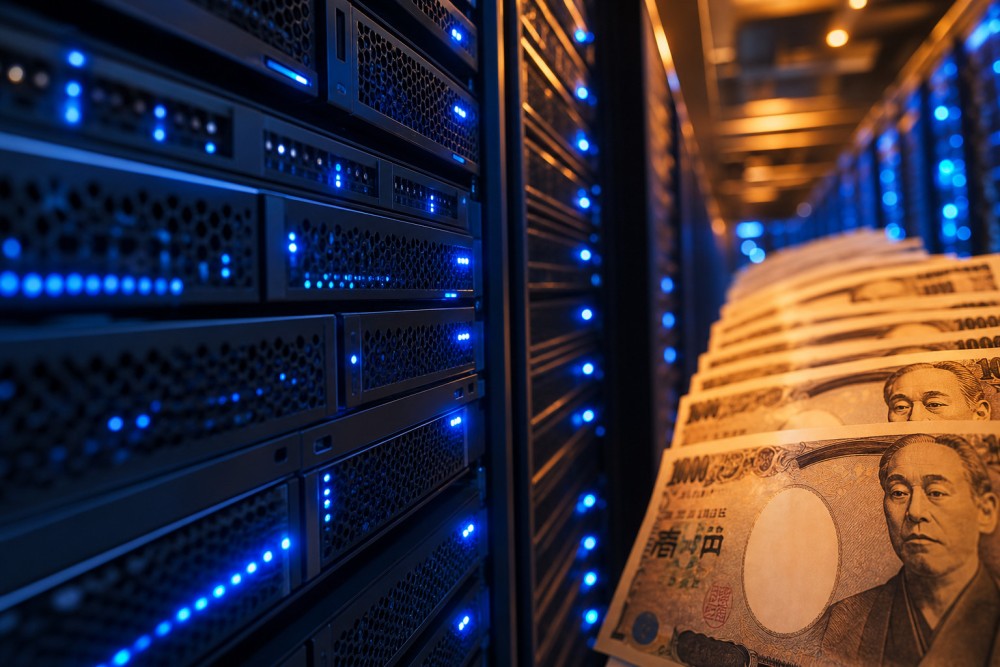
Gotrade News - Alphabet priced a record $3.6 billion foreign-issuer yen bond to fund AI infrastructure, signaling deepening capex. HSBC upgraded Cisco to Buy on AI infrastructure spending momentum, reinforcing the picks-and-shovels thesis.
The moves underscore how mega-cap balance sheets and credit markets are bankrolling AI buildouts. Investors view the wave as durable demand for networking, compute, and model providers.
Key Takeaways
- Alphabet's record $3.6B yen bond funds an accelerating AI infrastructure roadmap.
- HSBC's Cisco upgrade frames networking as a core AI capex beneficiary.
- Anthropic's $30B raise at $900B valuation signals robust private AI demand.
Capex Engines And Credit Markets
According to Quartz, Alphabet sold $3.6 billion in yen bonds, breaking the foreign-issuer record. The proceeds will fund data center, chip, and model training spending across its AI stack.
The deal taps cheaper Japanese funding to defray a multi-year capex ramp. It also signals that AI investment cycles are extending beyond domestic dollar issuance.
As reported by Investing.com, HSBC lifted Cisco to Buy citing AI infrastructure momentum. Analysts flagged accelerating orders for networking gear tied to hyperscaler buildouts.
Cisco's silicon and Ethernet roadmap positions it as a counterweight to incumbents inside AI clusters. The upgrade hints at broadening beneficiaries beyond GPU leaders.
Private AI And Software Pull-Through
Per Quartz, Anthropic is closing in on a $30 billion raise at a roughly $900 billion valuation. The report notes the round would value Anthropic above OpenAI, cementing its frontier-lab status.
That capital underwrites further training runs and enterprise distribution. It also reinforces compute demand flowing to Nvidia and cloud partners.
According to Quartz, Figma's stock surged after AI usage fees lifted its revenue forecast. The print is an early proof point that AI features convert into measurable software revenue.
That pull-through matters because AI capex needs revenue validation to stay durable. Software monetization narrows the gap between training spend and end-user value.
As reported by Bloomberg Opinion, productivity workflows still anchor enterprise adoption today. The piece argues input devices and software UX remain decisive for AI rollouts.
That nuance favors platforms that bundle AI into existing workflows. It also tempers expectations of a clean replacement cycle for human input layers.
The combined signals frame current AI spending as a multi-year picks-and-shovels cycle. Networking, hyperscaler debt, and model labs each capture a distinct slice of capex.
Investors should watch issuance windows, analyst upgrades, and private valuations as leading indicators. Together they map where capital is rotating across the AI stack.
Sources
- HSBC lifts Cisco to Buy on AI infrastructure momentum (Investing.com)
- Alphabet broke the foreign yen bond record with a $3.6B sale to fund AI (Quartz)
- Anthropic is closing in on a $30B raise that would make it more valuable than OpenAI (Quartz)
- Figma's stock surges after AI usage fees drive a bigger revenue forecast (Quartz)
- Don't Throw Out the Keyboard in the AI Revolution (Bloomberg Opinion)