

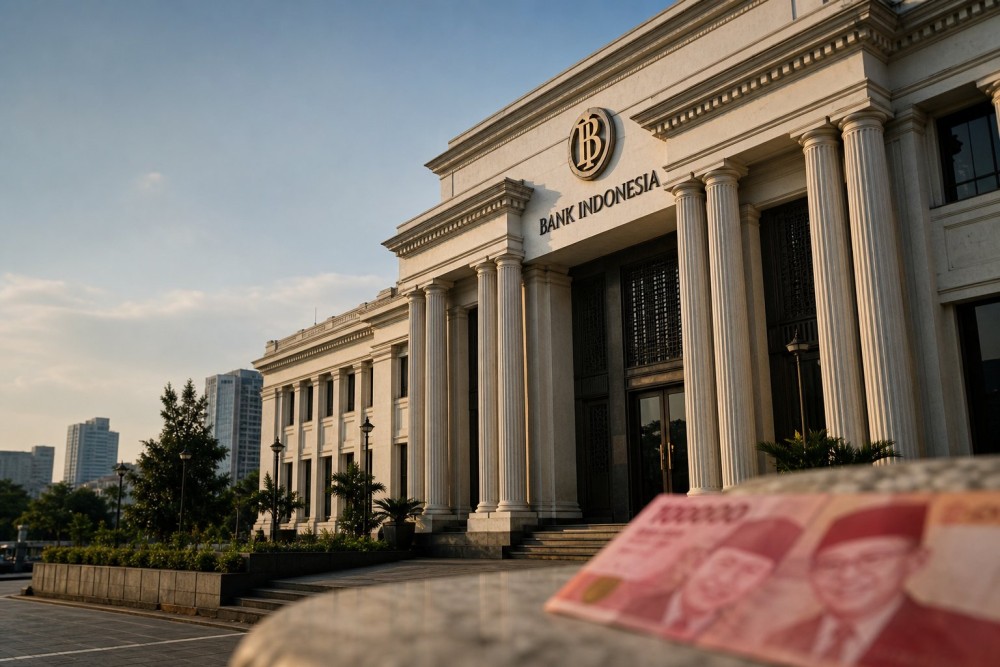
Gotrade News - Bank Indonesia raised its benchmark BI Rate by 50 basis points to 5.25% on May 20, 2026. The move marks the central bank's latest defense of a weakening rupiah amid intensifying global volatility.
The decision matched market consensus and follows pressure from Middle East conflict-driven dollar strength. Tighter Indonesian policy lifts emerging-market yields and reinforces the safe-haven bid lifting US Treasuries and the dollar.
Key Takeaways
- BI Rate now sits at 5.25% after a 50 bps hike on May 20, 2026.
- Governor Perry Warjiyo cited rupiah stabilization and inflation anchoring as primary drivers.
- Higher EM rates support dollar strength and lift demand for US Treasuries among global allocators.
What Triggered the Hike
According to Bloomberg Technoz, BI's board of governors approved the hike during its May 19-20 meeting in Jakarta. Deposit facility rates rose to 4.25% and lending facility rates to 6%.
Governor Perry Warjiyo said the move responded directly to rupiah weakness driven by Middle East war risk. He reiterated the 2026 and 2027 inflation target at 2.5%, plus or minus 1 percentage point.
As reported by Kumparan, the rupiah had recently tested levels near 17,700 against the dollar. The hike aims to restore yield differentials that had narrowed sharply against US rates.
Per Kompas, BI framed the decision as a pre-emptive stabilization measure. Officials emphasized monetary policy alone cannot fully offset external shocks.
Risk to US Equities
Indonesia is Southeast Asia's largest economy and a bellwether for emerging-market sentiment. When EM central banks tighten defensively, capital often rotates toward US dollar assets and safe-haven Treasuries.
A stronger dollar typically pressures US multinationals with significant overseas revenue exposure. Large-cap banks with EM trading desks may benefit from elevated volatility and widening cross-border spreads.
Payment networks like Visa (V) and Mastercard (MA) face mixed effects from EM currency moves. Stronger dollar earnings translate poorly, but cross-border transaction volumes often rise during currency stress.
US money-center banks such as JPMorgan Chase (JPM) earn meaningful fees from EM FX and rates trading. Defensive EM rate hikes typically widen client hedging demand across institutional desks.
The iShares 20+ Year Treasury Bond ETF (TLT) often catches inflows when EM stress accelerates. Global allocators rotate into long-duration US debt as a hedge against further EM currency depreciation.
Indonesian equity outflows have historically correlated with broader EM-wide de-risking episodes. US small-caps with EM supply-chain exposure may face mild pressure from a stronger dollar regime.
The hike also tightens financial conditions for Indonesian corporates with dollar-denominated debt. That dynamic feeds back into global credit spreads, indirectly affecting US high-yield markets.
Investors will monitor whether other Asian central banks follow BI's lead. A coordinated EM tightening cycle would amplify dollar strength and reshape global equity flows materially.
Sources
- BI Rate Rises to 5.25 Percent in May 2026 (Kumparan)
- BI Rate Rises to 5.25 Percent to Strengthen Rupiah (Kompas)
- BI Raises Rate to 5.25 Percent, Cites Rupiah as Primary Focus (Kabar Bursa)
- BI Hikes Benchmark Rate 50 bps to 5.25% in May 2026 (Tirto)
- Central Bank Raises BI Rate 50 bps to 5.25% (Bloomberg Technoz)
- Bank Indonesia Raises BI Rate to 5.25 Percent (Liputan6)