Gotrade News - China's private RatingDog factory PMI eased to 52.0 in October from 52.1 as export orders cooled, Reuters reported, while the official gauge fell to 49.3, into contraction. Regulators weigh fresh stock support after a record 12-week CSI 300 slide, a backdrop for the iShares China Large-Cap ETF (FXI).
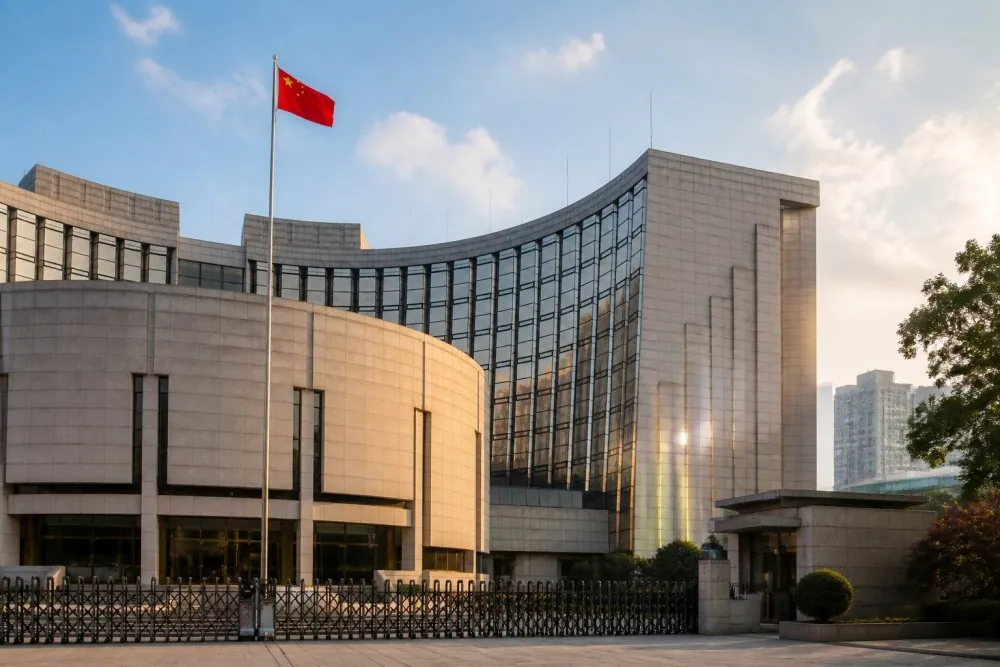
On the policy side, the People's Bank of China said it would run overnight reverse repo operations every working day from Monday, Nov. 2, at a rate of 1.25%, below the 1.4% seven-day reverse repo rate, according to a Reuters report carried by The Standard. The step moves the overnight rate toward becoming the central bank's main policy anchor.
RatingDog PMI at 52.0 Beats 51.6 Forecast as Export Orders Cool
According to Reuters, the RatingDog China General Manufacturing PMI, compiled by S&P Global, came in at 52.0, above the 51.6 median in a Reuters poll. The new orders index slipped to 53.3 from 53.4, and export order growth slowed to a three-month low. Output, by contrast, rose at its fastest pace in six months.
Pricing was the weak spot. Output prices fell after rising in September as competition pushed firms to cut prices, and export prices declined for the first time since November 2025, per Reuters. Business confidence stayed positive but slipped to a nine-month low, with some firms citing high input prices and stiffer competition.
As reported by investingLive, October marked the survey's 11th straight month above the 50 expansion line, the longest such run since mid-2021. The survey covers about 650 manufacturers and leans toward export-oriented firms.
Official Manufacturing PMI Falls to 49.3, Back in Contraction
The National Bureau of Statistics (NBS) gauge, released on Saturday, dropped to 49.3 from 50.1 in September, according to China Daily. The production subindex fell to 49.8 from 51.7 and new orders fell to 49.4 from 50.5, while high-tech manufacturing held in expansion at 51.3.
NBS statistician Huo Lihui attributed the weaker reading partly to demand pulled forward before the National Day holiday and an unstable global backdrop, China Daily reported. Activity outside factories also softened, with the non-manufacturing PMI at 49.7 from 50.2.
The table below sets the October readings against September, using the figures Reuters reported for the RatingDog survey and China Daily reported for the NBS survey.
| Gauge | Survey | October | September |
|---|
| Manufacturing PMI | RatingDog | 52.0 | 52.1 |
| New orders | RatingDog | 53.3 | 53.4 |
| Manufacturing PMI | NBS | 49.3 | 50.1 |
| New orders | NBS | 49.4 | 50.5 |
| Non-manufacturing PMI | NBS | 49.7 | 50.2 |
| Composite PMI | NBS | 49.7 | 50.7 |
CSI 300 Slides 8.5% in October as Beijing Weighs Stock Support
The People's Bank of China is set to meet the National Financial Regulatory Administration, the China Securities Regulatory Commission and major banks on Monday, according to investingLive, citing a Sunday report by Cailian that quoted industry people. The agenda is reported to be improving a relending programme that funds share buybacks and stake increases, under which companies and major shareholders borrow from banks backed by central bank funding to buy shares.
The 21st Century Business Herald reported that some securities firms and funds had been notified, investingLive said, though there has been no official confirmation of the agenda or of any planned measures. The CSI 300 fell 8.5% in October and entered a bear market, its record 12th straight weekly decline and its worst month in more than a decade, per the same report.
Measures announced in October did not stop the losses, with weak domestic growth and doubts over AI earnings weighing on investors, investingLive reported. In its view, only a meaningful expansion of the relending programme would signal real firepower, while a credible package could ease pressure on the yuan and support Asian risk appetite.
For investors in US-listed securities, China equity exposure is commonly held through funds such as the iShares MSCI China ETF (MCHI) and through US-listed shares of Chinese companies such as Alibaba (BABA).
FXI, MCHI and BABA Market Data
| Ticker | Close | Daily change |
|---|
| FXI | $33.08 | +1.19% |
| MCHI | $49.07 | +0.22% |
| BABA | $98.04 | -1.51% |
Regular-session close on October 30, 2026, New York time. Prices and changes: Yahoo Finance, cross-checked against the closing price on Nasdaq.com.
PBOC Makes the 1.25% Overnight Rate Its Policy Anchor
Per The Standard, carrying Reuters, the daily overnight operations are fixed-rate, quantity-based tenders, and the 1.25% operating rate was disclosed for the first time. The seven-day reverse repo shifts to a fixed-quantity tender with multiple winning bid rates, run mainly around tax payment periods and month-ends.
Other tools, such as temporary repo and reverse repo operations, will be priced at a spread to the overnight rate, with spread sizes unchanged, the report said. PBOC Governor Pan Gongsheng said earlier in October that the bank was studying a switch of its main policy rate to the overnight reverse repo rate.
Zhou Hao, chief economist at Guotai Junan International, described the move this way, according to the report:
"The clearest signal yet that the PBOC is moving toward an overnight-rate-based operating system."
Ming Ming, chief economist at Citic Securities, said the reform of the short-end mechanism lays groundwork for diversifying the benchmarks for loan rates and for passing broad interest rate declines through to the economy, The Standard reported.
This article is for education and information only and is not investment advice. Investment decisions are yours to make after your own research.
Sources