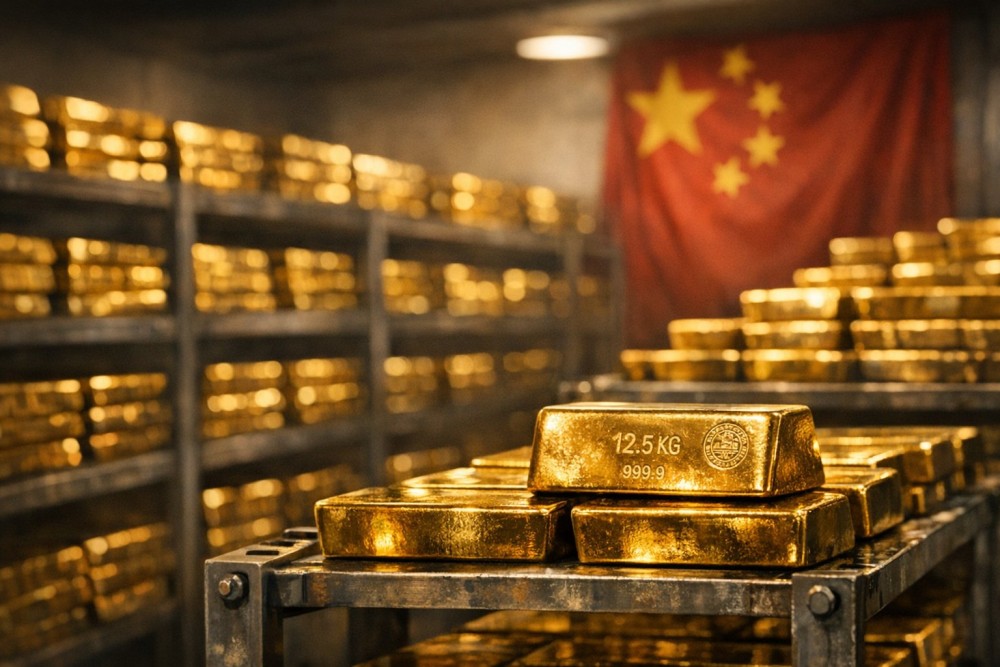
China's central bank bought gold for 17 consecutive months, pushing holdings to a record 2,313 tonnes. The purchasing spree is part of a broader BRICS strategy to reduce dependence on the US dollar as a reserve currency.
Gold surged past $4,660 per ounce in April 2026, up over 60% year-over-year. The rally reflects a structural shift in how central banks think about reserves, not just a short-term trade.
Key Takeaways:
- BRICS nations now hold 17.4% of global official gold reserves, up from 11.2% in 2019
- The US dollar's share of global reserves fell to 57%, its lowest level since 1994
- Central bank gold buying nearly doubled after 2022, from 500 tonnes to over 1,000 tonnes annually
Russia leads BRICS gold holders with 2,336 tonnes, followed by China at 2,298 tonnes. India holds 880 tonnes, and Brazil doubled its gold position in 2025.
According to Watcher Guru, BRICS+ nations accumulated roughly 663 tonnes worth $91 billion in just the first nine months of 2025. Gold now comprises about 10% of China's total foreign exchange reserves.
The dollar's decline is not sudden but steady and accelerating. Its share of global allocated reserves dropped from 71% in 1999 to 57% by the end of 2025.
Why Gold Over Treasuries
Central banks are choosing gold because it carries no counterparty risk and no political jurisdiction. Unlike US Treasuries, gold cannot be frozen or sanctioned by any single government.
A World Gold Council survey found 73% of central bankers expect the dollar's reserve share to keep shrinking. A record 43% plan to increase their gold allocations in the coming years.
Michael Harris of EBC Financial Group put it plainly in a Kitco interview. "The shift from dollar reserves to gold is not a prediction but a trend, supported by three years of data."
Annual central bank purchases nearly doubled after 2022, jumping from around 500 tonnes to over 1,000 tonnes per year. The World Gold Council projects 750 to 850 tonnes of accumulation in 2026 alone.
For retail investors, the gold trade has clear vehicles. SPDR Gold Shares (GLD) tracks bullion directly, while Barrick Gold (GOLD) and Newmont (NEM) offer leveraged exposure through mining operations.
Deutsche Bank set a gold price target of $6,000 per ounce, and JPMorgan went even higher at $6,300. Both targets assume continued central bank buying at current rates.
The BRICS gold accumulation trend looks durable because it is driven by policy, not speculation. As long as geopolitical tensions persist and dollar alternatives remain limited, gold keeps winning.
Sources: Watcher Guru, China Buying Gold as BRICS Reserves Rise and Dollar Weakens, 2026. Kitco News, The Shift from Dollar Reserves to Gold Is Not a Prediction but a Trend, 2026.