Gotrade News - Two deals emerging this week signal how fast capital is flowing into AI infrastructure and tooling. Cursor, the AI-powered code editor formerly known as Anysphere, is raising more than $2 billion at a $50 billion pre-money valuation, while Alphabet (GOOGL) has deepened its partnership with Marvell Technology (MRVL) to co-develop custom AI chips.
Key Takeaways
1. Cursor has doubled its valuation in six months and now forecasts $6 billion in annualized revenue by year-end 2026.
2. Google and Marvell are designing two new chip architectures, including a Memory Processing Unit that tackles the data-movement bottleneck in AI training.
3. Both deals reflect a broader push to build proprietary AI stacks, reducing reliance on third-party models and off-the-shelf Nvidia (NVDA) hardware.
Cursor's Record-Setting Revenue Trajectory
According to TechCrunch, Cursor's new round is led by Thrive Capital and Andreessen Horowitz, with Battery Ventures and Nvidia joining as new investors. The round values the company at nearly double its $29.3 billion figure from just six months ago.
The underlying revenue growth is what makes the valuation credible rather than speculative. Cursor went from $100 million in annual recurring revenue in January 2025 to $2 billion by February 2026, a pace no other B2B software company has matched.
Management now forecasts more than $6 billion in ARR by the end of 2026. Gross margins are positive on enterprise contracts, though individual developer subscriptions still run at a loss.
The company has also shifted from relying on third-party AI models to building its own proprietary Composer model, launched in November 2025. That strategic pivot places Cursor in direct competition with Anthropic's Claude Code and OpenAI's Codex for developer mindshare.
Founded in 2022 by four MIT students, Cursor now represents the fastest path from college project to $50 billion valuation in software history. The round remains oversubscribed, though final terms have not been locked.
Google and Marvell Reshape the AI Chip Landscape
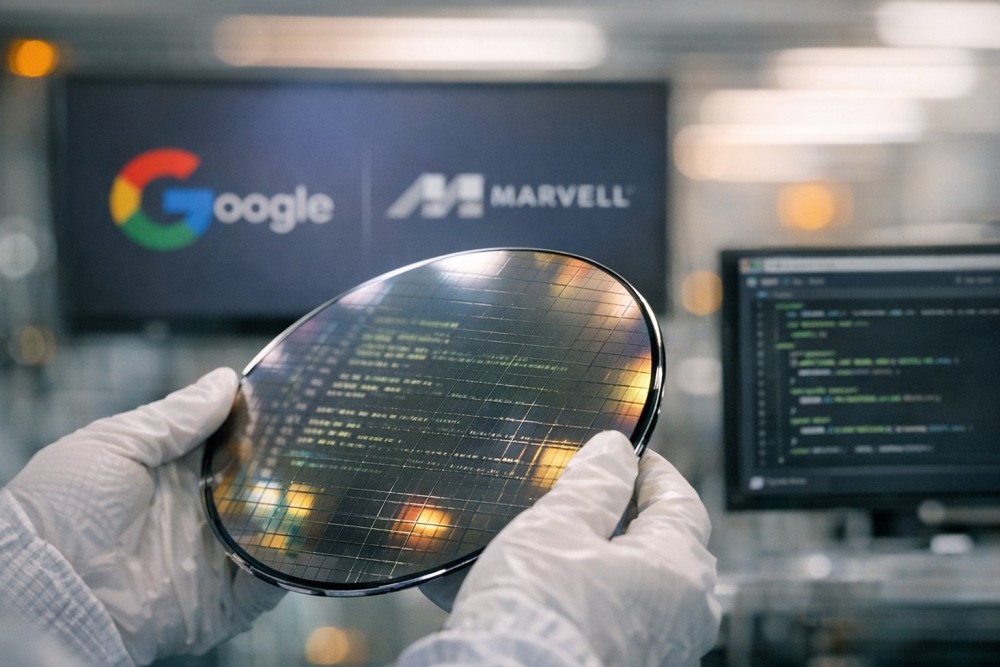
On the hardware side, Google and Marvell are collaborating on two new chip designs. The first is a Memory Processing Unit built to work alongside Google's existing TPUs, addressing the data-movement bottleneck that slows large-scale AI workloads.
The second is a next-generation TPU that could finalize its design by next year. According to Benzinga, this effort is part of Google's broader strategy to reduce its dependence on Nvidia's GPUs for cloud AI infrastructure.
Google's custom chip program is already generating significant revenue through its cloud division. In February 2026, Meta signed a multi-year lease deal for Google TPU capacity, validating external demand for the hardware.
By March 2026, analysts noted that Google's chip demand could make it one of TSMC's largest customers globally. GOOGL currently scores at the 95th percentile for Quality metrics, reflecting strong fundamentals beneath the AI investment push.
For investors watching AI infrastructure, these parallel moves tell a consistent story. The companies best positioned in AI are building vertically, controlling both the software intelligence layer and the silicon underneath it.
Sources
TechCrunch, Cursor Raising $2B+ at $50B Valuation as Enterprise Growth Surges, 2026.
Benzinga, Google Teams Up With Marvell Technology To Build New AI Chips, 2026.