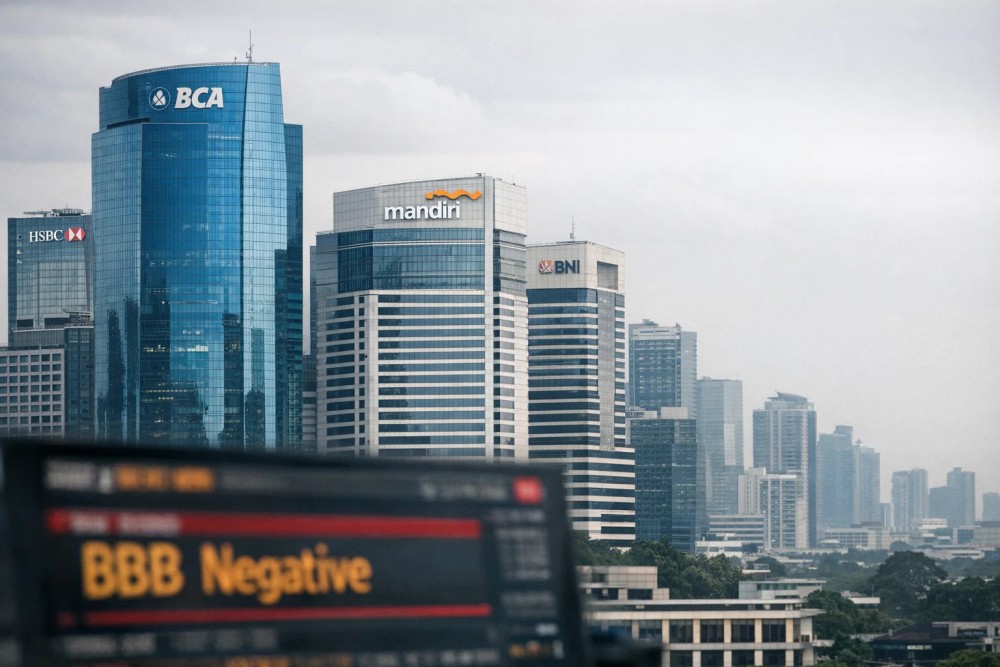
Fitch Keeps BBB, Negative Outlook for Indonesia Big 4 Banks
Rendy Andriyanto
Gotrade Team
Reviewed by Gotrade Internal Analyst
Share this article
Gotrade News - Fitch Ratings has maintained its BBB credit rating with a negative outlook for Indonesia's four largest banks. BCA, BRI, BNI, and Bank Mandiri received assessments aligned with Indonesia's sovereign rating.
The negative outlook reflects growing policy uncertainty that could affect medium-term banking stability. Geopolitical risks from the Iran conflict also threaten to pressure borrower repayment capacity through elevated energy costs.
Fitch maintains BBB with negative outlook for BCA, BRI, BNI, and Mandiri, aligned with sovereign
Three key drivers: fiscal policy uncertainty, geopolitical risk, and pressure on foreign reserves
Banking sector remains resilient with projected GDP growth of 5.1% in 2026
The four banks' ratings are directly linked to Indonesia's sovereign rating. Fitch revised the sovereign outlook to negative in March 2026.
Despite the negative outlook, Fitch projects Indonesia's economic growth at 5.1% in 2026 and 5.0% in 2027. This exceeds the 2.4% median for BBB-rated nations.
Individual Bank Strengths
BCA holds the strongest capital position with a CET1 ratio of 29.2%. Its CASA ratio of 84.6% and LCR of 311% demonstrate superior liquidity strength compared to peers.
Bank Mandiri leads market share with 22% of credit and 21% of deposits in the banking system. Its NPL ratio remains stable at 1.1% with 13.4% credit growth in 2025.
BRI excels in the micro-lending segment with Indonesia's most extensive rural network. Its CET1 ratio declined from 25.5% to 22.4%, though profitability remains strong driven by micro-credit yields.
BNI commands a 10.3% deposit market share with a Tier 1 ratio of 18.4%. Credit growth reached 15.9% in 2025, the highest among the four banks.
Rating Triggers to Watch
A downgrade of Indonesia's sovereign rating would directly trigger downgrades for all four banks. Conversely, stabilization of the sovereign outlook could open the path for rating improvements.
Global banking investors such as JPMorgan Chase and Bank of America maintain exposure to emerging market banking sectors. These rating developments signal important shifts in foreign capital flows to Indonesia.
Gotrade is the trading name of Gotrade Securities Inc., which is registered with and supervised by the Labuan Financial Services Authority (LFSA). This content is for educational purposes only and does not constitute financial advice. Always do your own research (DYOR) before investing.