

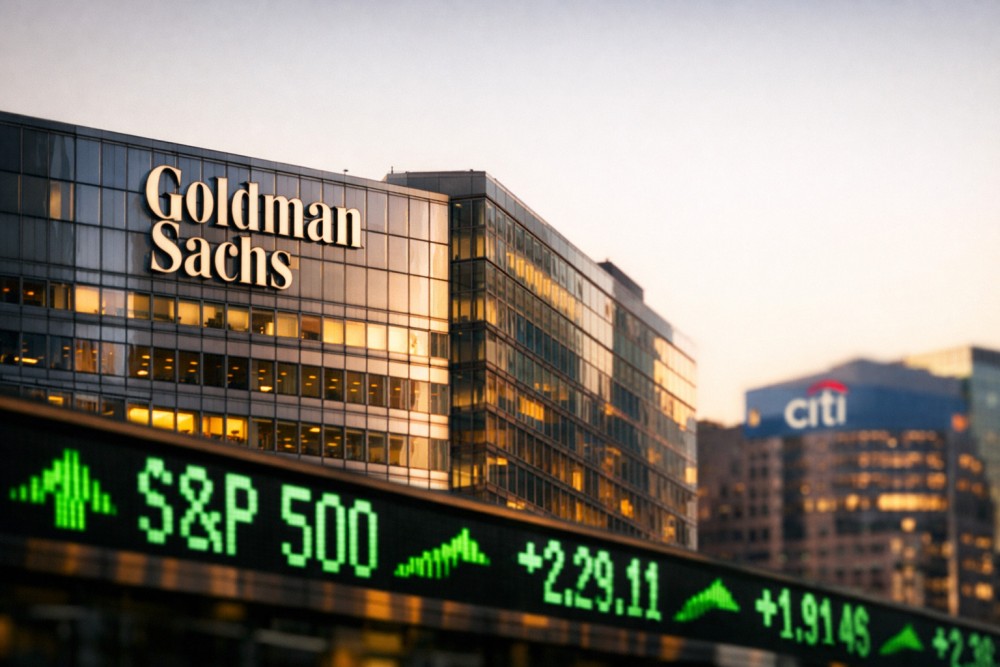
Gotrade News - Three of Wall Street's biggest sell-side desks turned more bullish on US equities on the same day, May 11, 2026. Goldman Sachs cut its US recession probability to 25%, HSBC lifted its S&P 500 year-end target, and Citi's Drew Manthey said US-stock outperformance has further to run.
The cluster of upgrades arrived as soft-data dispersion narrowed and earnings expectations firmed across large-cap names. For retail investors, the message points to broad index exposure through products tracking the S&P 500 and Nasdaq 100.
Key Takeaways:
- Goldman Sachs cut its US recession probability to 25% and pushed back the expected Fed rate-cut timing.
- HSBC raised its S&P 500 year-end price target, citing stronger earnings optimism into 2026.
- Citi strategist Drew Manthey said US stock outperformance versus global peers still has further to run.
What Each Bank Said
According to Investing.com, Goldman Sachs lowered its US recession probability to 25% from a higher prior reading. The bank also delayed its expected timing for the next Federal Reserve rate cut, citing firmer activity data.
As reported by Investing.com, HSBC lifted its S&P 500 year-end target on the back of improved earnings momentum. The bank's strategists pointed to broader profit growth across sectors as the main upgrade driver.
Per Bloomberg, Citi strategist Drew Manthey said the US equity premium versus international peers is not exhausted. Manthey argued that earnings breadth and dollar strength continue to support relative US outperformance.
Why the Calls Cluster Matters
Three independent desks moving in the same direction on the same day is a stronger signal than any single upgrade. The convergence suggests sell-side consensus is tilting risk-on, not just one shop adjusting a model.
The Goldman recession cut and the HSBC target lift both lean on earnings, which makes the calls reinforce each other. Citi's relative-value framing then anchors the case for staying overweight US equities versus other developed markets.
The trade-off is timing on rate cuts, since Goldman now sees the Fed waiting longer before easing. That pushes back the typical small-cap and rate-sensitive rotation that usually leads in early-cut environments.
For broad exposure, investors can track SPY and VOO as the most direct S&P 500 vehicles. Both ETFs sit at the center of the index upgrade thesis.
For higher-beta tech tilt, QQQ gives exposure to the Nasdaq 100 mega caps driving most of the earnings revisions. The Nasdaq 100 has historically led when sell-side desks lift index targets on profit grounds.
What Retail Investors Should Watch
The bull case rests on earnings holding up and dispersion staying contained through the next two quarters. A negative surprise in either input would unwind the converging upgrades quickly, so position sizing still matters.
Rate-sensitive sectors including small caps and REITs need patience under Goldman's later-cut framework. Investors leaning on those segments should size for a longer wait rather than an imminent Fed pivot.
The broader read-through is that base-case US equity exposure looks better supported today than a quarter ago. Three desks rarely agree on direction without underlying data backing the same conclusion.
Sources: