Oil pulls back as investors monitor inflation risks and tech momentum.
U.S. stocks ended Tuesday mostly lower as investors continued to digest developments surrounding the conflict involving Iran and its potential impact on global energy supply. Markets remained cautious after the sharp swings earlier in the week driven largely by volatility in oil prices.
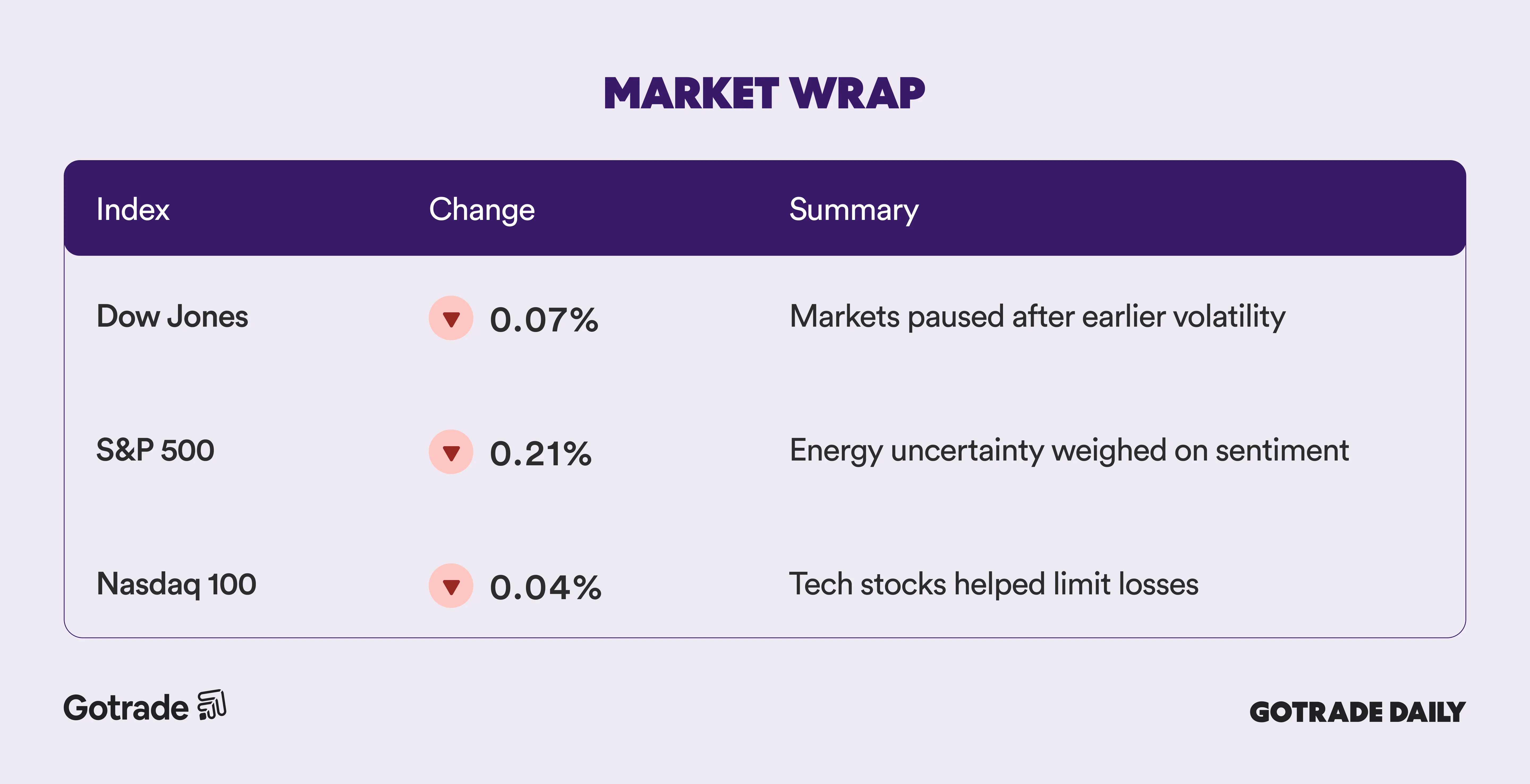
The S&P 500 slipped 0.21%, while the Dow Jones Industrial Average edged down 0.07%. The Nasdaq Composite finished nearly flat, reflecting a pause in momentum after Monday’s strong rebound.
Oil prices declined sharply during the session. West Texas Intermediate crude fell more than 8% to around $87 per barrel, retreating from earlier spikes after confusion surrounding reports that the U.S. Navy had escorted oil tankers through the Strait of Hormuz.
Earlier in the week, oil futures had surged above $119 per barrel, their highest level since 2022, before pulling back as G7 officials discussed the possibility of releasing oil from strategic reserves to stabilize supply.
The outlook for energy markets has become a key focus for investors. Some strategists warn that if oil prices remain elevated for longer, the increase could feed into inflation expectations and weigh on equities.
Meanwhile, technology stocks helped stabilize the market. Several major tech names ended higher, while memory chip maker Western Digital (WDC) also extended its recent gains.
📊 Market Wrap
🧠 Analyst Notes

💬 Market Highlights
Microsoft 365 Updates Seen Boosting Microsoft’s Agentic AI Strategy
Morgan Stanley believes Microsoft’s (MSFT) newly introduced Frontier version of Microsoft 365 could strengthen the company’s agentic artificial intelligence strategy while enhancing AI monetization across its product ecosystem. The firm noted that growth in Microsoft’s average revenue per user continues to be driven primarily by adoption of Microsoft 365 Copilot and upgrades to the security-focused E5 subscription tier, while the introduction of Agent 365 could provide an additional growth lever going forward. Recent CIO survey results also indicate increasing enterprise spending intentions for Office 365, a shift toward higher-tier subscriptions, and rising adoption of Microsoft’s generative AI tools, supporting long-term growth prospects for the Microsoft 365 platform.
Rivian Gains After Analyst Upgrade on Strong R2 SUV Outlook
Shares of Rivian Automotive (RIVN) climbed about 8% after TD Cowen upgraded the stock to Buy from Hold, citing strong demand projections for the company’s upcoming R2 mid-sized SUV set to debut at SXSW in Austin. The analyst estimates full-scale U.S. demand for the R2 could reach between 212,000 and 335,000 units annually, exceeding consensus expectations, with pricing expected to compete directly with Tesla’s (TSLA) Model Y, Hyundai’s Ioniq 5, and Ford’s (F) Mustang Mach-E. The stronger demand outlook could narrow Rivian’s projected 2027 EBITDA loss and improve long-term valuation assumptions, prompting the firm to raise its price target by 18% to $20, implying roughly 26% upside from the prior close.
Applied Materials and Micron Partner to Develop Next-Gen AI Memory
Applied Materials (AMAT) and Micron Technology (MU) announced a strategic partnership to develop next-generation memory technologies including DRAM, high-bandwidth memory, and NAND aimed at improving the performance of artificial intelligence systems. The collaboration will leverage Applied Materials’ EPIC Center in Silicon Valley alongside Micron’s innovation hub in Boise, Idaho, to strengthen the semiconductor innovation pipeline in the United States. The partnership will also focus on advanced packaging technologies designed to enable high-bandwidth, low-power memory solutions required for increasingly demanding AI workloads, while Applied Materials’ $5B EPIC Center represents one of the largest U.S. investments in advanced semiconductor equipment research and development.
📅 Earnings Watch

With oil prices stabilizing but geopolitical risks still present, investors will continue watching whether developments around the Iran conflict begin to influence inflation expectations and broader market sentiment.