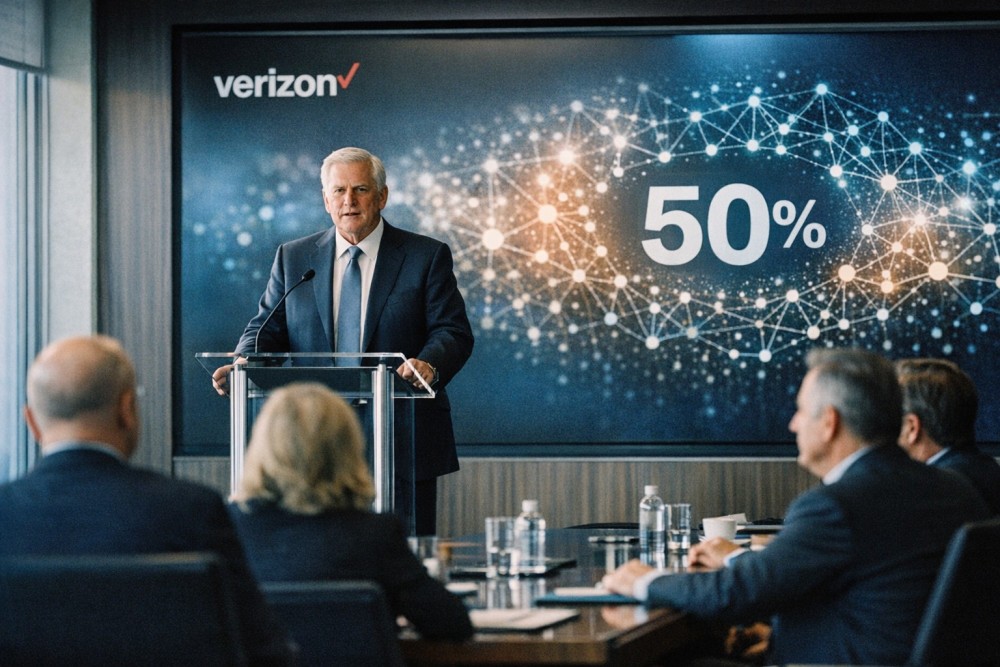
Gotrade News - Half of all business executives in the United Kingdom now believe artificial intelligence will lead to a net reduction in total employment over the coming decade. A new survey conducted by global consulting firm Accenture reveals a sharp escalation in corporate anxiety about AI's long-term workforce impact, with entry-level roles in finance, administration, and customer service identified as the most vulnerable category.
Key Takeaways:
- 50% of UK executives predict AI will reduce total employment, up from 33% just two years ago
- Verizon cut 13,000 positions and launched a $20 million career-transition fund
- Boston Consulting Group research estimates 15% of U.S. jobs could be eliminated by AI within 2-3 years
The proportion has jumped dramatically from just one-third of executives who held this view two years earlier, when generative AI technology was only beginning to spread widely across industries. According to Bloomberg, entry-level positions across financial services, back-office administration, and customer support face the highest risk of displacement as companies accelerate automation across their core operations.
The nearly 17 percentage point increase within two years signals a fundamental shift in how corporate leadership across the United Kingdom views AI's net impact on employment. Business leaders who were previously optimistic that AI would create more job opportunities than it destroys are now confronting growing evidence that automation replaces existing roles faster than it generates new ones in practice.
The Accenture survey also revealed that junior employees, interns, and recent graduates face the greatest exposure to AI-driven displacement in the near term. Entry-level positions that have served as primary career entry points for decades are increasingly vulnerable to automated systems that cost less to operate, process data faster, and remain available to work around the clock without breaks.
The implications are particularly significant for younger workers across the globe who are entering a job market that grows more competitive with each wave of mass AI adoption by large and mid-sized enterprises. Basic analytical and administrative tasks that once formed the core responsibilities of entry-level employees can now be completed by AI chatbots and automated software tools in seconds, often with higher accuracy than their human counterparts.
Schulman's Call for Corporate Honesty on AI Layoffs
Verizon CEO Dan Schulman has taken a notably different approach from most technology industry leaders by advocating for full transparency about the real consequences of AI on jobs. He is publicly urging corporate executives to communicate honestly with their employees about AI-driven workforce reductions rather than obscuring the reality behind carefully crafted corporate messaging.
"It's a very difficult time, and everyone knows it is. So I think being authentic, being realistic, telling the truth as best you can, is the most essential thing," Schulman stated in his public remarks. According to PYMNTS, this stance stands in sharp contrast to competitors across the technology industry who tend to significantly downplay the true scale of their planned workforce reductions.
Verizon eliminated 13,000 employee positions last year as part of a comprehensive AI-driven restructuring program spanning the entire company. The largest telecommunications provider in the United States simultaneously established a $20 million career-transition and retraining initiative specifically designed for workers displaced by automation, covering programs in AI skills development, cloud computing, and cybersecurity.
Schulman previously led PayPal for several years before joining Verizon as chief executive officer, giving him firsthand experience with how automation fundamentally reshapes workforce dynamics in the fintech sector. "Like it or not, we live in the age of AI, and I happen to like it," he added, underscoring his pro-innovation stance while openly acknowledging the social costs that inevitably accompany rapid technological adoption.
This candid and direct approach clearly distinguishes Verizon from other major technology companies that prefer more diplomatic and carefully hedged messaging about workforce changes driven by artificial intelligence. Schulman believes that honesty ultimately builds stronger employee trust and deeper long-term loyalty, even when the underlying message being delivered is genuinely difficult for the recipients to hear.
Broader Implications Across Global Labor Markets
Amazon CEO Andy Jassy has taken a different position, suggesting that new roles would emerge over time to offset positions replaced by AI automation. However, the latest industry data suggests that new role creation is not keeping pace with the elimination of existing positions, creating a painful transition period for millions of workers.
Boston Consulting Group research paints a more sobering picture of this workforce transformation's scale, estimating that approximately half of all U.S. jobs could face significant reshaping within two to three years. Of that total, roughly 15% of positions face outright elimination through AI-powered automation, making this a near-term reality rather than a distant theoretical concern.
Major technology firms including Microsoft and Alphabet continue to ramp up their AI investments at an accelerating pace across every major business unit and product line. Block, Jack Dorsey's fintech company, has publicly predicted that competitors across the entire industry will soon follow its lead on dramatic workforce reductions as AI tools grow increasingly capable of handling complex tasks.
For global investors, this trend presents a dual dynamic that requires careful and ongoing monitoring when making portfolio allocation decisions going forward. On one hand, AI-powered efficiency gains could meaningfully improve corporate profit margins as operating costs decline, but on the other hand, the social fallout from mass workforce displacement may eventually trigger a wave of stricter government regulation of AI deployment across major economies worldwide.
The transparency that Schulman is modeling at Verizon may become the new standard for corporate leadership navigating the AI transformation ahead. Companies that proactively manage workforce transitions with honesty and retraining support are better positioned to maintain investor confidence and public trust over the long term.
Sources:
- Bloomberg - Half of UK Executives Think AI Will Mean Fewer Jobs
- PYMNTS - Verizon's Dan Schulman Tells CEOs to Be Open About AI Job Cuts