

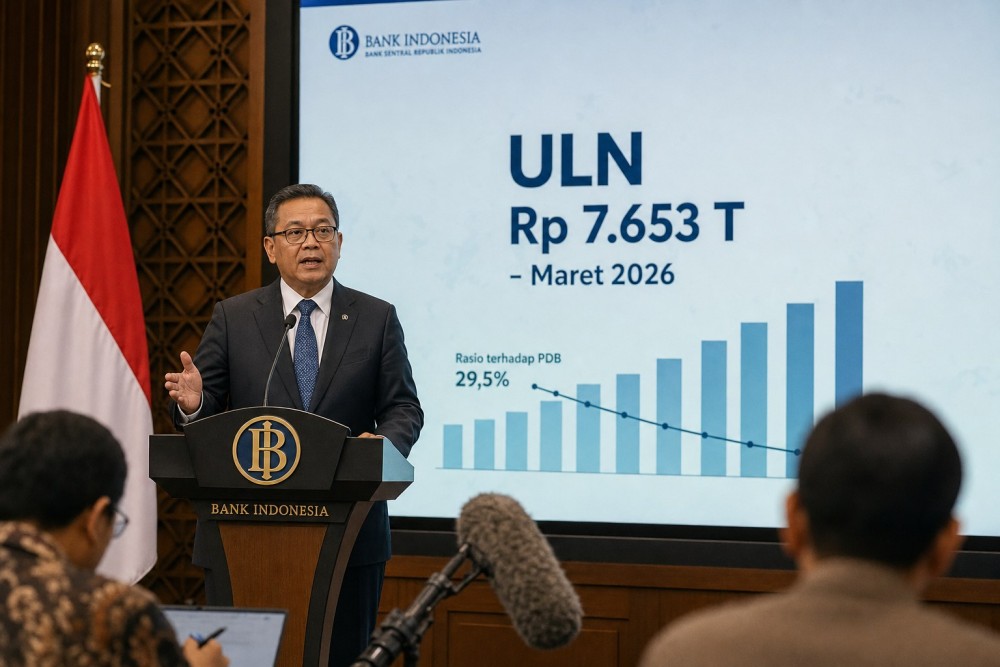
Gotrade News - Indonesia's external debt reached USD 433.4 billion or roughly IDR 7,653 trillion as of March 2026. The stock grew 0.8% year-over-year, decelerating from 1.9% in the prior quarter.
The slowdown coincided with the debt-to-GDP ratio falling to 29.5% from 30.0% in Q4. The structural shift signals that debt-servicing capacity remains intact despite the higher nominal figure.
Key Takeaways
- Indonesia's external debt edged up to USD 433.4 billion in Q1 2026.
- Debt-to-GDP ratio improved to 29.5% from 30.0% in Q4 2025.
- Singapore is the largest creditor country with USD 52.75 billion in claims.
According to kumparanBISNIS, government external debt stood at USD 214.7 billion in the period. That position grew 3.8% year-over-year, down from 5.5% in Q4 2025.
Bank Indonesia attributed the increase to foreign inflows into international government securities issued recently. Sustained investor confidence in Indonesia's economic outlook drove the demand across global allocators.
Healthcare and social services absorbed 22.1% of government debt allocation, with public administration at 20.2%. Education received 16.2%, construction 11.5%, and transportation 8.5% of the total mix.
Debt Composition and Creditor Mix
Private-sector debt totaled USD 191.4 billion, contracting 1.8% year-over-year across both financial and non-financial firms. Manufacturing, finance, energy, and mining remain the dominant user sectors of private external debt.
As reported by Katadata, Singapore led as Indonesia's largest creditor with USD 52.75 billion. The United States followed with USD 27.51 billion and China with USD 25.32 billion.
Long-term obligations represented 85.4% of the total external debt stock at end-March 2026. Bank Indonesia characterized the composition as a healthy and well-managed profile across both sectors.
FX Risk Premium Under Watch
Per Bloomberg Technoz, the release landed while the rupiah traded near historic lows. USD-denominated debt servicing has therefore become costlier for local issuers.
Market analysts are now linking the dynamic to upcoming Bank Indonesia rate decisions closely. The central bank must balance rupiah stability against fiscal flexibility for the government with care.
Month-over-month, the debt stock fell from USD 438.4 billion in February 2026. Yet the March 2026 reading remains above the USD 429.9 billion seen one year earlier.
Global investors track Indonesia exposure through instruments like the iShares MSCI Indonesia ETF (EIDO). Multinational banks such as JPMorgan Chase (JPM) regularly publish emerging-market debt research.
Broader emerging-market exposure is available through the Vanguard FTSE Emerging Markets ETF (VWO). The ETF carries diversified equity and debt-linked exposure across developing economies including Indonesia.
Ramdan Denny Prakoso, BI Executive Director for Communications, said coordination with the government remains strong. The goal is preserving a healthy debt structure while minimizing forward-looking risks.
Overall, Indonesia's structural debt metrics remain within prudent thresholds set by domestic authorities. Yet the FX risk premium warrants close monitoring as rupiah weakness extends through mid-May.