

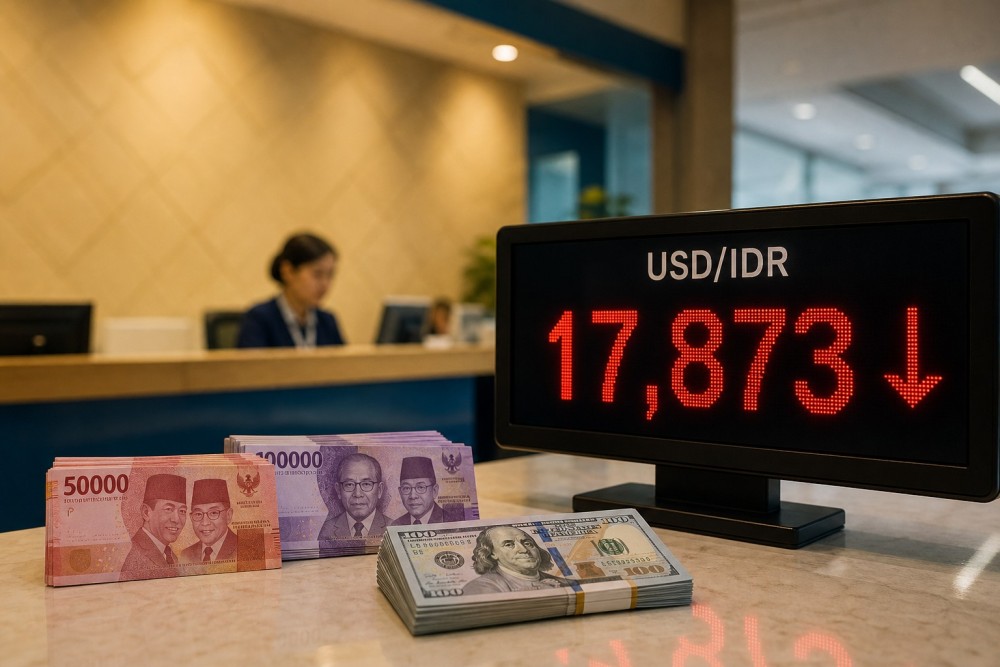
Gotrade News - The Indonesian rupiah weakened to Rp17,873.5 per US dollar on Thursday, slipping 0.41% toward the Rp18,000 threshold. The decline came as the local market reopened following the Idul Adha religious holiday, when most Indonesian trading desks were closed.
Rising Middle East tensions, firmer oil prices, and broad Asian currency weakness pushed regional foreign exchange markets lower. The move added pressure on Indonesian assets and rekindled concerns about emerging market capital outflows during a fragile global backdrop.
Key Takeaways
- Rupiah fell to Rp17,873.5 per US dollar on May 28, down 72.5 points or 0.41% intraday.
- Asian peers also weakened, with the South Korean won down 0.49% and the Malaysian ringgit down 0.24%.
- Economists warn the rupiah could approach Rp17,900 to Rp18,000 as oil holds above USD 92 per barrel.
According to IDX Channel, the rupiah opened at Rp17,857 per US dollar, citing Bloomberg pricing data. The currency briefly retested a historic low before steadying near Rp17,870 by late morning Jakarta time.
Indonesia's financial regulator OJK and the central bank have intervened periodically to smooth volatility in recent sessions. Government bond yields edged lower as state-linked buyers stepped in to absorb selling pressure across the curve.
What Is Driving the Rupiah Decline
As reported by Liputan6, economist Ibrahim Assuaibi expects the rupiah to test the Rp17,900 to Rp18,000 zone in the near term. He cited US strikes on Iranian facilities, retaliation fears, and Russian attacks on Kiev as the dominant risk drivers.
Oil prices have climbed above USD 92 per barrel, with intraday prints reaching USD 96 per barrel. Indonesia's 2026 state budget, known locally as APBN, assumes USD 100 per barrel, so officials see no immediate need for fiscal revisions.
Investors tracking the broader dollar trend can monitor the Invesco DB US Dollar Index Bullish Fund (UUP), which mirrors greenback strength against major peers. A stronger US dollar typically tightens financial conditions across emerging Asian markets.
Per Kompas Money, Finance Minister Purbaya Yudhi Sadewa said the weakness defies sound fundamentals. He noted currencies usually slide when economic disturbances appear, suggesting external factors are doing most of the work here.
Spillover Risks Ahead
Markets are now pricing a 52.3% probability that the US Federal Reserve will hold rates steady through year-end. That outlook keeps US Treasury yields supported and limits relief for high-beta emerging Asia currencies like the rupiah.
Indonesia-focused investors often use the iShares MSCI Indonesia ETF (EIDO) to track local equity exposure denominated in dollars. Sustained rupiah weakness can erode dollar-based returns even when Jakarta-listed stocks hold their ground.
Broader emerging market vehicles such as the Vanguard FTSE Emerging Markets ETF (VWO) tend to move with global risk appetite. Weakening Asian foreign exchange may pressure these funds if dollar strength persists into the second half of the year.
Asian peers tracked the rupiah lower, with the South Korean won down 0.49% and the Thai baht off 0.23%. The Philippine peso, Japanese yen, and Chinese yuan also softened, underscoring the region-wide nature of the dollar bid.
The post-holiday session also reignited debate about Indonesia's commodity export controls and external balance. Traders will watch Friday's open closely for any breach of the symbolic Rp18,000 per US dollar level.