

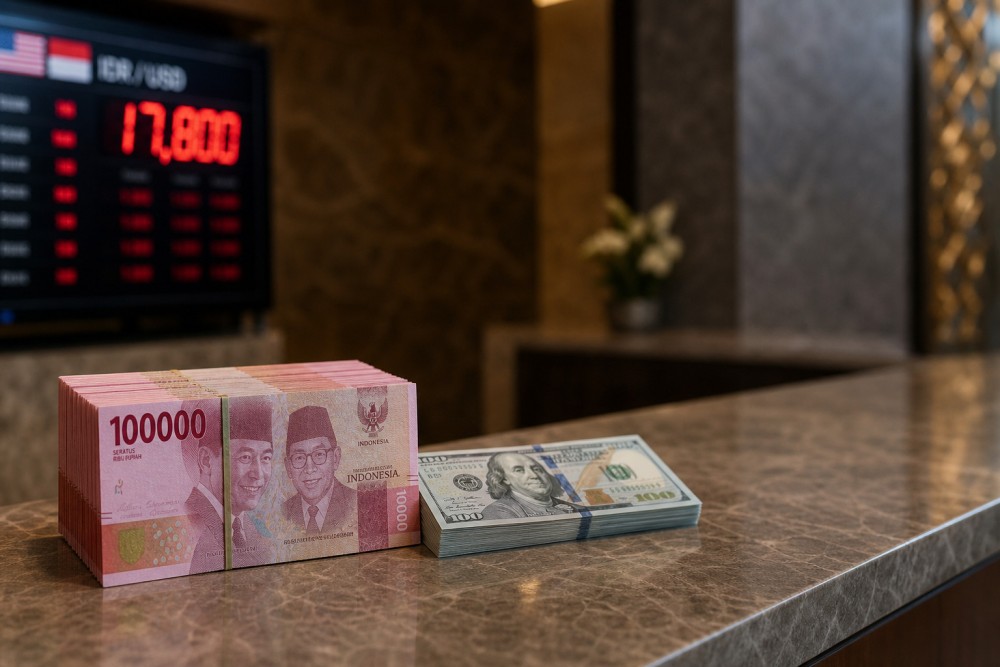
Gotrade News - The Indonesian rupiah traded in a Rp 17,721 to Rp 17,870 per US dollar range on Monday. The currency hovered near multi-month lows as dollar strength continued to weigh on Asian foreign exchange markets.
Persistent Federal Reserve hawkish guidance and a widening Indonesian current account deficit drove the weakness. Bank Indonesia (BI), the country's central bank, recently lifted rates to cushion the slide.
Key Takeaways
- Rupiah opened at Rp 17,726 per dollar and traded as weak as Rp 17,870 at major banks.
- Bank Indonesia raised its policy rate by 50 basis points to 5.25% on May 19-20.
- Analysts forecast the rupiah could test Rp 18,000 within the week if dollar strength persists.
According to Kompas, the rupiah opened at Rp 17,726 per dollar, down 0.05% from Friday's close. The currency briefly recovered to Rp 17,715 by mid-morning before sliding again on dollar demand.
Bloomberg data cited by Kompas showed the rate at Rp 17,716 per dollar at 10:15 WIB. Major bank sell rates ranged from Rp 17,740 at BCA to Rp 17,870 at BRI, reflecting wider intraday spreads.
Drivers Behind Rupiah Weakness
The rupiah was the only Asian currency to decline against the dollar on Monday morning. The Thai baht gained 0.71%, the Korean won rose 0.57%, and the Philippine peso added 0.52% during the same session.
Analyst Ibrahim Assuaibi forecast the rupiah could weaken further toward Rp 18,000 within the trading week. He projected the US Dollar Index (DXY) range at 97.600 to 101.00 between May 25 and May 29.
Investors tracking dollar strength often follow the Invesco DB US Dollar Index Bullish Fund (UUP), which mirrors broader greenback momentum. The fund has benefited from sustained Fed hawkishness across the past quarter.
As reported by Metro TV, the rupiah sat at Rp 17,721 per dollar at 09:48 WIB. Muhammad Amru Syifa of ICDX attributed the weakness to the Fed's higher-for-longer rate stance.
Risks Still on the Horizon
Indonesia's Q1 2026 current account deficit widened to USD 4 billion, adding structural pressure on the rupiah. The shortfall has reduced the country's external buffers against dollar volatility this year.
The Jisdor reference rate set by Bank Indonesia stood at Rp 17,717 on May 22, up from Rp 17,673 on May 21. The benchmark guides interbank transactions and signals the central bank's tolerance band.
Analyst Lukman Leong projected a Rp 17,600 to Rp 17,750 range, citing easing Middle East tensions and a recent drop in oil prices. Lower crude prices typically reduce Indonesia's import bill and ease pressure on the currency.
Investors seeking direct Indonesian equity exposure often watch the iShares MSCI Indonesia ETF (EIDO). The fund tracks large and mid-cap Indonesian stocks and reflects rupiah-driven sentiment shifts.
Broader emerging market exposure flows through the iShares MSCI Emerging Markets ETF (EEM). The ETF aggregates dozens of developing economies and tends to soften when the dollar strengthens.
Per Bank Indonesia's recent move, the 50 basis point hike to 5.25% on May 19-20 was designed to limit further rupiah downside. The action raised real yields and aimed to retain foreign portfolio flows in domestic bonds.
Traders will watch upcoming US data prints and Fed commentary for fresh direction on the dollar. Any softer prints could ease pressure on the rupiah and broader Asian currencies this week.