
Gotrade News - Indonesia's financial regulator OJK and market participants are awaiting the outcome of the MSCI Semi-Annual Index Review announced on May 12, 2026. The review follows the Jakarta Composite Index closing down 0.92% on May 11, 2026.
MSCI had previously frozen new Indonesian stock additions pending regulatory reforms, and the current rebalancing could remove existing constituents. The decision is a key catalyst for foreign capital flows and Indonesia-focused ETFs trading in the US market.
Key Takeaways:
- MSCI Semi-Annual Index Review was announced May 12, 2026, after a freeze on Indonesian additions.
- OJK frames the rebalancing impact as short term pain for long term gain.
- ETFs EIDO and VWO serve as global proxies for Indonesian equity exposure.
OJK Stance and MSCI Implications
OJK Board Chair Friderica Widyasari Dewi, known as Kiki, described the rebalancing impact as temporary. According to Kabar Bursa, reforms on transparency and free float aim to strengthen long-term market integrity.
The regulator has scheduled a follow-up evaluation in June 2026 to determine Indonesia's emerging market status. Global investors track exposure through the iShares MSCI Indonesia ETF (EIDO), the primary proxy for Indonesian equities.
As reported by Kabar Bursa, Indonesia's domestic investor base has grown to 26 million. The expanding retail base is seen as a buffer against potential foreign outflows after the MSCI announcement.
Ongoing reforms also address ownership structure and issuer disclosure standards. OJK views these measures as prerequisites for Indonesia to remain competitive within major global index destinations.
JCI Pressure and Global Sentiment
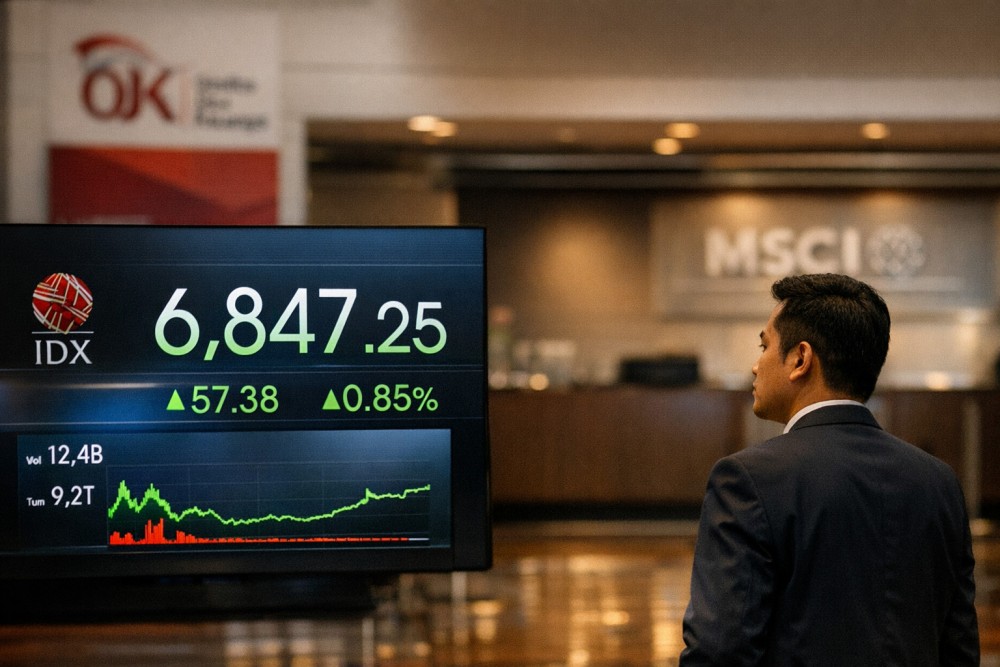
Per IDXChannel, the JCI touched 6,847 or 1.76% lower on May 11, 2026. A mining royalty hike delay announced by Energy Minister Bahlil Lahadalia eased pressure ahead of the MSCI decision.
Of 912 stocks traded, only 251 advanced during the session. Banking heavyweight BMRI, alongside DSSA and BREN, weighed on the index due to ex-dividend effects and broader banking sector weakness.
Global investors gauge sentiment through emerging market ETFs such as the Vanguard FTSE Emerging Markets ETF (VWO) and the broader iShares MSCI Emerging Markets ETF (EEM). Both vehicles carry Indonesian equity weightings that respond to MSCI rebalancing outcomes.
According to IDXChannel, 6,847 marked the JCI's lowest level since early 2026. The MSCI verdict and OJK reform progress will steer market direction into the June evaluation window.
The combination of royalty policy relief and OJK reform commitment offers short-term stabilization. However, reclassification risk within MSCI indices remains the central concern for cross-border investors.
MSCI has previously flagged free float transparency and ownership structure as core review criteria for Indonesia. These items now anchor the June 2026 index evaluation framework for emerging market status.
For retail investors, US-listed ETFs offer liquid indirect exposure to Indonesian equities. Vehicles such as EIDO and VWO mitigate single-issuer reclassification risk while preserving thematic positioning.
Passive fund managers will recalibrate Indonesian weightings once full SAIR results are released. The output shapes index-tracking flows over the next several weeks heading into June.
OJK reforms and JCI stability could reinforce each other if domestic investor growth continues. That resilience underpins a constructive medium-term narrative for the Indonesian equity market.
Sources:
- Penundaan Kenaikan Royalti Tambang Redam Tekanan IHSG, Pasar Tunggu Keputusan MSCI (IDXChannel)
- OJK Ungkap Dampak Pengumuman MSCI ke Pasar Saham Indonesia (Kabar Bursa)