
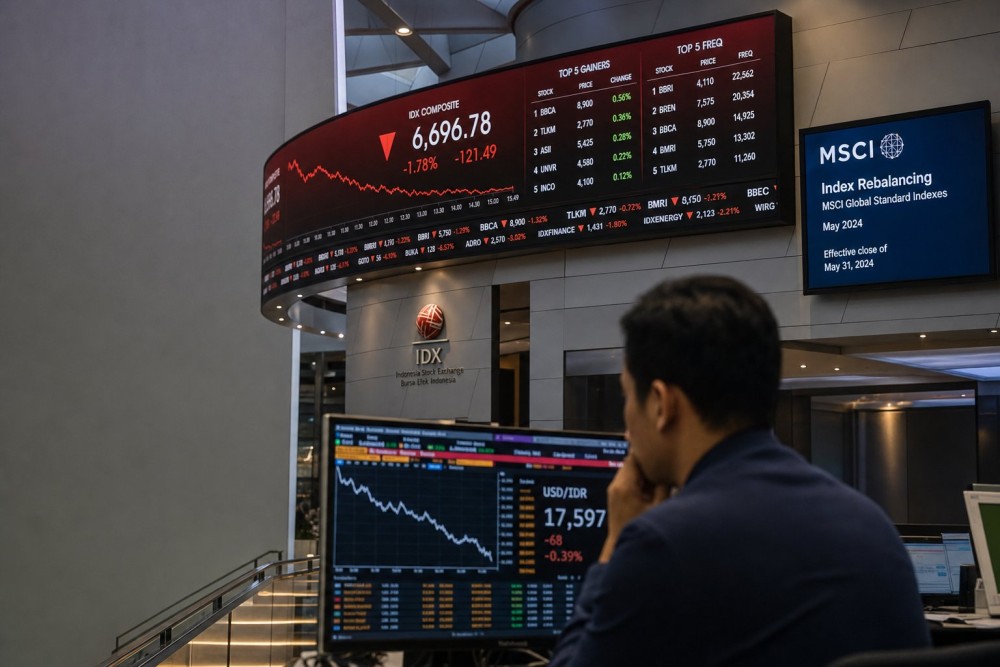
Gotrade News - Indonesia faces foreign outflows of up to $10 billion as MSCI rebalancing removes six large-cap stocks from its Global Standard Index. The Jakarta Composite Index, locally known as the IHSG, is projected to weaken toward the 6,650-6,700 zone on Monday.
The selling pressure stems from passive funds tracking MSCI benchmarks unwinding positions before the May 29 implementation date. The rupiah has already slid to 17,597 per US dollar, amplifying risk for global investors holding Indonesian exposure.
Key Takeaways
- Six Indonesian mega-caps including AMMN, BREN, and TPIA were removed from the MSCI Global Standard Index, triggering passive selling estimated at Rp 18.5 trillion.
- Worst-case foreign outflow scenario reaches $10 billion or roughly Rp 165 trillion, with each $1 billion exit potentially weakening the rupiah by 1 to 1.5 percent.
- The iShares MSCI Indonesia ETF (EIDO) offers US investors the most direct way to track the unfolding repricing.
The IHSG closed Wednesday, May 13 at 6,723.32, down 1.98 percent as institutional desks priced in the index reshuffle. According to kumparan, Phintraco Sekuritas analysts said sentiment continues responding to the MSCI removals.
M. Nafan Aji Gusta of Mirae Asset noted the index appeared oversold based on RSI indicators, hinting at a possible technical bounce. Bank Indonesia is widely expected to hold its policy rate at 4.75 percent on May 20, limiting near-term monetary support.
What MSCI Rebalancing Means for Global Investors
MSCI and FTSE Russell rebalances reshape billions in passive emerging-market flows whenever index weights are recalibrated. Indonesia carries roughly a 0.7 percent weight in the broader MSCI Emerging Markets index, making each adjustment outsized relative to local market depth.
The six stocks dropped from the Standard index are AMMN, BREN, TPIA, DSSA, CUAN, and AMRT, alongside 13 names exiting the Small Cap index. As reported by Katadata, Sinarmas Sekuritas analysts cited insufficient free-float-adjusted market capitalization as the main driver of exclusions.
Passive funds replicating these benchmarks must sell the deleted constituents on or before May 29, 2026. That mechanical selling explains the residual Rp 18.5 trillion passive outflow flagged for late May.
For US-based investors, the most accessible vehicle is the iShares MSCI Indonesia ETF (EIDO), which mirrors the affected basket. Capital rotating out of single-country exposure often migrates into the iShares MSCI Emerging Markets ETF (EEM) or peer markets like the iShares MSCI India ETF (INDA).
IHSG Fair Value and Rupiah Risk
Per Kompas, Hendra Wardana of Republik Investor said the market remains in an adjustment phase following pressure on mega-cap stocks. He flagged the 6,900 psychological level as the next test, with downside extending to 6,600-6,700.
Sinarmas Sekuritas analysts Kenny Shan and Isfhan Helmy set 2026 IHSG fair value at a headline 8,200, but a fundamental basis closer to 6,500. The gap reflects how much of the current rebalancing damage is mechanical rather than earnings driven.
The rupiah remains the bigger second-order risk for global portfolios holding Indonesian equities. Worst-case modeling suggests the currency could weaken to 18,750-19,500 per dollar should the full $10 billion outflow materialize.
That depreciation would compound dollar-denominated losses for foreign holders even if IHSG stabilizes near fair value. Defensive sector rotation and selective dividend names are emerging as preferred hedges among domestic institutional desks.