
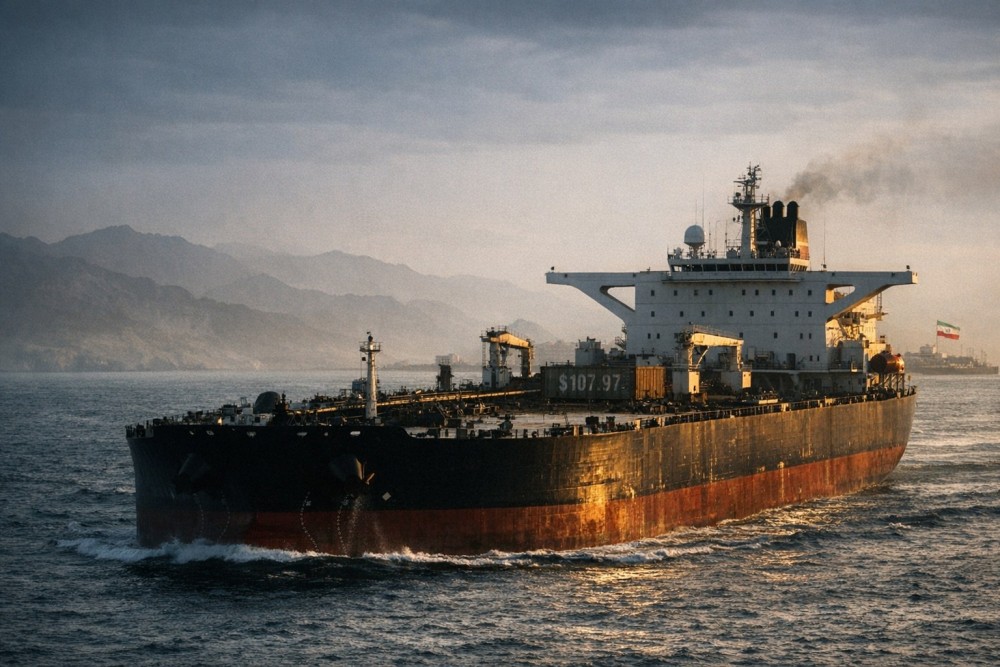
Gotrade News - Brent crude surged more than 2% to $107.97 per barrel on Monday as US-Iran nuclear negotiations stalled over the weekend, keeping the Strait of Hormuz closed and global energy markets on edge.
The breakdown came after the Trump administration canceled a planned diplomatic trip to Islamabad, where US envoys had been expected to meet Iranian counterparts. Trump stated that Tehran could initiate talks if it wished, according to Reuters reporting via Investing.com.
Key Takeaways
- Brent crude hit a three-week high above $107, driven by the Hormuz closure disrupting Middle East energy exports.
- Goldman Sachs raised its year-end Brent forecast from $80 to $90 per barrel on the prolonged supply shock.
- S&P 500 futures slipped 0.3% while Asian equities showed a mixed picture heading into a major earnings week.
The Strait of Hormuz remains shut, disrupting energy exports from the broader Middle East region. LNG prices for June delivery into northeast Asia reached $16.70 per million BTU, a level 61% above pre-war levels, according to Investing.com data.
A ceasefire has frozen most active fighting from US-Israeli strikes that began roughly two months prior. Iran's foreign minister has continued shuttle diplomacy, but no breakthrough emerged over the weekend.
Goldman Sachs raised its year-end Brent crude forecast from $80 to $90 per barrel, citing the prolonged supply disruption. The bank's revised outlook reflects expectations that the Hormuz closure may persist longer than initially assumed.
US stock index futures moved in mixed directions at Sunday evening close. S&P 500 futures fell 0.3% to around 7,189, while Nasdaq 100 futures edged 0.1% higher to 27,455, according to Investing.com.
Both the S&P 500 and Nasdaq had closed at record highs the prior Friday. The S&P 500 gained 0.6% for the week, and the Nasdaq rose 1.5%, per Investing.com data.
Asian markets offered a split picture at Monday's open. South Korea's KOSPI and Japan's Nikkei reached record highs, while Australian shares slipped on energy import cost concerns.
Currency markets showed modest moves on the geopolitical uncertainty. The euro declined 0.15% to $1.1706 against the dollar, and the yen traded marginally weaker at 159.53 per dollar.
The week ahead carries significant event risk beyond the Iran situation. The Federal Reserve, European Central Bank, and Bank of England are all expected to hold rates at their respective meetings.
The Bank of Japan is anticipated to maintain its 0.75% policy rate at its Tuesday meeting. Fed Chair Jerome Powell chairs what may be his final policy meeting before Kevin Warsh is expected to take over in May.
Tech earnings season reaches its peak this week. Microsoft, Alphabet, Amazon, and Meta report on Wednesday, while Apple reports Thursday.
Companies representing 44% of the S&P 500 by market cap are due to report results this week, according to Investing.com. The slate means equity volatility could spike regardless of the geopolitical backdrop.
Traders are closely watching whether Iran makes any new diplomatic overture following Trump's latest cancellation. Any signal of resumed talks could quickly reverse oil's move and lift risk sentiment globally.
For now, the energy market is pricing in a protracted standoff. Elevated LNG and crude prices are feeding into inflationary pressure across energy-importing economies in Asia and Europe.