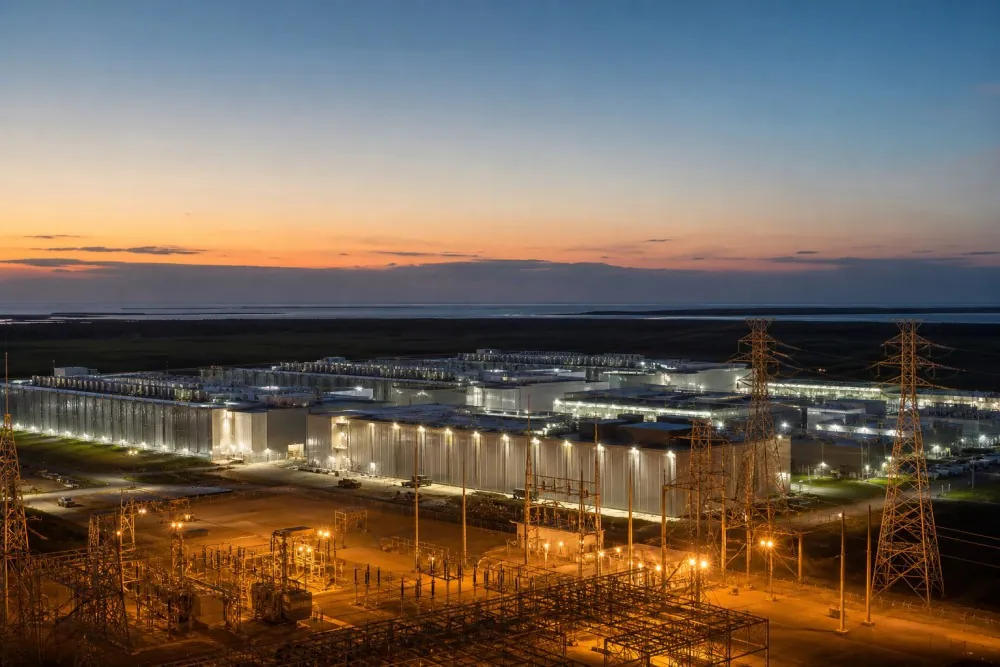
Gotrade News - OpenAI is going big in Georgia. The company plans to spend more than $30 billion, at full build, on one of the largest AI data centers anyone has tried to put on a single site.
The location is Effingham County, near Rincon, about half an hour outside Savannah. That detail matters more than it looks. Land, water, and above all power decide where these projects land now, and this one lines up all three.
Here is the read for investors. OpenAI is private, so you cannot buy it. What you can buy is the supply chain it is feeding, and a $30 billion check is a loud signal about where AI money goes next.
Key Takeaways
- The Georgia project runs past $30 billion at full build, anchored by a $20 billion local investment commitment.
- It locks up 3.2 gigawatts from Georgia Power, roughly what 2.25 to 2.4 million homes use.
- Headcount starts near 400 six-figure jobs in 2028 and climbs toward 1,000 by 2032.
- It is part of Sam Altman's Stargate push, and power, not chips, is now the real bottleneck.
3.2 Gigawatts From Georgia Power
Start with the electricity, because that is the whole story here.
OpenAI locked up 3.2 gigawatts from Georgia Power, per Investing.com. That is enough to run somewhere between 2.25 and 2.4 million homes. All of it for a single data center.
To keep the grid from buckling, the company said it will pull back by as much as 1 gigawatt when demand peaks. It is also paying for the energy upgrades itself, so other Georgia Power customers do not eat the cost.
Cooling runs on a closed loop that recirculates water. That is a deliberate choice. Water use has become a sore point at big data centers, and OpenAI clearly knows it.
Georgia Power likes the setup. "Companies like OpenAI are making real commitments when it comes to responsible operation," said senior vice president Aaron Mitchell, as quoted by The Atlanta Journal-Constitution.
Jobs, Taxes, and an $80 Million Community Package
For a coastal county, the numbers are big. The site should employ about 400 people in six-figure jobs when it opens in 2028, then grow to 1,000 by 2032, according to The Atlanta Journal-Constitution.
There is a tax break attached. The Effingham County Industrial Development Authority signed off on a 50% property-tax abatement running 15 years. Even with that discount, OpenAI is on track to become the county's biggest taxpayer once the lights are on.
The company also put $80 million on the table for local schools, public safety, healthcare, job training, housing, veterans services, and small businesses. That package, plus the tax profile, is a big reason the authority said yes.
| Total project cost | $30B+ at full build ($20B headline local commitment) |
| Power secured | 3.2 GW from Georgia Power |
| Jobs | 400 (2028) growing to 1,000 (2032) |
| Community fund | $80 million |
| Timeline | Several-hundred-MW online 2028, full build 2032 |
Stargate and the Capex Read-Through
Georgia is one node in Sam Altman's "Stargate" build-out, OpenAI's plan to pour capital into a few giant US compute hubs. To get there, it walked away from planned sites in the UK, Norway, and Texas, per Investing.com. It also expects to go public at some point.
The bigger shift is what counts as scarce. Not money. Not chips. Power. Multi-gigawatt access is the new gatekeeper for AI infrastructure, and it is quietly redrawing the map of where these things get built.
OpenAI wants the next build to be cheaper. "There's a bunch of lessons around how these things should be designed that can cut both costs as well as make it faster to build," its VP of compute strategy said, according to OpenAI, which plans to open-source its data-center blueprints.
So where does a retail investor actually get exposure? Not OpenAI itself. The read-through runs to the names selling the picks and shovels. Nvidia (NVDA) supplies the accelerators that fill these halls. Oracle (ORCL) and Microsoft (MSFT) sit in the cloud layer behind Stargate-scale projects, and Microsoft is still OpenAI's closest partner. When one project commits to several gigawatts at once, these are the tickers that tend to move.
Sources