

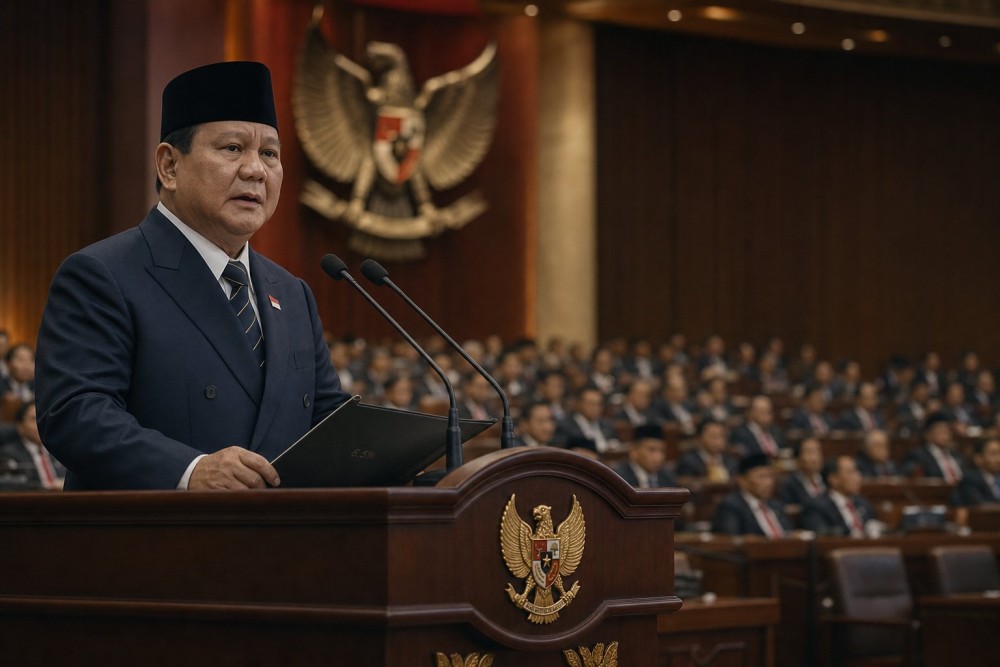
Gotrade News - Indonesian President Prabowo Subianto unveiled a 2027 budget framework targeting GDP growth of 5.8% to 6.5%. The plan sets the rupiah at 16,800 to 17,500 per US dollar and 10-year bond yields at 6.5% to 7.3%.
The macro assumptions land as the rupiah trades near record lows around 17,698 per dollar after touching 17,733 on May 19. Market reaction was muted, with bonds and currency holding steady as investors weighed fiscal deficit risks against the growth ambition.
Key Takeaways
- 2027 GDP growth target set at 5.8% to 6.5%, above the 2026 baseline of 5.4%.
- Rupiah assumption weakened sharply to 16,800-17,500 per USD, versus 16,500 in 2026.
- 10-year government bond yields penciled in at 6.5-7.3%, with deficit capped at 2.4% of GDP.
Budget Targets
According to Kompas, the framework projects revenue at 11.82-12.40% of GDP and spending at 13.62-14.80%. The budget deficit is targeted between 1.80% and 2.40% of GDP for 2027.
Inflation is expected to stay within a 1.5% to 3.5% band over the year. Crude oil assumptions sit at 70 to 95 US dollars per barrel, with daily oil output of 602,000 to 615,000 barrels.
Coordinating Minister Airlangga Hartarto framed the plan as a push for faster, higher growth versus the prior baseline. The 6.5% upper bound marks Indonesia's most ambitious near-term growth pledge since the early 2010s commodity boom.
Finance Minister Purbaya Yudhi Sadewa argued private investment will carry the load rather than government spending. As reported by Liputan6, Purbaya said private sector machines are still operating at partial capacity heading into 2027.
Prabowo also flagged Indonesia's revenue-to-GDP ratio of 11-12% as the lowest in the G20. He compared it to Mexico at 25%, India at 20%, the Philippines at 21%, and Cambodia at 15% during the parliamentary address.
Implications for the Rupiah and Bonds
The weaker rupiah anchor signals Jakarta is bracing for sustained dollar strength rather than a quick recovery. The midpoint near 17,150 implies roughly 4% additional depreciation versus the 2026 assumption of 16,500 per dollar.
Per Bloomberg Technoz, the rupiah barely moved after the speech, holding at 17,698 per dollar by midday. Analysts noted markets showed no fresh panic but lacked catalysts to spark inflows or appreciation.
For global investors, the bond yield band of 6.5-7.3% remains attractive against US Treasuries below 5%. Vehicles such as the iShares 20+ Year Treasury Bond ETF (TLT) offer one duration benchmark for comparison.
A weaker rupiah typically pressures Indonesian importers and dollar-debt issuers while supporting commodity exporters. Banks with emerging-market exposure such as JPMorgan Chase (JPM) and Bank of America (BAC) often see indirect spillovers through trade finance and EM debt flows.
Purbaya signaled no new tax categories will be introduced next year despite the wider deficit ceiling. He said the government is preparing measures to strengthen the rupiah meaningfully over the medium term toward 2029.
Bank Indonesia Governor Perry Warjiyo separately projected 2026 growth could reach 5.7%, providing a runway into the 2027 target. The central bank will need to balance currency defense with rate cuts to support the private investment thesis underlying the plan.
Sources
- 2027 Budget Focuses on Boosting Economic Growth, Targeted to Reach 6.5 Percent (Kompas)
- Purbaya Confident Economy Will Grow 6.5%, Here's How (Liputan6)
- Purbaya Confirms No Additional New Tax Categories Next Year (Liputan6)
- Indonesia Sets Rupiah Exchange Rate at Rp16,800-Rp17,500/USD in 2027 (Bloomberg Technoz)
- Fate of the Rupiah and Bonds After Prabowo's Speech Today (Bloomberg Technoz)
- BI Governor Confident Indonesia's Economy Can Grow Up to 5.7% Throughout 2026 (MetroTV)