

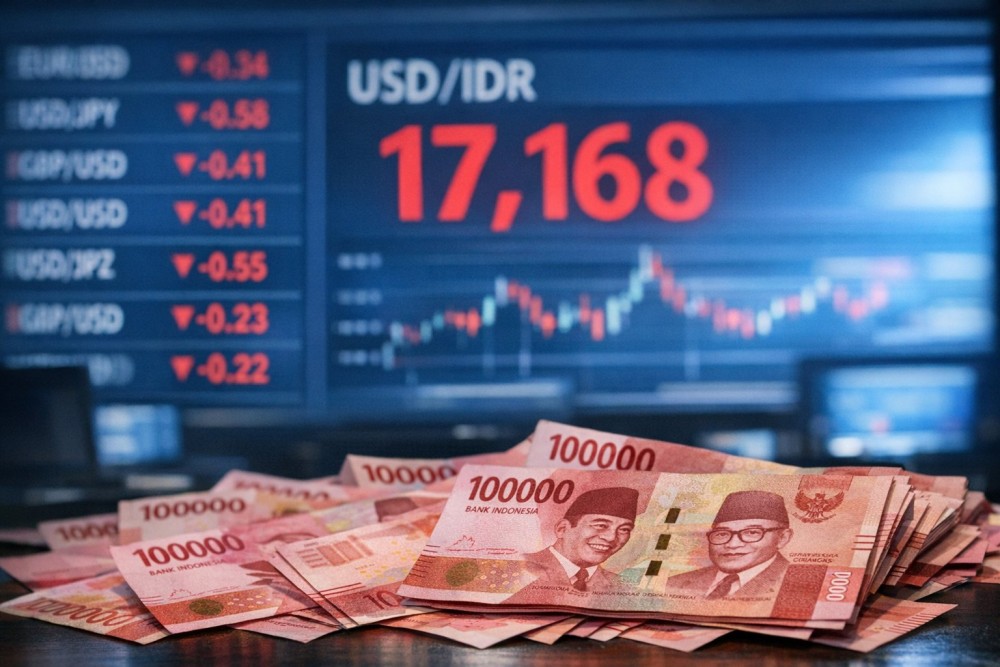
Gotrade News - The Indonesian rupiah ranks as the world's fifth weakest currency according to Forbes Advisor's April 2026 report. It trails only the Iranian rial, Lebanese pound, Vietnamese dong, and Laotian kip.
Despite the ranking, the rupiah closed slightly higher at Rp17,168 per US dollar on Monday (Apr 20), gaining 0.12%. Only three Asian currencies posted gains in afternoon trading: the Taiwan dollar, Philippine peso, and rupiah, according to Bloomberg Technoz.
Key Takeaways:
- Rupiah ranks 5th weakest currency globally per Forbes, despite a 0.12% daily gain to Rp17,168
- Government policy concerns and fiscal sentiment are key pressures per Fitch Solutions
- CORE Indonesia economist argues nominal weakness does not reflect underlying fundamentals
Fitch Solutions identified government policy concerns as a significant pressure factor on the rupiah. Fiscal discipline and economic policy credibility remain top concerns for foreign investors, according to Kompas.
CORE Indonesia economist Yusuf Rendy Manilet argued that the weakest currency label does not reflect fundamental economic weakness. Movement direction, stability, and purchasing power are more relevant indicators, according to Katadata.
Foreign capital flows into Bank Indonesia's Rupiah Securities (SRBI) instruments continue to show strong interest. At the April 17 auction, total bids reached Rp50 trillion although Bank Indonesia absorbed only Rp19 trillion.
Bank Indonesia has increased SRBI auction frequency to twice weekly since February 2026. The move aims to attract foreign capital and stabilize the exchange rate amid global pressures.
Several structural factors continue to weigh on the rupiah's performance overall. Import dependence, capital outflow pressures, and growing government financing needs represent the primary challenges.
Indonesia's gold reserves stand at approximately 85 metric tons, far below China's 2,303.5 tons as of Q1 2026. Manilet notes that increasing gold reserves is a long-term diversification strategy rather than an immediate rupiah-strengthening solution.
The rupiah's daily gain came amid persistent US-Iran conflict uncertainty that continues to shadow regional markets. Investors remain focused on geopolitical developments and monetary policy direction in the weeks ahead.