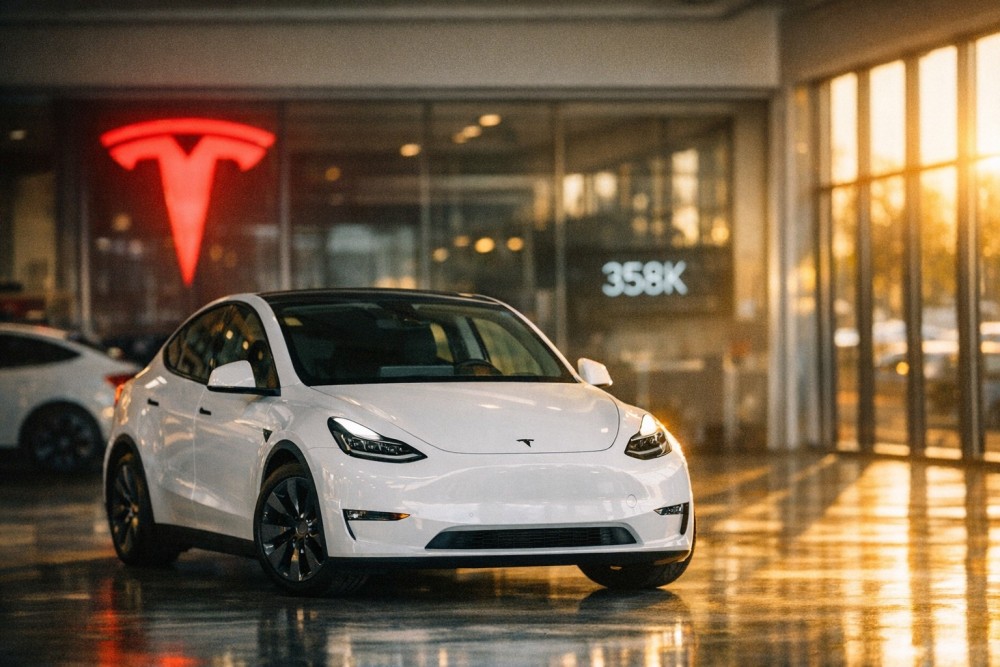
Gotrade News - Tesla is set to report first-quarter 2026 financial results on Tuesday, April 22, as investors weigh whether the electric vehicle giant can sustain its growth narrative amid slowing deliveries and surging capital expenditure plans. TSLA shares closed at $400.41 on Friday, up 3% on elevated trading volume of 91 million shares, well above the 63 million daily average, pushing the company's market capitalization to $1.5 trillion.
Key Takeaways:
- Q1 2026 deliveries came in at 358,023 units, missing Wall Street's consensus estimate of approximately 370,000 vehicles by roughly 12,000 units
- Capital expenditure for 2026 is expected to exceed $20 billion, more than double the $8.5 billion spent in 2025, funding new factories and AI infrastructure
- At a P/E ratio of approximately 370, far above traditional automakers trading at P/E ratios of 5 to 15, analysts suggest waiting for a better entry
Tesla delivered 358,023 vehicles in Q1 2026, marking a 14% sequential decline from the previous quarter while still posting 6% year-over-year growth compared to the same period last year. According to Motley Fool, Wall Street had expected approximately 370,000 deliveries, meaning Tesla fell roughly 12,000 units short of the consensus estimate.
The sequential decline suggests that Tesla's aggressive price cuts implemented throughout 2025 have not fully translated into sustained demand momentum across its key markets in North America, Europe, and China. The company faces an increasingly competitive electric vehicle landscape, with ambitious new entrants from China, Europe, and the United States intensifying the battle for market share across every major geography.
Friday's trading volume of 91 million shares represented a 44% surge above the daily average of 63 million shares typically exchanged on normal trading sessions. This elevated activity reflects a mix of investor anticipation and anxiety heading into what many consider one of the most consequential earnings releases of the quarter.
Production Outpacing Demand
Production reached 408,386 units during Q1 2026, representing approximately 13% year-over-year growth compared to the same period in the prior year across all Tesla manufacturing facilities. The significant gap between production output and actual deliveries added roughly 50,000 vehicles to Tesla's growing inventory, signaling a potential structural imbalance between factory capacity and real consumer demand at current price points.
This inventory buildup is particularly concerning given that Tesla had already implemented substantial price reductions across multiple models to maintain competitiveness against rivals offering lower-priced alternatives. Gross margins stood at 18.03%, a level that reflects ongoing pressure on per-vehicle profitability as the company balances volume growth against margin preservation.
During the full year 2025, Tesla delivered approximately 1.6 million vehicles globally, with vehicle sales accounting for a dominant 73% of the company's total revenue during that period. The company experienced declining vehicle sales through much of the year driven by intense pricing competition across the EV industry before showing modest signs of demand recovery at the start of 2026.
These dynamics make Tuesday's Q1 2026 earnings report a critical juncture for investors evaluating whether Tesla's pricing strategy is delivering results commensurate with margin sacrifice. Should margins continue to erode while delivery volumes miss expectations, the pressure on the stock's already stretched valuation could intensify meaningfully.
The AI and Autonomy Bet
Tesla plans to deploy more than $20 billion in capital expenditure during 2026, directed toward new factory construction and large-scale artificial intelligence compute infrastructure development. This represents a dramatic increase from the $8.5 billion spent in 2025, underscoring the extraordinary scale and urgency of the company's autonomous technology ambitions going forward.
The company has successfully taped out its next-generation AI5 self-driving chip, purpose-built for autonomous driving applications at commercial scale across diverse environments. Its current AI4 chip reportedly outperforms human safety benchmarks across multiple testing scenarios, providing the technical foundation for Tesla's ambitious self-driving roadmap.
Key products in the development pipeline include the robotaxi autonomous ride-sharing network and the purpose-built Cybercab vehicle, which is expected to enter the market later in 2026. The Optimus humanoid robot also remains an integral part of Tesla's longer-term vision for revenue diversification beyond the traditional automotive business.
As noted by Motley Fool, Tesla is currently "priced for the future, not the present," meaning its premium valuation leaves virtually no room for execution disappointments or timeline delays. The success of this transformative vision ultimately hinges on proving that autonomous vehicles can operate safely without human drivers across diverse traffic conditions.
With a P/E ratio of approximately 370, Tesla trades at a dramatic premium compared to traditional automakers, which typically carry P/E ratios in the range of 5 to 15 times earnings. This valuation reflects extraordinarily high market expectations for Tesla's potential to fundamentally reshape the transportation and energy industries through artificial intelligence technology.
In the competitive EV landscape, Rivian continues to scale production capacity for its electric trucks and SUVs in the United States while NIO expands its battery-swapping infrastructure network across China and into European markets. Tesla must demonstrate that its massive investments in autonomous technology and AI will yield durable competitive advantages that rivals simply cannot replicate.
Tuesday's Q1 2026 report will serve as a pivotal moment to assess whether Tesla can maintain its growth narrative amid delivery slowdowns and a massive ramp in capital spending requirements. Investors should recognize that at current valuation levels, this stock demands near-flawless execution across every single business segment to justify its premium pricing in the market.
Sources:
- Motley Fool, "Is Tesla Stock a Buy in the Second Quarter of 2026?", April 19, 2026
- Motley Fool, "Is Tesla Stock a Buy Ahead of Earnings?", April 19, 2026