The amd data center segment just posted $5.8 billion in Q1 FY2026, up 57 percent year over year, and the print changes every ai chip portfolio decision on your screen. AMD shares jumped 15 percent, total revenue hit $10.3 billion (+38 percent), non-GAAP EPS at $1.37.
If you own NVDA only, reassess now. If you own AMD, decide whether to add, hold, or rotate part of the gain.
Quick Context: Data Center Revenue Jumped to $5.8B (+57%)
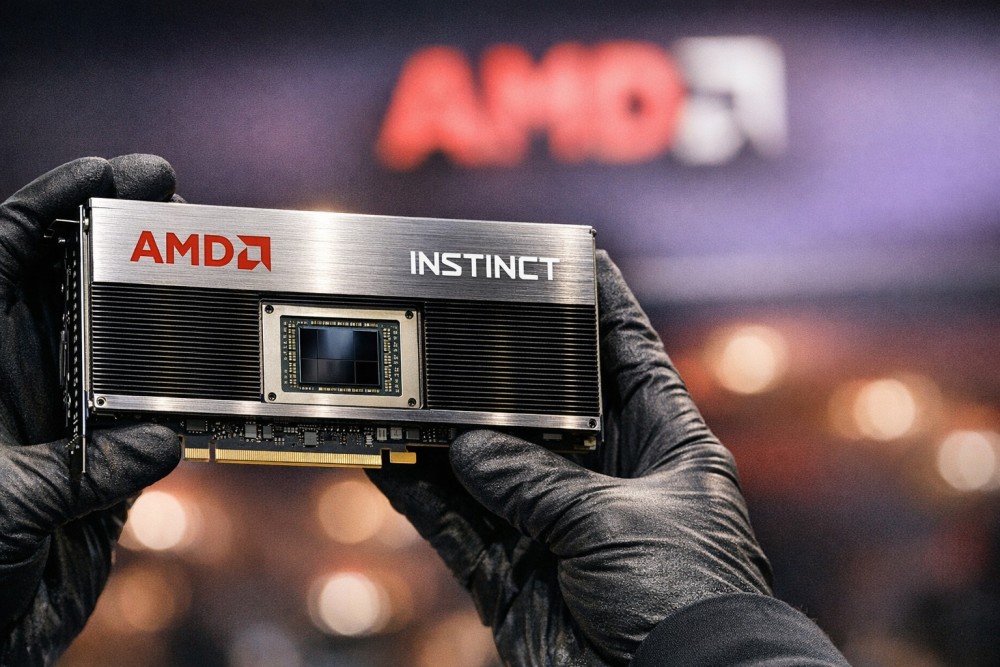
AMD data center revenue climbed from $3.67 billion a year ago to $5.8 billion, driven by Instinct GPU shipments and EPYC server CPU strength. Management guided Q2 revenue to roughly $11.2 billion (+46 percent YoY). That guide is what triggered the 15 percent move, because it says the Instinct ramp is not a one-quarter event.
AMD is now a credible second source in AI training and inference, with hyperscaler visibility deep enough to support multiple expansion. The full action plan from the print sits in our AMD Q1 beat-and-raise breakdown.
Why This Forces an AI Sleeve Re-Rating
Before this print, the consensus AI sleeve looked like 70 percent NVDA, 15 percent AMD, 15 percent ASIC. That mix is now too NVDA-heavy.
The Meta deal changes customer concentration
In February 2026 AMD and Meta announced a 6GW Instinct deployment, with the first 1GW on the custom MI450 platform and shipments starting H2 2026. Independent estimates put the contract at $60 billion over five years. With confirmed Microsoft and Oracle orders too, AMD now has hyperscaler visibility that was NVDA-exclusive.
Hyperscaler capex tailwind keeps the sleeve hot
Aggregate hyperscaler AI capex for 2026 is tracking above $300 billion. Even if NVDA holds 80 percent of training share, the spillover supports a 30 to 40 percent AMD weight inside the AI sleeve.
Not in Yet: Entry Strategy After the Q1 Print
If you are flat AMD after the +15 percent pop, do not chase the full position in one clip. The risk is a giveback over the next two to three weeks as fast money trims.
Tier the entry across three legs
Put one third of your target AMD weight on now to capture the guidance upgrade. Put the second third into any pullback of 5 to 8 percent over the next 10 trading days. Hold the final third for the sentiment dip that usually follows a strong print by four to six weeks.
Use options only if you already understand them
June or July at-the-money calls let defined-risk investors participate without full equity capital. Cash-only investors should stick to the tiered equity entry.
Ready to act on the AMD print? Open a Gotrade account and trade AMD, NVDA, and the AI chip sleeve in fractional shares.
NVDA-Only Holders: Add AMD or Stay Concentrated
If your AI exposure is 100 percent NVDA, this print is the cleanest trigger this year to diversify. The amd vs nvda weight question stops being theoretical once a second hyperscaler-grade vendor delivers 57 percent growth on a $5.8B base.
Trim 10 to 20 percent of NVDA into AMD
NVDA still owns the CUDA moat and the Blackwell ramp is real, so a full rotation is wrong. If your NVDA weight is 20 percent of your portfolio, trim it to 16 to 18 percent and put the freed capital into AMD.
Stay concentrated only if you have a specific NVDA thesis
If you own NVDA because CUDA lock-in keeps training sticky for three to five more years, do not dilute it. But be honest about whether you own NVDA for the moat or because it has been the winning ticker.
Action Plan: Optimal AMD vs NVDA vs ASIC Weights
For a 20 percent AI infrastructure sleeve, the post-print weights I would target are NVDA at 50 percent, AMD at 30 percent, and ASIC at 20 percent split between AVGO and MRVL. AVGO covers custom silicon for Google and Meta. MRVL covers Amazon custom silicon plus optical interconnect. For a deeper look at non-NVDA names, see our 3 semiconductor stocks beyond NVDA piece.
Why ASIC names belong in the sleeve
Custom silicon is the third leg of the AI buildout. Hyperscalers will not buy 100 percent merchant GPUs forever, so ASIC plays grow with capex even if slower than GPU vendors.
Rebalance trigger rules
Rebalance quarterly, not weekly. Trim any name back to target if it runs more than 10 points above. Add to any name that drifts more than 5 points below.
Conclusion
AMD just delivered the kind of data center number that forces every AI chip portfolio decision back onto the table. A 57 percent jump on a $5.8B base is not noise, and the Q2 guide says the ramp continues.
If you are flat AMD, tier in across three legs. If you are NVDA-heavy, trim 10 to 20 percent into AMD plus a measured ASIC allocation. The thesis is no longer pick the AI winner. It is own the AI infrastructure stack at the right weights.
Trade the AI chip sleeve on Gotrade with fractional shares.
FAQ
How big was the AMD data center segment in Q1 FY2026?
It came in at $5.8 billion, up 57 percent year over year from $3.67 billion last year.
Should I sell all my NVDA to buy AMD?
No. Rotate 10 to 20 percent of your NVDA into AMD to keep CUDA moat exposure while diversifying.
What ASIC stocks fit alongside AMD and NVDA?
AVGO for Google and Meta custom silicon, and MRVL for Amazon custom silicon plus optical interconnect.
What is the Meta MI450 deal worth to AMD?
Independent estimates put the 6GW deployment at roughly $60 billion over five years, with first shipments in H2 2026.