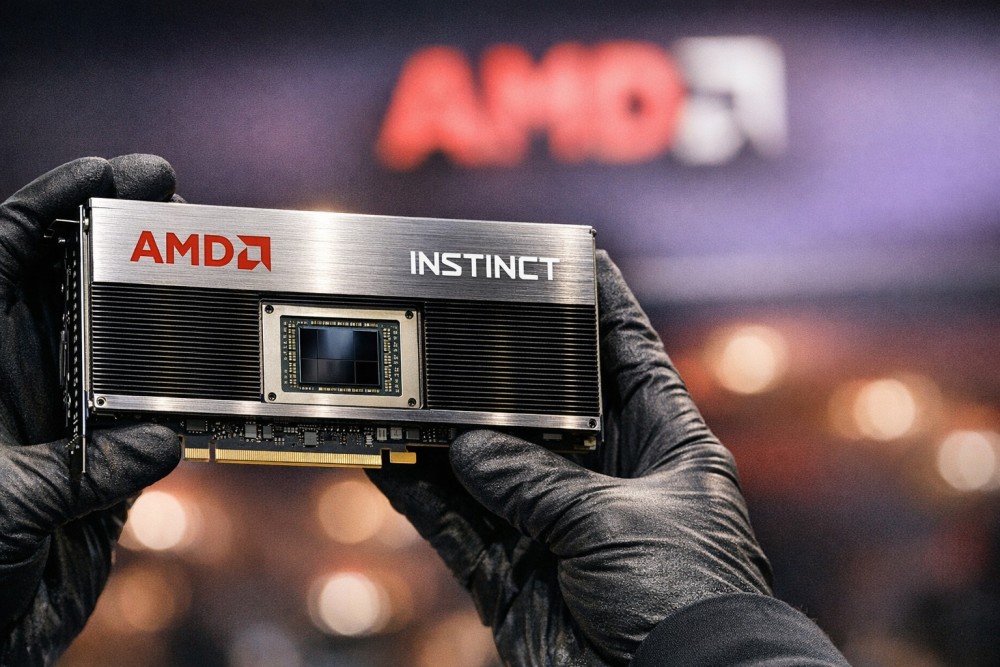
The amd q1 2026 earnings print landed exactly the way bulls wanted, and the +15% gap up is forcing every AMD investor to make a decision rather than cheer the headline. Revenue of $10.3 billion crushed the $9.85 billion consensus, Data Center surged 57% year over year to $5.8 billion, and management raised Q2 guidance to $11.2 billion at the midpoint.
The question is what you do with your position on Wednesday morning?
$10.3B Revenue, +57% Data Center, +15% Stock Pop
This was a clean beat-and-raise. Non-GAAP EPS hit $1.37, up 43% YoY, and GAAP EPS was $0.84. According to Yahoo Finance, Data Center alone added more revenue year over year than the rest of the business combined.
The Q2 guide of $11.2 billion plus or minus $300 million implies roughly 46% YoY growth at the midpoint, with non-GAAP gross margin around 56%. The MI450 ramp also got the green light, with the first 1 gigawatt deployment under the META agreement shipping in the second half of 2026.
Why the print mattered for your position
The Meta wins are no longer paper wins. Shipped revenue into a named hyperscale customer with a five-year contract removes the biggest bear argument.
What changed in the bull thesis
Before the print, the bull case rested on guidance. After the print, it rests on contracted product flowing through the P&L.
AMD Holders: When to Add, Hold, or Trim After the Pop
If you already own AMD, the +15% gap is rewarding your conviction and concentrating your portfolio whether you wanted that or not.
If you are sitting on a 30%+ gain
Trim 20-30% into the gap. Not because the thesis is broken, but because position sizing says you take chips off the table when the market hands them to you. Move your stop on the rest to just below the pre-earnings close.
If you are flat or slightly green
Hold the full position and let the new guidance work. Move your stop to the 20-day moving average. Trimming a small winner into a beat-and-raise is the mistake that turns AMD into a stock you wish you had held.
Open Gotrade and check your AMD weight as a percentage of your total portfolio. If it is above 8%, the gap up just made the trim decision for you.
Not in Yet: Entry Strategy After a 15% Gap Up
Chasing a 15% gap into a name everyone is talking about is the fastest way to underperform over the next 90 days. The print was real, but the entry math is not.
The pullback playbook
Wait for AMD to pull back to the rising 20-day moving average and start a half-position there. Post-earnings drift in mega-cap semis usually delivers a 4-7% retrace within 5 to 10 trading days.
If the pullback never comes
If the stock grinds higher for a full week without a 3% red day, accept you missed the optimal entry and start a quarter-position instead. Add the second quarter only on a confirmed test of the gap-fill.
Portfolio Impact: Sizing AMD vs NVDA vs ASIC Plays
One earnings beat does not change the structure of your AI book. It changes the weights inside it. Most retail portfolios are over-indexed to NVDA and under-indexed to the second-source story.
Target weights coming out of this print
A defensible allocation looks like 8% to 10% NVDA, 3% to 5% AMD, and 2% to 3% in custom-silicon exposure via the hyperscalers themselves, including META for its in-house ASIC roadmap. Combined accelerator exposure stays inside 15%.
Why AMD now earns a bigger seat
The Meta deal gave AMD a contracted multi-year revenue stream that did not exist 90 days ago. As CNBC reports, data center growth is now tracking ahead of the broader AI semi group. Diversified semiconductor exposure remains the safer expression for anyone uncomfortable picking single winners.
30-Day Action Plan: Triggers, Stops, and Profit Targets
Discipline beats opinion every quarter. Here is the plan for the next 30 trading days.
For existing holders
First profit target is a 10% move above the gap-up close; take another 25% off there. Hard stop sits 3% below the pre-print close, no exceptions. If the stock revisits that level, the gap is failing and you want out.
For new entrants
Set a price alert at the rising 20-day moving average and start a half-position there. Stop loss goes 5% below entry. First add only on a higher low confirmed on a closing basis.
Conclusion
AMD Q1 2026 was the cleanest beat-and-raise the company has printed in this AI cycle. The easy money is already gone, and from here the trade is about sizing, stops, and patience.
Holders trim into strength and trail the rest. New buyers wait for the pullback and size in halves. Everyone caps total accelerator exposure inside 15% of the book.
Open Gotrade, pull up your AMD weighting, and decide which plan applies before Wednesday's open. Have your ticket ready and let discipline do the work.
FAQ
Should I sell all my AMD after the 15% pop?
No, full exits on a beat-and-raise typically underperform over the next 90 days; trim 20-30% and trail the rest.
Is it too late to buy AMD here?
Buying the gap-up open is rarely the best entry; wait for a pullback to the 20-day moving average for a half-position.
How does AMD compare to NVDA after this print?
NVDA stays the larger position by structure, but AMD now earns a 100-200 basis point overweight versus most retail portfolios.
What is the single biggest risk from here?
Hyperscaler capex digestion or any delay in the MI450 ramp into Meta in the second half would re-rate the stock fast.