A compound interest investing calculator is the simplest tool in personal finance, and also the most underrated. Feed it $200 per month, a realistic market return, and 30 years, and the output often lands in six-figure territory. The power of compounding in the stock market is arithmetic that rewards patience, and it explains how $200 a month becomes rich-level savings for investors who start early.
Compound Interest Explained: The Math Behind Wealth Building
The classic compound interest formula is A = P(1 + r/n)^(nt), where P is principal, r is the annual rate, n is compounding periods per year, and t is years. In plain English, you earn returns on your original money, then returns on those returns, and the base keeps growing.
Simple interest pays a flat return on the original principal. Compound interest pays on principal plus every prior gain, which is why the growth curve bends upward rather than running in a straight line.
Time is the most powerful variable in the equation, not the rate. Doubling your horizon from 15 to 30 years does more than bumping your return from 8% to 10%, because each extra year multiplies the already-compounded base.
According to Investor.gov, the SEC defines compound interest as interest paid on principal and on accumulated interest, and urges investors to start as early as possible.
A quick mental shortcut is the Rule of 72. Divide 72 by your expected return to get the years it takes to double your money. At 8%, money doubles every nine years. At 12%, every six.
Simulation: $200 per Month at Different Return Rates
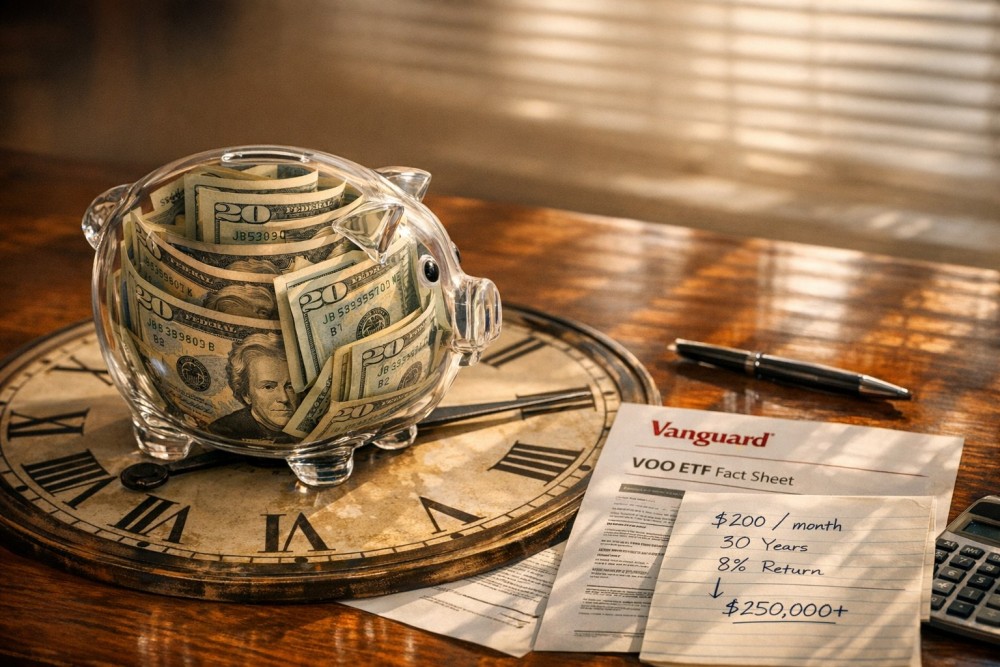
Here is $200 per month, or $2,400 per year, compounded monthly at 8%, 10%, and 12% across three time horizons, using the future value of an ordinary annuity formula.
| Time Horizon | 8% Return | 10% Return | 12% Return |
|---|---|---|---|
| 10 years | ~$36,589 | ~$41,310 | ~$46,739 |
| 20 years | ~$117,804 | ~$151,874 | ~$197,851 |
| 30 years | ~$298,072 | ~$452,098 | ~$698,202 |
Notice how the 8% to 12% gap widens dramatically with time. At 10 years, the 12% path beats 8% by roughly $10,150. At 30 years, the same spread produces a $400,000 difference on identical contributions.
That is the case for staying in diversified equities instead of cash. A four-point return improvement is life-changing when given thirty years to compound.
Ready to start your own $200 per month DCA habit? Open a Gotrade account and set up a recurring buy into VOO with fractional shares from US$1.
Real-World Examples: S&P 500 Historical Compounding
The 10% rate in the simulation is not hypothetical. According to NYU Stern's Damodaran dataset, the S&P 500 has delivered roughly a 10% nominal compound annual return from 1928 through 2024, with inflation-adjusted real returns near 7% per year.
The market does not hand out 10% every calendar year. Some years return 30%, others drop 20%. Rolling 20-year and 30-year windows have historically averaged close to that long-term mean, which is why compounding rewards patient investors.
For practical exposure, broad index ETFs are the cleanest tool. SPY was the original S&P 500 ETF and remains the most liquid. VOO and VTI from Vanguard deliver core market exposure at a 0.03% expense ratio, with VTI extending to mid and small caps.
How to Maximize Compounding
Knowing the math is half the battle. Behavior is the other half, and three habits separate investors who capture long-term compounding from those who do not.
1. Start early, time is the biggest lever
Starting at 25 instead of 35 can nearly double your 30-year outcome, even with smaller contributions. The earliest dollars do the heaviest lifting because they compound the longest.
2. Stay consistent with DCA
A disciplined dollar cost averaging plan removes the guesswork of timing the market and smooths your cost basis across bull and bear phases. It also protects you from sitting in cash waiting for a better entry.
3. Reinvest dividends automatically
Reinvested dividends have historically contributed a meaningful share of total S&P 500 returns. Turning on automatic reinvestment means every payout buys more shares, which generate their own dividends. It is the most underrated button in any brokerage account.
Conclusion
The $200 monthly path proves six-figure outcomes are not reserved for high earners. They are reserved for disciplined investors who give their capital enough time and diversification. The math does not care about your starting salary, only your starting date.
Pairing that discipline with a long-term investing mindset keeps you in the market through drawdowns where compounding does its quietest work. Investors who sell during 20% corrections rarely capture the 30-year averages that make the table work.
Start your compounding machine today on Gotrade apps. Set up a $200 monthly DCA into VOO or VTI with fractional shares from US$1, turn on automatic dividend reinvestment, and build your core S&P 500 position one paycheck at a time.
FAQ
How much does $200 per month become in 30 years at 10% return?
Roughly $452,098, based on the future value of an ordinary annuity formula with monthly compounding.
Is 10% a realistic expected return for stocks?
Yes, the S&P 500 has averaged around 10% nominal annualized since 1928, though any single year can vary widely.
Can I really start with only US$1 on Gotrade?
Yes, Gotrade's fractional shares let you build positions in VOO, VTI, or SPY starting from US$1 per order.
Should I wait for a market dip before starting my DCA?
No, time in the market beats timing the market for long-term compounding, which is why consistent DCA usually wins.