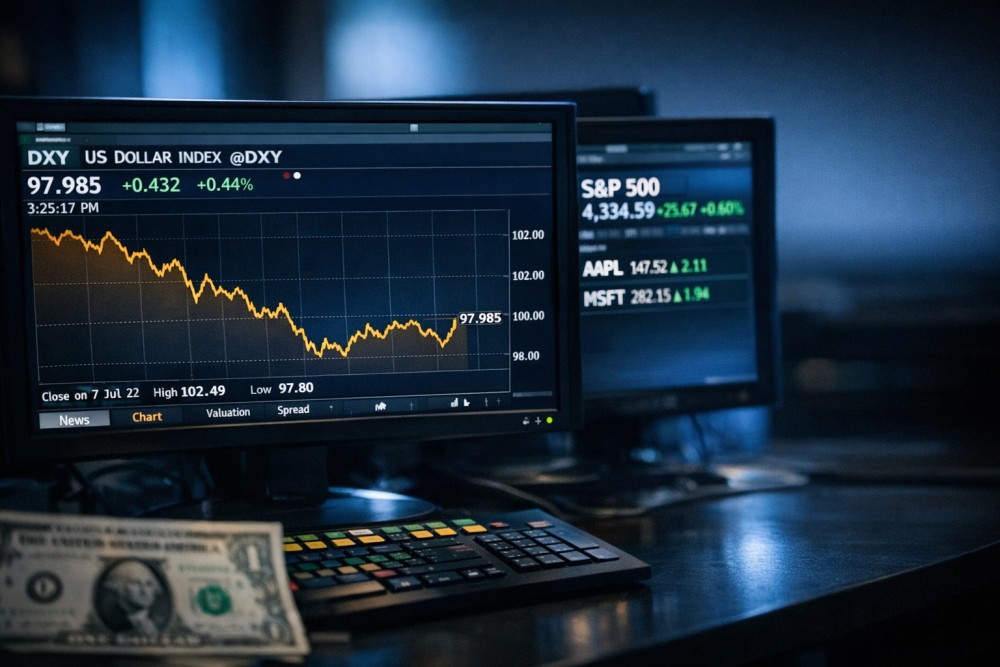
The Dollar Index DXY explained in one line: it is the most-watched gauge of US dollar strength, and it quietly shapes the earnings of nearly every large US company you own. Understanding how DXY affects the stock market helps investors read macro risk without a forex account.
A sustained move in the dollar can change the earnings math for hundreds of S&P 500 names in a single quarter.
What Is the Dollar Index and How Is It Calculated
The DXY is a geometric-mean index that measures the US dollar against a fixed basket of six major currencies. It launched in March 1973 after the end of Bretton Woods, with a baseline of 100.
According to ICE, the basket weights are fixed at euro 57.6%, Japanese yen 13.6%, British pound 11.9%, Canadian dollar 9.1%, Swedish krona 4.2%, and Swiss franc 3.6%.
The euro alone accounts for more than half the index, so DXY is effectively a euro-dollar proxy with add-ons. ICE Futures US lists DXY futures and options.
As of late April 2026, DXY trades near 98.5, well below its 2024 highs but firming on safe-haven flows.
The Inverse Relationship Between DXY and Multinational Earnings
Roughly 40% of S&P 500 revenue is generated outside the United States. When foreign sales translate back into a stronger dollar, reported figures shrink even when underlying demand is unchanged.
A rule of thumb: every 10% sustained rise in DXY shaves 2% to 4% off S&P 500 EPS, and the drag concentrates in the most global names.
Apple (AAPL) generates roughly 60% of revenue overseas, Microsoft (MSFT) about 50%, Coca-Cola (KO) close to 65%, and Procter & Gamble (PG) roughly 55%.
When the dollar weakens, the math flips, and multinationals often surprise to the upside on margins without doing anything different operationally.
Want to see how your US holdings would react to a dollar move? Open your Gotrade portfolio and check how much of your exposure is tilted toward multinationals versus domestic-revenue names.
DXY Correlation with Other Assets
1. DXY vs commodities
Most global commodities, including oil and copper, are priced in US dollars. A stronger DXY makes those raw materials more expensive for non-US buyers, dampening global demand.
Energy and materials stocks usually underperform when DXY is in a clear uptrend and lead when the dollar rolls over. According to Reuters, commodity-linked equities have historically moved inversely to sustained dollar strength.
2. DXY vs emerging markets
A strong dollar is brutal for EM economies with USD-denominated debt. Repayment burdens rise in local-currency terms, tightening financial conditions without any central bank action.
This is why EM equity indices often trade as a near-mirror image of DXY on a multi-month view. If you own EM ETFs or ADRs, dollar direction matters as much as local earnings.
3. DXY vs gold (GLD)
Gold is priced in dollars and pays no yield, so it competes directly with holding dollar assets. When DXY strengthens, gold tends to fall; when the dollar rolls over, gold catches a bid.
For stock investors, the SPDR Gold Trust (GLD) is the cleanest equity-like way to express a weak-dollar view.
How to Use DXY as a Signal for Stock Portfolio Decisions
DXY is most useful as a regime filter rather than a short-term timing tool. Small daily moves rarely matter, but sustained breaks from one regime to another do.
Tilt with the trend
When DXY breaks out hard to the upside, consider tilting toward domestic-revenue names such as US small caps, regional banks, and utilities that earn almost everything in dollars. When DXY rolls over, lean back into multinational compounders and selectively add emerging-market exposure.
Use the 200-day moving average
A cleaner signal than watching daily ticks is tracking DXY relative to its 200-day moving average. Sustained trading above the 200-day is a dollar-strength regime; sustained trading below flips the setup for multinationals and commodities.
Pair with Fed policy
DXY does not move in a vacuum. Pair it with Federal Reserve meeting dates, because shifts in rate expectations are the single biggest driver of the dollar. A hawkish Fed plus a rising DXY is a much stronger signal than either alone.
Conclusion
The Dollar Index is a portfolio-level input that touches earnings, commodities, emerging markets, and gold at once. Ignoring it means accepting hidden macro risk in what looks like a clean US-only stock portfolio.
Know how much of your exposure earns revenue overseas, watch DXY relative to its 200-day trend, and treat Fed meetings as the main catalyst that can flip the regime.
Open your Gotrade account and review your multinational exposure today. If your book is concentrated in global names, consider adding GLD or a domestic-revenue core holding as a DXY hedge.
FAQ
Q: What is the Dollar Index (DXY) in simple terms?
It is a single number that measures the US dollar against a fixed basket of six major currencies, heavily weighted toward the euro.
Q: Does a stronger dollar always hurt US stocks?
Not always; it mainly pressures multinationals, commodities, and emerging markets while helping domestic-revenue names like small caps and regional banks.
Q: How does DXY affect gold and GLD?
Gold is priced in dollars, so a stronger DXY usually drags GLD lower, while a weaker dollar typically supports higher gold prices.
Q: How often should I check DXY as a long-term investor?
Checking weekly against the 200-day moving average is usually enough, with extra attention around Fed meetings and major macro data releases.