Quantum computing stocks 2026 are one of the most polarizing corners of the US market: real scientific progress on one side, valuations assuming commercial payoff still years away on the other. For diversified investors, the question is not whether to buy quantum, but how to size a speculative sleeve.
The State of Quantum Computing Technology in 2026
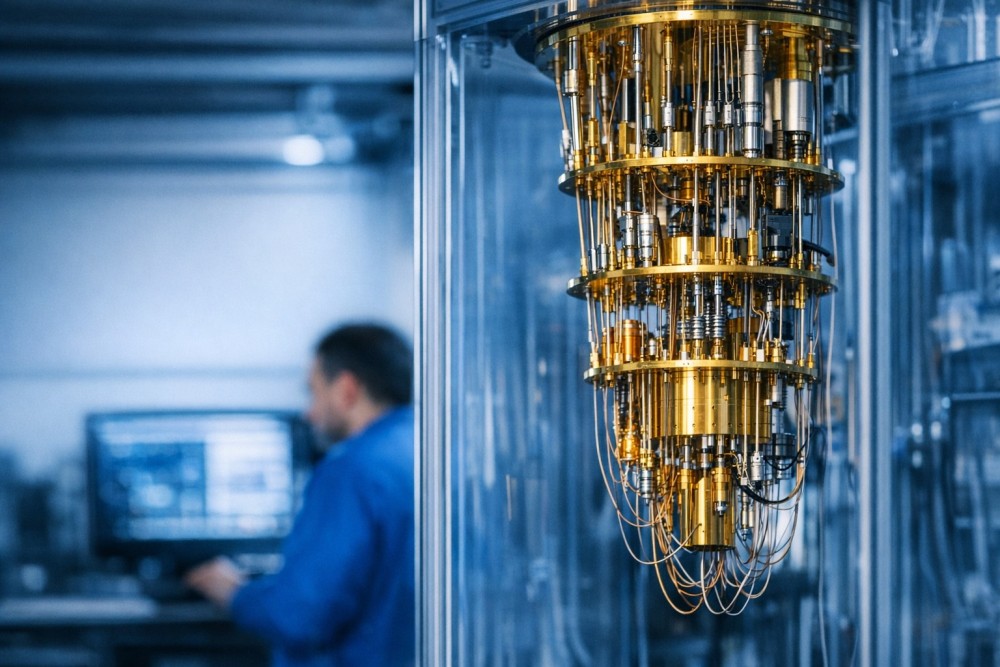
The industry still operates in the NISQ era, noisy intermediate-scale quantum. Today's leading systems top out in the low hundreds to low thousands of physical qubits, with error rates that require aggressive correction.
The big 2024 headline came from Google. According to Google Research, the 105-qubit Willow chip achieved "below threshold" quantum error correction, meaning adding more physical qubits reduces logical error rates rather than amplifying them.
Three architectures dominate. Superconducting qubits (Google, IBM, Rigetti) are most mature at scale. Ion-trap systems (IonQ) trade speed for fidelity. Photonic and topological approaches (QUBT, Microsoft) are earlier stage but carry long-term scaling arguments.
Commercial "quantum advantage" for real-world problems is still a work in progress. Useful chemistry, cryptography, and optimization workloads at scale remain a late-decade story. That gap is why these stocks trade like lottery tickets.
Public Quantum Stocks
1. IonQ (IONQ)
IonQ is the largest pure-play by revenue, with roughly US$130 million in 2025 sales and 2026 guidance of US$225-245 million. The business rests on trapped-ion hardware and partnerships with AWS Braket, Microsoft Azure, and US government programs.
Risk callout: IonQ runs at a large adjusted EBITDA loss and has repeatedly issued equity. The multiple depends on the 256-qubit target for late 2026 translating into commercial workloads by 2028-2030.
2. Rigetti Computing (RGTI)
Rigetti takes a modular superconducting approach. Its 108-qubit Cepheus-1 system, built from twelve 9-qubit chiplets, reached general availability in Q1 2026 at roughly 99.1% median two-qubit gate fidelity. Its Fab-1 is one of the few integrated quantum-device fabs in the industry.
Risk callout: revenue is small, customers concentrate in government labs, and the 2027 roadmap to 1,000+ qubits assumes fab execution that has slipped before.
3. D-Wave Quantum (QBTS)
D-Wave is the odd one out: built on quantum annealing rather than gate-based computing. That makes it suited to optimization and has produced a real commercial book, with recent 2026 deals including a US$20 million Florida Atlantic University system sale and a US$10 million QCaaS agreement with a Fortune 100 buyer.
Risk callout: annealing's long-term relevance versus fault-tolerant gate-based machines remains debated. Treat QBTS as an optimization-software business with quantum optionality.
4. Quantum Computing Inc (QUBT)
QUBT is the smallest and highest-beta pure-play, built around photonic and entropy-based computing. Revenue is thin and the story rests on architecture scaling arguments rather than shipped commercial workloads.
Risk callout: tiny float, brutal volatility, high dilution risk. Speculative even by this group's standards.
Quantum belongs in the speculative sleeve, not the core.
Use Gotrade fractional shares to build positions from US$1 per order and cap total exposure. Start the Quantum Computing frontier watchlist on Gotrade, now!
Big Tech's Quantum Efforts
1. Alphabet (GOOGL) and Google Quantum AI
Alphabet runs Google Quantum AI, producer of the Willow logical-qubit milestone. For equity investors, quantum is a rounding error on Alphabet's search and cloud cash flows today, but an asymmetric call option on long-term compute.
2. IBM Quantum
According to IBM Research, the Heron R2 156-qubit processor now powers cloud systems in the US and EU, supports up to 5,000 two-qubit gates, and targets a "quantum advantage" demonstration in 2026. IBM also has the deepest enterprise-sales motion in the space.
3. Microsoft Azure Quantum
Microsoft's Majorana 1 chip, unveiled in February 2025, aims at topological qubits that could in theory scale to a million qubits per chip. The science remains contested, but Microsoft has the balance sheet to keep pushing.
Risk Profile: Why Quantum Computing Remains Highly Speculative
There is still no commercial killer app running at scale on quantum hardware. Pure-plays regularly issue equity to fund R&D, so shareholders absorb dilution as the science advances. Architectures can go obsolete if a rival reaches fault-tolerance first.
Volatility is extreme. IONQ, RGTI, QBTS, and QUBT routinely move 10-15% on no news. Drawdowns of 50% or more have happened repeatedly. Anyone sizing these like mainstream AI names is underwriting risk they probably do not intend to take.
Conclusion
Quantum computing is a real technology story with a real investment story attached, but the two do not move in sync. Science is advancing faster than revenue, and revenue faster than profit. Pure-plays belong in a clearly sized speculative sleeve, not a core holding.
The cleanest way to participate is a barbell: Alphabet, IBM, and Microsoft for funded, diversified exposure, and small fractional positions in the pure-plays for asymmetric upside. If any single quantum name going to zero would hurt your plan, you are oversized.
Treat quantum as a decade-horizon idea that needs strict sizing. You can build a quantum computing stocks 2026 watchlist on Gotrade from US$1 per order and review adjacent themes in our guide to AI stocks and primer on speculation in trading.
FAQ
Are quantum computing stocks a good investment in 2026?
They can work as a small speculative sleeve, but they are too volatile and unprofitable to be treated as a core holding.
What is the difference between IonQ and Rigetti?
IonQ builds trapped-ion systems optimized for fidelity, while Rigetti builds modular superconducting chips optimized for scalability.
Is D-Wave a real quantum computer?
D-Wave uses quantum annealing, a specialized technique best suited to optimization problems rather than universal gate-based computing.
How much of my portfolio should be in quantum stocks?
Most risk-aware investors cap frontier themes like quantum at a few percent of total portfolio, sized so a total loss would not derail the plan.