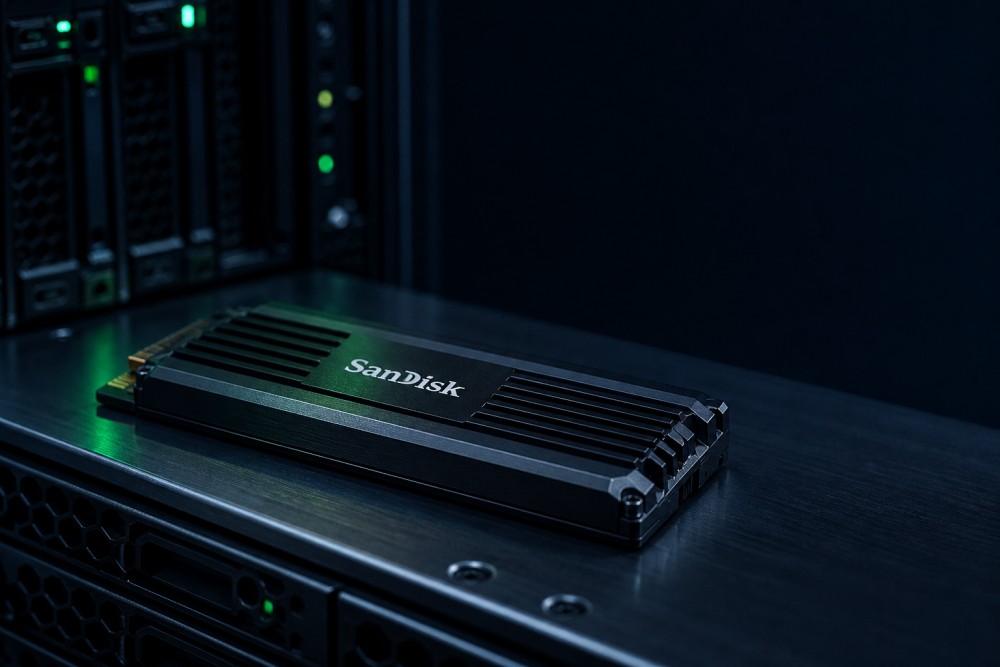
SanDisk has been the surprise winner of the 2026 AI trade. The pure-play NAND maker has gone vertical since its early 2025 spin-off from Western Digital, leaving most semiconductor names behind.
The question is no longer whether the AI memory cycle is real. It is whether you are too late to participate in SanDisk stock after a multi-bagger move.
Below is a practical breakdown of what changed, what the numbers say, and how to think about a buy, hold, or trim decision today.
SanDisk Spinoff: What the New Standalone Looks Like
SanDisk relisted on Nasdaq in February 2025 as a tax-free spin-off from Western Digital, ending nearly a decade of being buried inside a hybrid HDD and flash conglomerate.
The standalone business is now a pure NAND flash and enterprise SSD play. That clean exposure is exactly what investors wanted when AI server demand began consuming flash storage at industrial scale.
Revenue in the most recent quarter reached $3.03 billion, up 61 percent year over year, with data center revenue jumping 645 percent. Enterprise SSD is now the swing factor for both top line and margins.
Why NAND Tightness Is Driving the Rally
The rally is grounded in a real supply-demand mismatch, not just sentiment. NAND prices rose roughly 60 percent in the first quarter of 2026 alone.
According to Yahoo Finance, datacenter revenue jumped 645 percent year over year on hyperscaler AI buildouts, with supply constraints expected to persist into 2028.
Hyperscalers are signing long-dated take-or-pay agreements to lock in capacity. SanDisk has reportedly secured roughly $11 billion in multi-year supply guarantees, which converts cyclical revenue into something closer to a contracted backlog.
This is the structural piece. AI servers are using more NAND per node than traditional cloud workloads, and capacity additions take 18 to 24 months. The gap will not close quickly.
Valuation Reset After a 5x Move
This is where the math gets uncomfortable. SanDisk now trades near 41x trailing earnings, well above its five-year median of about 16x.
Forward multiples look gentler at roughly 24x because consensus EPS has been revised sharply higher. But forward multiples in commodity-adjacent businesses are only as reliable as the next pricing cycle.
Per The Motley Fool, the stock trades at about 24 times forward earnings, with the author suggesting investors wait for at least a 10 percent pullback before adding new money rather than chasing the run.
The takeaway is straightforward. Most of the easy money from the multiple rerating has already been made. From here, the bull case relies on earnings continuing to grow into the multiple, not on the multiple expanding further.
Capacity Discipline and Pricing Outlook
One reason NAND prices have held is that the major suppliers, including SanDisk, Kioxia, Micron, and Samsung, have been disciplined on new wafer capacity since the 2022 to 2023 downturn.
That discipline is now being rewarded. If the four NAND majors maintain measured capex through 2027, pricing power likely extends into next year and protects gross margins.
The risk runs the other way too. Any single supplier announcing a large fab expansion would compress the entire pricing curve. This is the dynamic that has historically broken every memory rally, so it is worth watching capex commentary closely.
For broader memory context, our breakdown comparing Micron and SanDisk as pure-play memory stocks walks through how the two names share NAND tailwinds but diverge on HBM exposure and cycle risk.
Risk-Reward: Buy, Hold, or Take Profit
If you do not own SNDK yet, chasing here is hard to justify. The base case has been priced in, and any disappointment on NAND pricing or AI capex pacing could trigger a sharp drawdown.
If you own it from lower levels, a staged trim is reasonable. Booking 25 to 33 percent of the position locks in a real win while leaving a core for the multi-year supply cycle.
For new buyers, a more disciplined approach is to wait for a 10 to 15 percent pullback, which has happened repeatedly in past memory cycles even within structural uptrends. Pair that with a smaller initial position size than you would normally take.
Avoid is also defensible. If you cannot stomach a 30 to 40 percent drawdown without selling, this is not the right name regardless of the long-term thesis.
Conclusion
SanDisk is a real beneficiary of a real AI memory cycle, but the stock has already done a lot of the work. The structural story still supports owning some exposure, but the entry point matters more than it did six months ago.
Trim winners, hold a core, and let the next pullback decide whether you add. Position sizing matters more than directional conviction at these levels, because even a correct long-term thesis can deliver a brutal interim drawdown. That is the practical playbook for a name that has already moved 5x.
Want to start investing in memory names like SanDisk? Open a Gotrade account from $1 and build your position with fractional shares.
FAQ
Is SanDisk stock still a buy after the 493 percent rally?
For new buyers, waiting for a 10 to 15 percent pullback is more defensible than chasing. Existing holders can trim winners while keeping a core for the multi-year NAND cycle.
What is driving SanDisk's rally?
AI server demand has pushed NAND flash into structural shortage, lifting prices and contracted revenue. SanDisk's pure-play exposure makes it a direct beneficiary.
How expensive is SNDK right now?
The stock trades near 41x trailing earnings versus a five-year median around 16x. Forward multiples look gentler near 24x but rely on continued NAND price strength.
What is the biggest risk to the SanDisk thesis?
A major capacity announcement from any NAND supplier would compress pricing across the industry. That single dynamic has broken every previous memory rally.