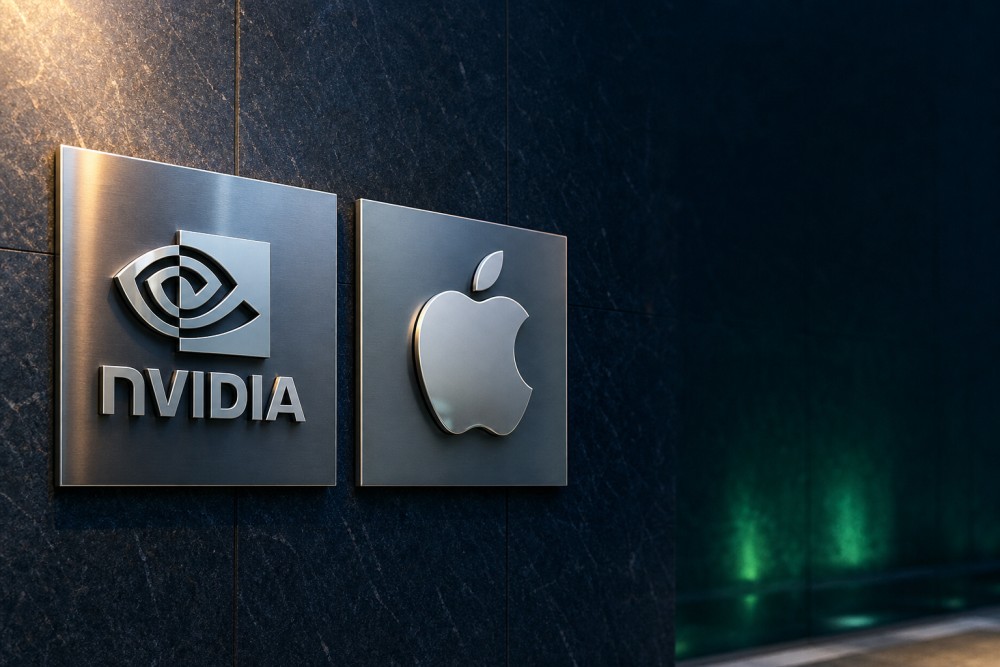
Bank of America walked into June 2026 with the same two names anchoring its US large-cap conviction list: Nvidia and Apple.
Both got reiterated Buy ratings and higher price targets in the last three weeks, on theses BofA has held through several quarters of AI capex debate.
This article translates the latest BofA notes into a practical sizing decision, with the math on what doubling up on AI exposure means for your risk profile.
BofA Buy Thesis on Nvidia and Apple
BofA semiconductor analyst Vivek Arya raised his NVDA price target to $320 from $300 on May 13, 2026, after lifting his 2030 AI data center TAM forecast to roughly $1.7 trillion from $1.4 trillion.
Two weeks later, on May 28, BofA's hardware analyst Wamsi Mohan raised the AAPL target to $380 from $330, pointing to between $15 and $30 billion in potential AI-related revenue by fiscal 2030.
According to Yahoo Finance's summary of the BofA note, the firm frames 2026 as the year of accelerating AI sales and 2027 as the year tokenomics improve as Blackwell and the upcoming Vera Rubin platform scale up.
The pairing is intentional. NVDA captures the picks-and-shovels side of AI infrastructure, while AAPL captures the consumer monetization side through devices and the higher-margin services bundle.
Nvidia: Blackwell Cycle and Sovereign AI Demand
NVDA reported $81.6 billion in Q1 FY27 revenue, up 85% year over year, with data center revenue at $75.2 billion. Blackwell now drives the majority of compute shipped in the quarter.
BofA's bull case rests on three pillars: Blackwell efficiency gains continuing to exceed initial market expectations, hyperscaler capex still scaling through 2027, and sovereign AI orders from governments in Europe, the Middle East, and Asia adding a fresh demand layer.
The clearest near-term risk is customer concentration. NVDA still sells the majority of its data center silicon to a handful of US hyperscalers, and any pause in their capex shows up in NVDA's quarterly numbers within one earnings cycle.
For deeper context on how Blackwell is actually shipping today, our recent post-earnings breakdown walks through the CoWoS packaging constraint at TSMC that still caps near-term upside on Blackwell volumes.
Apple: Gen-AI Upgrade Cycle and Services Margin
AAPL's services revenue hit an all-time high of $31 billion in Q2 2026, up 16% year over year. Services carries roughly 70% gross margin, well above the hardware blend in the 35% range.
BofA's Mohan argues that Apple's edge in AI is not model quality but distribution scale. Over 2.5 billion active devices give Apple a gatekeeper role as AI applications proliferate through the App Store and on-device Apple Intelligence layer.
Per Yahoo Finance's coverage of the BofA upgrade, agentic AI could drive between $15 and $30 billion in incremental Apple revenue by fiscal 2030, combining on-device Apple Intelligence subscriptions with higher App Store take rates as third-party AI apps ramp.
The hardware upgrade cycle adds a near-term catalyst on top of the services rerating. Investors holding AAPL shares get optionality on both a stronger iPhone refresh cycle this fall and a services multiple expansion.
Counterarguments and Concentration Risk
The bear case on NVDA is timing, not direction. At a roughly 45x P/E, the stock prices in continued hyperscaler capex growth, and any quarterly miss or capex guidance reset can compress the multiple very quickly.
For AAPL, the agentic AI thesis depends on execution Apple has not fully shown yet. Consensus price target sits near $308, well below BofA's $380, which tells you the broader Street is not unanimous on the services-led rerating.
The bigger structural risk is correlation. NVDA and AAPL both react to the same AI capex narrative and the same regulatory headlines, so a portfolio holding both does not get the diversification benefit a Buy-the-Mag-7 basket implies on paper.
How to Position Both Names in a Retail Portfolio
Treat NVDA and AAPL as one AI sleeve, not two independent bets. A reasonable starter weight is 5 to 8% combined for a growth-tilted portfolio, split roughly 60/40 toward AAPL given its lower realized volatility and dividend support.
If you already own one, adding the other should come out of your existing AI or tech bucket, not your defensive sleeve. Doubling up here doubles your exposure to hyperscaler capex cycles and to the same handful of supply-chain choke points.
For fractional investors, the practical move is dollar-cost averaging into both over the next two to three months, ahead of NVDA's August quarterly print and AAPL's September iPhone event, rather than chasing a single entry price.
Conclusion
BofA's June 2026 setup keeps NVDA and AAPL at the top of the list for a reason. Both names carry hard catalysts in the next 90 days and reiterated Buy ratings from one of the most-followed sell-side desks on the Street.
The discipline for retail investors is sizing, not stock selection. Buy the thesis, not the headlines, and treat the pair as a single AI bet inside your wider portfolio so the position size matches the correlated risk.
Want to start investing in BofA's top picks like NVDA and AAPL? Open a Gotrade account from $1 and build your position with fractional shares.
FAQ
What is BofA's current price target on NVDA?
BofA reiterated a Buy rating on NVDA with a $320 price target on May 13, 2026, raised from $300 prior on a higher 2030 AI data center TAM.
What is BofA's current price target on AAPL?
BofA reiterated Buy on AAPL with a $380 price target on May 28, 2026, raised from $330 on the agentic AI revenue opportunity.
Should I buy NVDA or AAPL if I can only pick one?
If you need lower volatility and dividend support, AAPL fits better; if you want pure AI infrastructure exposure with higher beta and faster upside, NVDA is the cleaner play.
How much of my portfolio should NVDA and AAPL be?
Most retail growth portfolios cap the combined NVDA plus AAPL weight at 5 to 8%, since both move on similar AI capex catalysts and offer limited diversification when held together.