The SCHD vs VYM question sounds like a coin flip. Both are large, cheap dividend ETFs from trusted issuers. Both screen for income and pay quarterly distributions.
Look closer and the two funds behave differently. The index rules differ, the sector tilts differ, and long term return profiles diverge in ways that matter for a buy and hold portfolio.
This dividend etf comparison breaks down what is under the hood, so you can pick what fits your goals.
Index Methodology: Dow Dividend 100 vs FTSE High Yield
The schwab dividend etf, SCHD, tracks the Dow Jones US Dividend 100 Index. The index starts with US stocks that have paid dividends for at least ten consecutive years, then ranks them by four quality factors.
Those factors are cash flow to total debt, return on equity, dividend yield, and five year dividend growth rate. Only the top 100 names make the cut, and the fund is reconstituted once a year.
VYM tracks the FTSE High Dividend Yield Index. The methodology is simpler. It includes US companies forecast to pay above average dividends over the next 12 months, excludes REITs, and weights the survivors by market cap.
That difference shows up in breadth. According to StockAnalysis, VYM holds 623 securities, while SCHD holds roughly 100. VYM casts a wide net for yield, SCHD applies a quality screen first.
Sector Composition and Concentration
The methodology gap drives the sector gap. SCHD ends up concentrated in mature dividend payers across staples, healthcare, energy, and industrials. Tech exposure comes through legacy names like Texas Instruments and Qualcomm, not high growth software.
VYM has a heavier tilt toward financials and tends to carry meaningful weight in semis through its top holding. According to StockAnalysis, SCHD's top 10 holdings make up about 41.6% of assets. VYM's top 10 sit closer to 24.4%.
That concentration is a feature, not a bug. SCHD is built to express conviction in a smaller slate of high quality dividend names. VYM is built to spread risk across the broader high yield universe.
| Metric | SCHD | VYM |
|---|---|---|
| Index | Dow Jones US Dividend 100 | FTSE High Dividend Yield |
| Holdings | ~100 | ~623 |
| Top 10 weight | ~41.6% | ~24.4% |
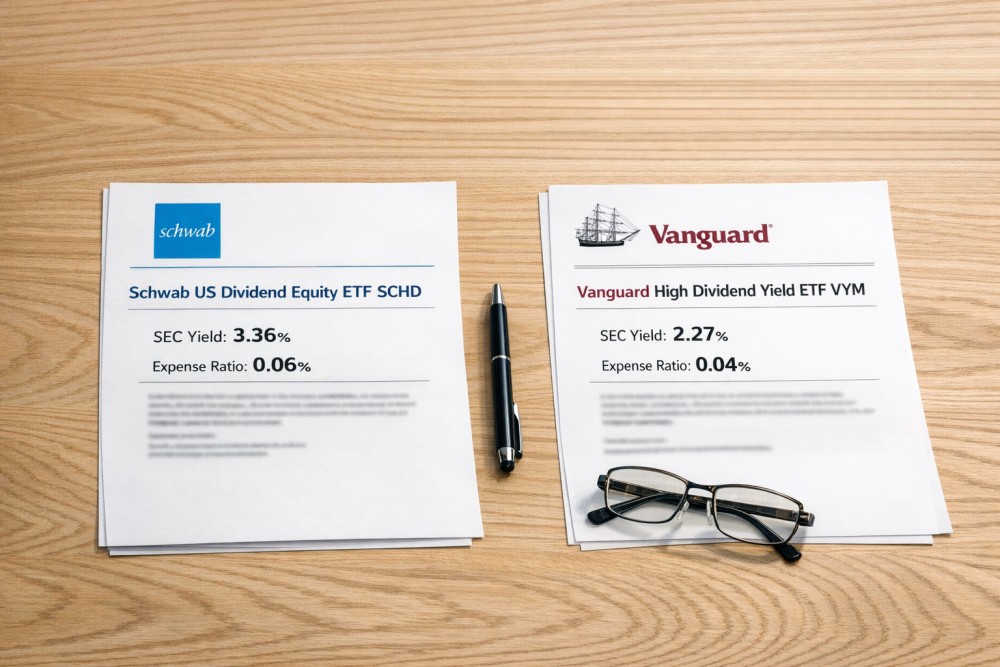
| Dividend yield | ~3.36% | ~2.27% |
| Expense ratio | 0.06% | 0.04% |
| AUM | ~$87.5B | ~$76.3B |
| Inception | Oct 2011 | Nov 2006 |
Want to start a dividend ETF position with fractional shares from US$1 and zero commission? Open a Gotrade account and put both ETFs on your watchlist before your next paycheck.
Yield, Expense Ratio, and Total Return History
SCHD has historically offered the higher current yield. VYM has the lower expense ratio, though the gap is small enough that it rarely changes a long term decision on its own.
The bigger story is how each fund got its return. SCHD's quality screen tends to favor companies that grow dividends steadily, which has translated into stronger dividend growth rates than VYM over the past decade.
VYM's market cap weighting means it leans toward the largest dividend payers, including a few mega caps that have driven much of US equity returns. That gives VYM a return profile closer to the broader market, with a yield premium on top.
Neither fund is a bond substitute. Both move with stocks, both fell hard in 2020 and 2022, and both can underperform growth indexes for years at a time.
Tax Efficiency for Long-Term Holders
Most distributions from both funds are qualified dividends for US tax purposes. That generally means lower rates than ordinary income for eligible holders, which is why these ETFs are popular in taxable accounts.
SCHD's annual reconstitution can trigger capital gains inside the fund, but ETF in kind redemptions usually keep distributions clean. VYM's broader, market cap weighted index has even lower turnover, which is friendly for after tax returns.
For non US investors, dividend withholding tax applies regardless of which fund you pick. The structural difference between SCHD and VYM matters less than your country's tax treaty, so check that first.
Long term holders often pair these ETFs with a thesis based review process. Our risk management rules for long term holders covers how to size positions and react to shocks without abandoning the plan.
Conclusion
SCHD and VYM are not interchangeable. SCHD is a concentrated quality dividend fund with a higher yield and a steeper sector tilt. VYM is a broad, low cost market cap weighted basket that behaves more like the dividend slice of the total US market.
If you want a higher current yield and conviction in a screened group of dividend growers, SCHD is the cleaner fit. If you want diversified high yield exposure that tracks closer to the broader market, VYM does the job at a slightly lower fee. Many investors hold both and let each play its role.
You can buy either ETF in fractional shares from US$1 on Gotrade. Open an account and start building a dividend sleeve that matches the income and growth balance you actually want.
FAQ
Is SCHD better than VYM for long term investors?
Neither is universally better; SCHD offers a higher yield and a quality screen, while VYM offers broader diversification and a lower fee.
Can I hold both VYM and SCHD together?
Yes, many investors pair them to combine SCHD's concentrated quality tilt with VYM's broad market cap exposure.
How do SCHD and VYM compare to higher income ETFs like JEPI?
SCHD and VYM rely on dividends from underlying stocks, while JEPI uses an options overlay to generate higher monthly income with different risks.
Are SCHD and VYM dividends qualified for tax purposes?
Most distributions from both funds are typically qualified dividends for US holders, though non US investors should check their local tax treaty.